Page contents
- What makes a surf fin high-performance?
- Static weight or dynamic weight: the criterion that counts
- Lift and drag of a fin: what the curves say
- Compared values of two fin profiles (Heliciel)
- Is a thinner fin faster?
- Where drive comes from: lift projected forward
- The criteria of a high-performance fin set
- Frequently asked questions
What makes a surf fin high-performance?
A high-performance surf fin is judged in action, not on the scales: it must grip (lift) when the line curves, brake as little as possible (drag) in a straight line, not stall in tight turns and turn the surfer's movements into acceleration. Between two fins, the difference in static weight rarely exceeds 0.1 kg; the difference in "dynamic weight", the resistance the fin opposes to the board in the wave, ranges from 70 g to 900 g per fin depending on whether its camber and angle of attack follow the water or not. That criterion, thirty times heavier than weight, is what separates fins. A variable-geometry fin such as the ADAC system of FYN fins adapts its camber and angle of attack to every phase of the wave: in its test tank, FYN measures 1.5 times more speed and twice the propulsion of a static fin of the same area.
Static weight or dynamic weight: the criterion that counts
Static weight is read on a scale and feeds many marketing arguments. Its effect on gliding is tiny: a glass of water drunk before the session weighs more than the largest difference ever measured between two fins of different technologies.
Dynamic weight is only visible in action: it is the resistance to forward motion the fin opposes to the board. A fin whose angle does not match the water direction, or which stalls, produces a drag that can rise from 70 g to 900 g in the same wave phases. A board with three fins therefore goes from 0.2 kg to 2.7 kg of braking depending on how well its fins adapt to the line; the 0.1 kg difference in static weight is thirty times smaller.
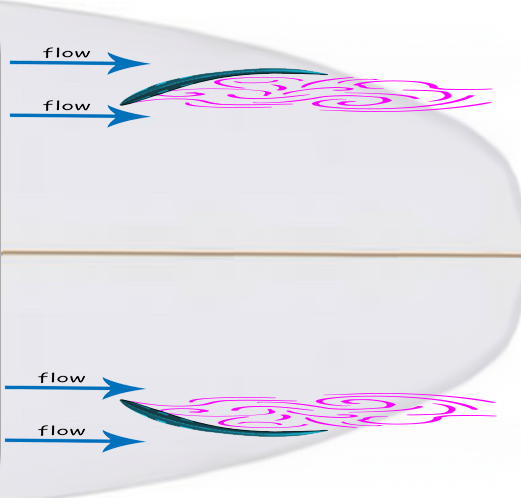
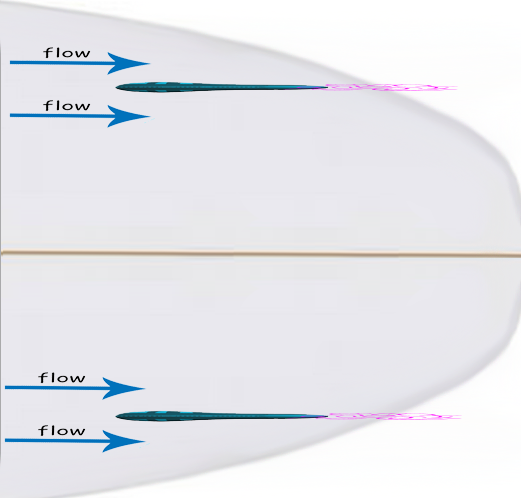
Lift and drag of a fin: what the curves say
The curves below are computed with the Heliciel software for a surf fin at surfing speeds (1 to 6 m/s). They compare a symmetrical profile (NACA 0008) and a cambered profile (NACA 9505), the two families between which fin designers have to choose.
- In a straight line (zero angle of attack) the symmetrical profile drags 0.7 N; the cambered profile drags 8 N. On a twin fin whose two fins have 4° of toe, resistance reaches 9 + 9 = 18 N, nearly 2 kg to push with your legs.
- In a turn, the symmetrical profile needs 40° of angle of attack to deliver 120 N of lift; the cambered profile gives 120 N at 10° and 160 N at 15°. The tail therefore slides four times less before the fin bites.
- Beyond about 30°, whatever the profile, the flow separates and lift collapses: this is the spin out.
The ideal profile is therefore symmetrical in a straight line and cambered in a turn. That is exactly what a variable-geometry fin does: the ADAC system aligns the fin at zero angle of attack when the line is parallel to the board axis, then cambers it on the loaded side as soon as a lateral component appears. On the twin of the example, the drag removed in a straight line is 18 − 1.4 = 16.6 N.
Compared values of two fin profiles (Heliciel)
| Situation | Symmetrical profile | Cambered profile | Variable geometry (ADAC) |
|---|---|---|---|
| Drag in a straight line (0°) | 0.7 N | 8 N | 0.7 N (aligned profile) |
| Angle of attack for 120 N of lift | 40° | 10° | 10° (cambered profile) |
| Lift at 15° | ≈ 60 N | 160 N | 160 N |
| Stall | > 30° | > 30° | delayed by the pivoting profile |
| Twin with 4° toe, straight line | 2 × 9 N = 18 N | 1.4 N |
Is a thinner fin faster?
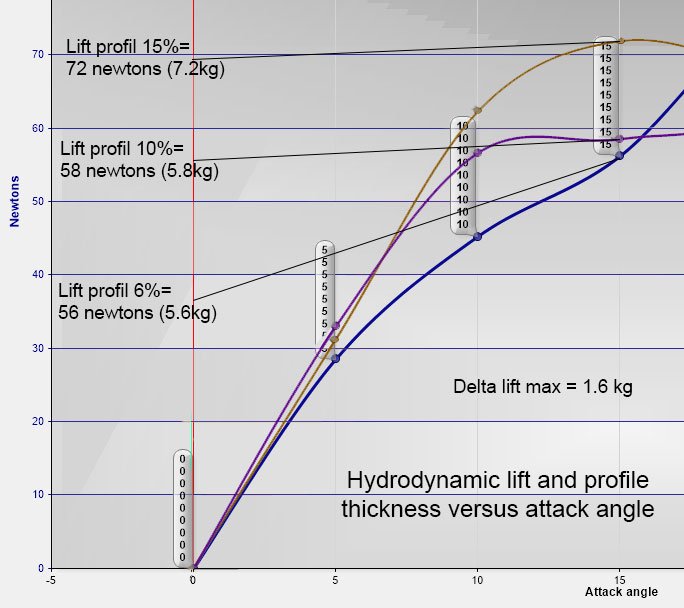
Not at surfing speeds. Between a 6 % and a 15 % relative-thickness profile, the drag difference at zero angle of attack is 20 g at 6 m/s (21.6 km/h). For comparison, the friction drag of the board alone, without fins, is around 15 N (1.5 kg) at 3 m/s: eighteen times the drag of a fin.
Thickness, on the other hand, adds lift at low angles: 16 N (1.6 kg) more at 15 % thickness than at 6 %. A little thickness serves grip and propulsion, and it also allows soft leading and trailing edges that do not cut (see fin safety).
Where drive comes from: lift projected forward
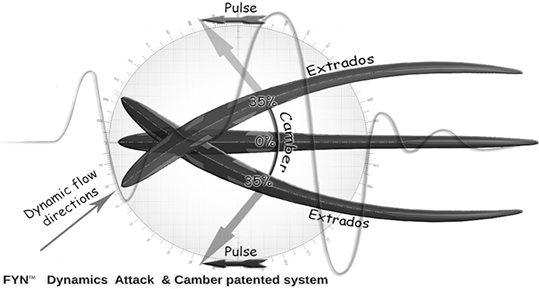
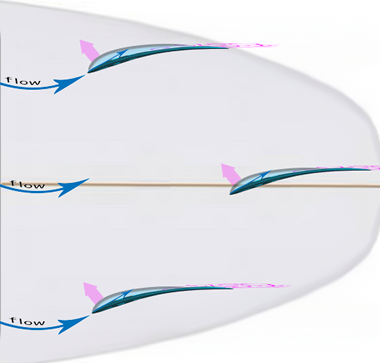
A correctly cambered and oriented fin behaves like a glider: its lift is not only a lateral support, it has a forward component that accelerates the board. This is drive. On a rigid fin, that component only exists in the narrow range of angles the shaper set with toe and cant; as soon as the line changes, the opposite fin works against the flow.
The ADAC kinematics tilt the lift direction forward at every change of line. Two effects follow: a natural ability to generate speed through lateral oscillations (horizontal pumping, comparable to a dolphin's tail beat) and acceleration in turns that opens sequences impossible without drive. In the test tank, FYN measures 2 N of thrust for the dynamic fin against 1 N for a static fin of the same area.
The criteria of a high-performance fin set
- A profile suited to each phase: thin and symmetrical in a straight line, cambered under load; variable geometry combines both.
- No antagonism between fins: fins that steer together prevent one fin braking while the other grips.
- Grip without stall down to the tightest turns, so the support is there when it counts.
- Drive: lift projected forward, usable through horizontal pumping and carved turns.
- Centre of lift close to the board and a centred support, to limit heeling and strengthen rail grip (see choosing your fins).
- Safety: tapered but soft edges and a fuse part protect the surfer and the board; FYN counts it among performance.
- Compatibility with existing boxes: FCS, Future and US box.
FYN sets are built on these criteria: Classic Thruster (2 statics + 1 dynamic), Powerful Quad, New Fish (2 dynamics), Parallel Dynamics (3 dynamics), Longboard set and the Summer Safety set (3 statics with soft parts). Tank measurements and comparative wake-surf tests on a constant wave were used to tune them before surfers tested them in France, Spain, Portugal, Brazil and the United States.
Frequently asked questions
Is a lighter surf fin a better fin?
The weight difference between two fins rarely exceeds 0.1 kg, while the difference in forward resistance between a well-aligned fin and a stalling fin reaches 0.8 kg per fin. Performance is decided by "dynamic weight", not on the scales.
What is the highest-performance surf fin?
The one whose profile stays symmetrical in a straight line and becomes cambered under load, without stalling in tight turns. A rigid fin can meet only one of these conditions; a variable-geometry fin such as the FYN Dynamic (ADAC system) meets them all by adapting its camber and angle of attack to the line.
How is fin performance measured?
By comparative tests under constant conditions: towing and timing in a test tank, then wake surfing on a constant wave to remove wave variability. This is how FYN measured 1.5 times the speed and twice the propulsion of the reference static fin, before having its prototypes tested by surfers of varied levels and styles.
Can I calculate the lift and drag of a fin myself?
Yes. The online lift and drag calculator gives the forces on a profile from its area, speed and angle of attack, and the Heliciel software plots the complete curves of a fin, foil or keel. For a specific project, Mecaflux also offers the study of your project or training on the software.