Page contents
How do I calculate the lift of a wing?
The lift of a wing is FL = ½ ρ V² S CL: air density (1.225 kg/m³ at sea level), relative speed squared, wing area (span × chord) and lift coefficient of the aerofoil at the chosen angle of attack, read on its polar (0.3 to 1.5 before the stall). For level flight the lift must equal the weight. Example: a wing of 6 m by 2 m (12 m²) at a CL of 1.2 lifts 2,100 N, i.e. 214 kg, at 30 knots (15.4 m/s). Lift grows with the square of speed: three times faster, nine times more lift.
Lift and drag formulas for a wing
- FL, FD: lift and drag, in N; their ratio CL/CD is the lift-to-drag ratio
- ρ: air density, 1.225 kg/m³ at 15 °C at sea level (1.112 at 1,000 m, 0.909 at 3,000 m)
- V: speed of the wing relative to the air, in m/s (1 knot = 0.514 m/s; 1 km/h = 0.278 m/s)
- S: wing area, in m² (span × chord for a rectangular wing)
- CL, CD: lift and drag coefficients of the aerofoil at the angle of attack considered, dimensionless
- m: mass to lift, in kg; CL max: maximum lift coefficient of the aerofoil, just before the stall
Lift of a 6 m × 2 m wing against speed
| Speed | Speed in m/s | Dynamic pressure ½ ρ V² | Lift FL | Mass lifted |
|---|---|---|---|---|
| 10 knots (19 km/h) | 5.1 | 16 Pa | 233 N | 24 kg |
| 20 knots (37 km/h) | 10.3 | 65 Pa | 934 N | 95 kg |
| 30 knots (56 km/h) | 15.4 | 146 Pa | 2,101 N | 214 kg |
| 50 knots (93 km/h) | 25.7 | 405 Pa | 5,836 N | 595 kg |
| 100 knots (185 km/h) | 51.4 | 1,621 Pa | 23,342 N | 2,379 kg |
Detailed explanations and calculation in Mecaflux
A simplified calculation of an airplane wing (with mecaflux):
Example calculation wing using lifting line theory (with heliciel):
Whether it is an airplane wing or sail of a sailboat calculating the lift can be done in the same way
We assume that the weight force of the aircraft is 2100 N.
we are seeking:
-
- a lift force balancing the weight of our aircraft: 2100 N=lift = weight
To do this we can act on:
-
-the angle of incidence(attack) of the wing
-
-the length of the wing
*****************
With standard mecaflux
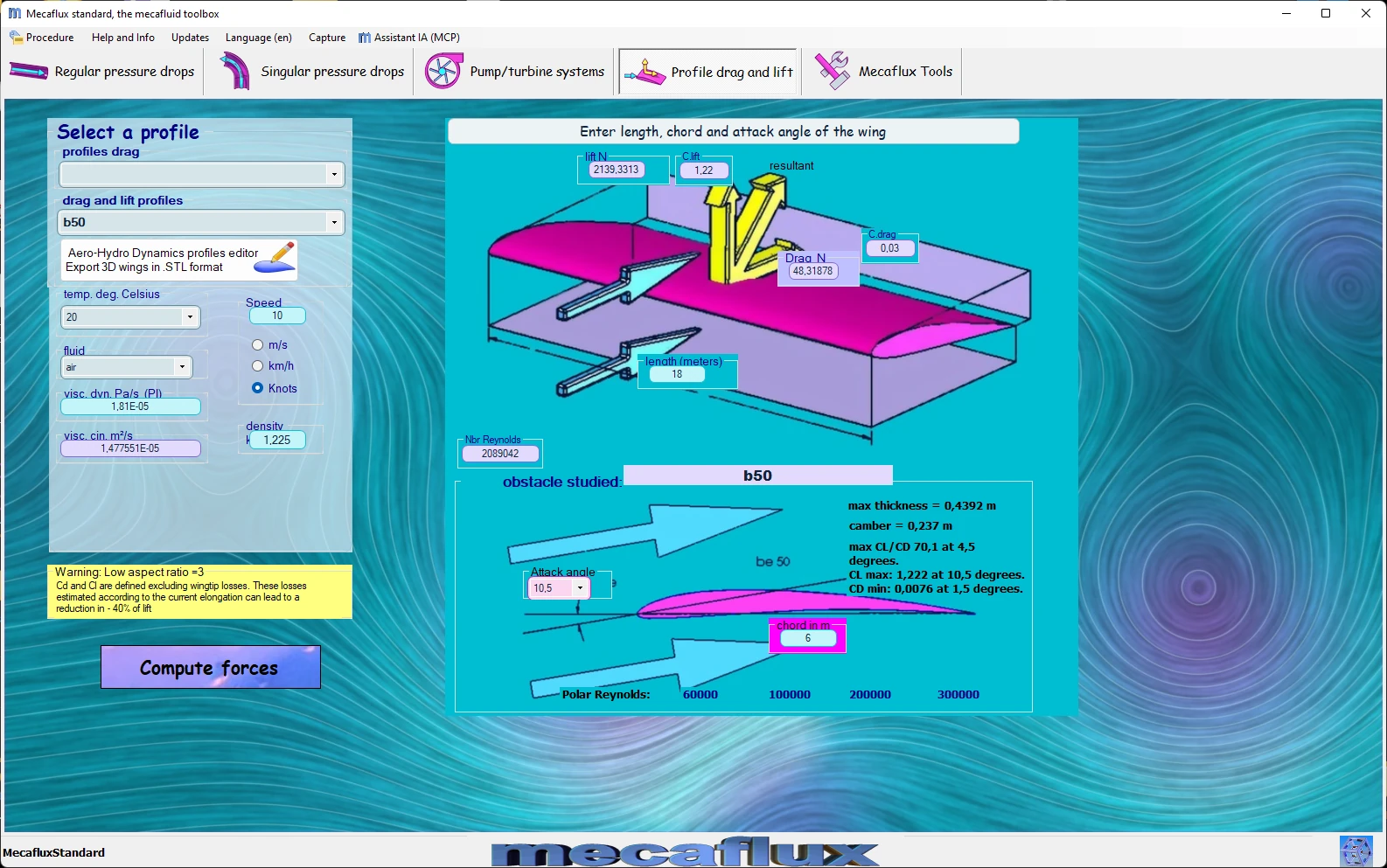
- -Select a profile with drag and lift. We use for our wing profile BE50. (Polar patterns are already set in mecaflux but you can change the Cd and CL.
- - Enter the parameters of the fluid-speed: 10 knots, temperature 20 ° C, density air (1.225 kg/m3)
- - Enter the profile chord (the width of the wing, take 4 meter)
- - Enter the length of the wing (say 10 meters)
- - the angle of incidence(attack) of the wing (try 10.5 °. Incidence proposed values are those studied in wind tunnels. they are limited to the interesting angles, beyond the profile is stalling)
- - Click to calculate
The diagram shows the profile BE50 after calculating the value of 782 Newton lift with 10 knots of wind ,we seek to balance a weight of 2100 N our lift is too low
- Change the profile chord (the width of the wing, take 6 meters)
- Change the length of the wing (say 18 meters)
- Click to calculate
the lift force for b50 is 2112 Newton (215 kgf) with 10 knots of speed.
We will therefore have a wing of 18 meters for lifting our plane with a speed of 10 knots...
let's see with a speed of 30 knots:
- Change the parameters of the fluid-speed: 30 knots, temperature 20 ° C, density air (1.225 kg/m3)
- 18 m in length is kept
- 6 m width is kept (chord)
- Click to calculate
the lift force for b50 is 19013 Newton (1939 kgf) with 30 knots of speed.
19013/2112 = 9 times more lift with three times the speed, Lift evolves with the square of the speed!:
in fact we see, by changing the length and width of the profile, as a wing with 6 meters long and 2 meters wide with 30 knots of speed we have enough lift for our plane to take off.
Warning: loss of lift at the wing tips are not considered.
For a wing with a length of 10 and a width of 1 count about 15% loss of lift compared to the results given by MECAFLUX.
For a wing with a length of 10 and a width of 5 count about 30% loss of lift compared to the results given by MECAFLUX.
you can create your profile by your own tables and polar coordinates with the profile editor integrated mecaflux and then export your files to solidworks coordinate to create a 3D file your wing:

Heliciel has its own 3D modeling engine to wing, and a large database of aerodynamic or hydrodynamic profiles and export 3D function (igs format) that allows rapid achievements models.
CALCULATION SOFTWARE WING HELICIEL using lifting line theory:
Designing and shaping a hydrofoil in Heliciel (video, episode 14, 8 min 21)
Modeling a wing mast sailing in heliciel
- Mecaflux is a simplified software wing or sails calculation
- HELICIEL is a wing propeller or sail software calculation more complete.
Frequently asked questions
What is the lift coefficient CL and where does it come from?
It is the dimensionless number that sums up an aerofoil's ability to deflect air downwards at a given angle of attack. It is measured in a wind tunnel or computed, and plotted on the aerofoil polar: it rises by about 0.1 per degree of incidence, reaches a maximum of 1.2 to 1.6 near 12 to 16° and then collapses at the stall. A cambered aerofoil already lifts at zero incidence, a symmetrical one does not.
What is the role of the wing's aspect ratio?
The aspect ratio λ = span²/area measures how slender the wing is. At the tip, air flows round from the lower to the upper surface: lift drops there and an induced drag appears, proportional to CL²/(π λ). A wing ten times longer than it is wide loses about 15 % of the lift computed in 2D, a wing twice as long as it is wide about 30 %. Gliders have aspect ratios of 20 to 30, light aircraft 7, delta wings 2.
How does lift change with altitude and temperature?
It is proportional to the density of the air, which falls with altitude (1.225 kg/m³ at sea level, 1.112 at 1,000 m, 0.909 at 3,000 m) and with heat (1.146 kg/m³ at 35 °C). For the same lift one must therefore fly faster: the stall speed rises by about 4 % at 1,000 m and 16 % at 3,000 m, hence longer take-off runs at altitude and in hot weather.
How do I calculate the wing of my own aircraft, drone or foil?
In the drag and lift tab of Mecaflux Standard you choose an aerofoil from the polar database (or your own, created in the aerofoil editor), the fluid, the speed, the chord, the span and the angle of attack: the software displays the lift, the drag and the diagram of the aerofoil, and exports the coordinates to CAD. Heliciel applies lifting line theory to a wing of any shape: tip losses, twist, chord distribution and 3D export. For a drone, a light aircraft, a hydrofoil or a wind turbine to design, Mecaflux carries out the study of your project, or offers training on the software applied to your own project.