Page contents
What is the difference between absolute and gauge pressure, and how do I convert the units?
Pressure is a force spread over an area: P = F / S, in pascals (1 Pa = 1 N/m²). Absolute pressure is measured from a perfect vacuum; gauge pressure (or relative pressure), the one a pressure gauge displays, is measured from atmospheric pressure: Pabs = Pgauge + Patm. At sea level Patm = 101,325 Pa = 1.013 bar; it decreases with altitude (89.9 kPa at 1,000 m). Example: a gauge reading 3 bar corresponds to 4.013 bar absolute at sea level, and to 3.899 bar absolute at 1,000 m. The usual units all come back to the bar: 1 bar = 100,000 Pa = 10.20 metres of water column = 14.50 psi = 750 mmHg. The converter below translates a pressure into all these units and switches between gauge and absolute pressure according to the altitude of the site.
Pressure formulas
- P: pressure, in Pa; F: force, in N; S: area it acts on, in m²
- Pabs: absolute pressure, measured from vacuum (never negative); Pgauge: gauge or relative pressure, negative under vacuum conditions
- Patm: atmospheric pressure, in Pa, from the standard atmosphere at the altitude z in m (101,325 Pa at sea level)
- ρ × g × h: hydrostatic pressure of a fluid column of height h (m) and density ρ (kg/m³), g = 9.81 m/s²; it is the basis of the mH₂O and mmH₂O units
Pressure unit equivalents: 1 bar equals
| Unit | Value of 1 bar | Unit | Value of 1 bar |
|---|---|---|---|
| Pa (N/m²) | 100,000 | atm (standard atmosphere) | 0.9869 |
| hPa = mbar | 1,000 | kgf/cm² (at) | 1.0197 |
| kPa | 100 | psi (lbf/in²) | 14.50 |
| MPa (N/mm²) | 0.1 | mmHg = Torr | 750.06 |
| mH₂O (metres of water column) | 10.197 | inHg | 29.53 |
| mmH₂O | 10,197 |
Atmospheric pressure against altitude
| Altitude z | Patm | Equivalent water column | Absolute pressure for 3 bar on the gauge |
|---|---|---|---|
| 0 m (sea level) | 1,013.2 hPa | 10.33 m | 4.013 bar |
| 500 m | 954.6 hPa | 9.73 m | 3.955 bar |
| 1,000 m | 898.7 hPa | 9.16 m | 3.899 bar |
| 1,500 m | 845.6 hPa | 8.62 m | 3.846 bar |
| 2,000 m | 795.0 hPa | 8.11 m | 3.795 bar |
| 3,000 m | 701.1 hPa | 7.15 m | 3.701 bar |
| 4,000 m | 616.4 hPa | 6.29 m | 3.616 bar |
Detailed explanations and calculation in Mecaflux
The unit of pressure is N/m2 or Pascal (Pa). 1 Pascal represents a force of 1 Newton applied on an area of 1 m²: Pressure (pascal) = Force (newton) / Surface(m²)
The pressure generated by a force of 10 N applied to 0.1 m² is equal to the pressure generated by a force of 100 N on 1 m²::
10/0.1=100/1=100 pascals.
This allows to increase the forces depending on pressure surfaces of. (hydraulic cylinders, pressure multipliers ...)
- the absolute pressure (P abs) pressure is measured with reference to a zero pressure (full vacuum).
- Pressure Gauge indicates the difference between the fluid pressure and the atmospheric pressure (P atm).
to convert a value from gauge pressure (PG) to absolute pressure (Pas), simply add the atmospheric pressure:
Pabs = PG + Patm
To convert from absolute pressure to pressure gauge, subtract the atmospheric pressure:
Meteorologists use the pressure in millibars.
-
1 mb = 0,1 kPa
1 Pa = 1 N/m2, 1 kPa = 1 x 10³ Pa
Within a volume of fluid, pressures types are distinguished depending on the physical phenomena that generate them:
- The hydrostatic pressure, or hydrostatic head: This is the pressure generated by the height difference between two points. It represents the force applied by the weight of a fluid column to its base.
- The dynamic pressure represents the inertia of the fluid, the force produced to generate the acceleration of the fluid mass.
Fluid height (in meters) x density of the fluid (kg/m3) x gravity (9.81) = hydrostatic pressure (in Pascals)
Dynamic pressure (Pascals) = 0.5 x density (kg/m3) x speed² (m / sec)
The sum of the energies of pressure in a same volume of fluid is constant: See bernoulli:
The relationship between pressure and flow capacity is very useful to estimate the output power of a fluid system:
- output power Watt = flow (m3/sec) x Pressure (pascals)
- Exemple: a non reversible pressure drop (head loss) of 10 pascals in a 1 m3/sec fluid flow , is a power loss of 10 Watts
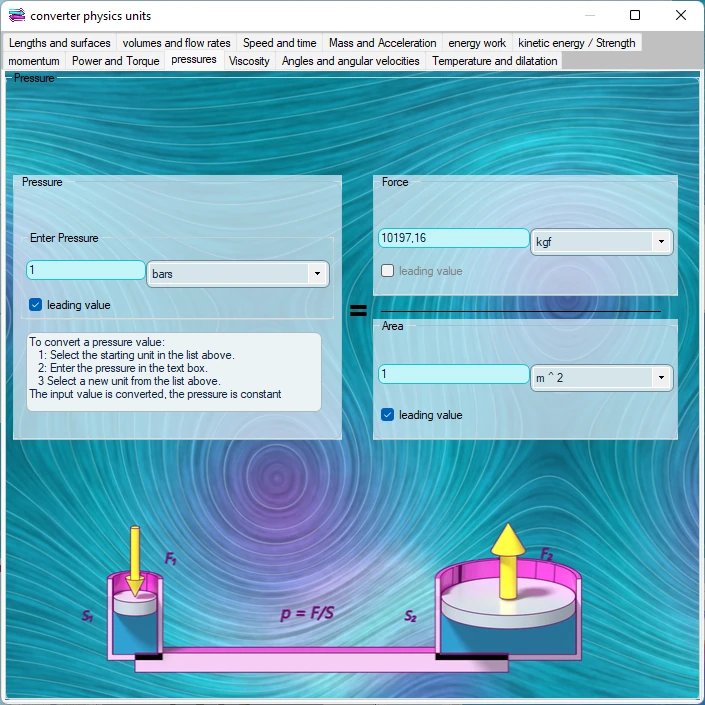
The pressure formula : Pressure = Force / Surface is associated in mecaflux to a unit converter.
mecaflux Standard unit converter::
inMecaflux Standard , the pressures in the ducts are parameterized using the pressure tank (absolute). .
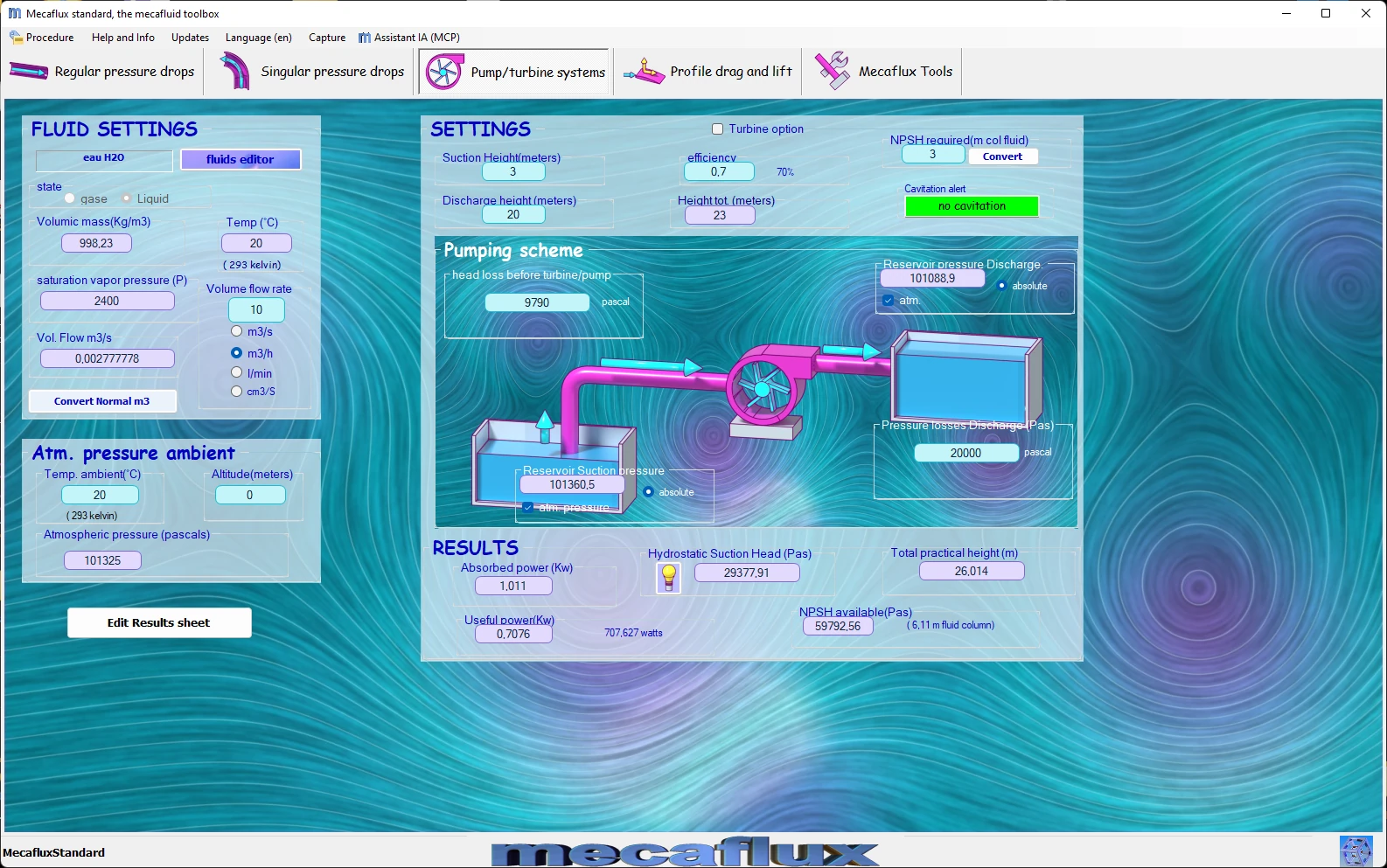
To enter a tank pressure other than ambient atmospheric pressure, uncheck the box atm. and enter the absolute pressure.
Attention: reservoir pressures are absolute pressures so if you want to set a gauge pressure (PG), you will have to add the atmospheric pressure (P atm) : Pabs = Patm + PG.
data powers will be updated accordingly ...
Frequently asked questions
Can a pressure be negative?
A gauge pressure, yes: it is then below atmospheric pressure, a partial vacuum, as on the suction side of a pump or in an extraction duct (−200 Pa). An absolute pressure, never: the lowest possible is a perfect vacuum, 0 Pa, so a vacuum can never exceed 1.013 bar at sea level. This physical limit is what caps the suction lift of a pump at 10.33 m of water in theory.
How do I convert bars into metres of water or of another liquid?
Through the hydrostatic pressure P = ρ g h: a 10.2 m water column exerts 1 bar, so 1 bar = 10.2 mH₂O and 1 mH₂O = 0.0981 bar. For another liquid, h = P / (ρ g): 1 bar corresponds to 0.75 m of mercury (ρ = 13,546 kg/m³), to 12.0 m of petrol (ρ = 850 kg/m³) or to 8.0 m of a brine at 1,270 kg/m³. Pump curves are given in metres of the pumped liquid, which makes them independent of its density.
What is the difference between static, dynamic and total pressure?
Static pressure is what a tapping flush with the wall measures, the pressure that pushes on the pipes. Dynamic pressure ½ ρ V² is the kinetic energy of the fluid per unit volume: 499 Pa for water at 1 m/s, 60 Pa for air at 10 m/s. Their sum is the total pressure, measured by a Pitot tube facing the flow. According to Bernoulli's theorem, the total pressure only decreases along a flow by the head losses.
How do I calculate the pressures in my own network or installation?
Mecaflux Standard calculates the pressure at every point of a circuit from the absolute pressures of the tanks, the hydrostatic head and the head losses of each section; its built-in converter links pressure, force and area in every unit, and the pumping powers update with the pressures entered. For a complete installation to design or check, Mecaflux carries out the study of your project and delivers the calculation report, or offers training on the software applied to your own installation.