Page contents
How does tank pressure affect a pump calculation?
The head of a pump adds three terms: the elevation difference between the suction and delivery levels, the pressure difference between the two tanks converted into metres of fluid, and the head losses. Two open tanks at the same place are at the same atmospheric pressure: this term cancels out. A closed pressurised tank adds it, a suction tank under vacuum subtracts it and also reduces the available NPSH. Example: filling a tank at 3 bar gauge from an open sump 8 m lower, with 4 m of head loss, requires H = 8 + 300,000 / (1,000 × 9.81) + 4 = 8 + 30.6 + 4 = 42.6 m.
Formulas with tanks
- H: pump head, in m; Δz: elevation difference between the free surfaces, in m
- Pd, Ps: pressures in the delivery and suction tanks, in Pa
- ΔHlosses: total head loss of the circuit, in m; ΔHs: suction losses only
- NPSHa: net positive suction head available, in m; Pvap: saturated vapour pressure; zs: water level above the pump (negative on suction lift)
Pressure and equivalent water head
| Pressure (bar) | Water head (m) |
|---|---|
| 0.1 | 1.02 |
| 0.5 | 5.1 |
| 1 | 10.2 |
| 3 | 30.6 |
| 6 | 61.2 |
| 10 | 101.9 |
Detailed explanations and calculation in Mecaflux
The tank pressure acts on the flow...
Note: The calculation of leakage flow of an holding tank for rain water or emptying of, reservoir of liquid or gas, is detailed in the article: calculation of leakage flow from a tank
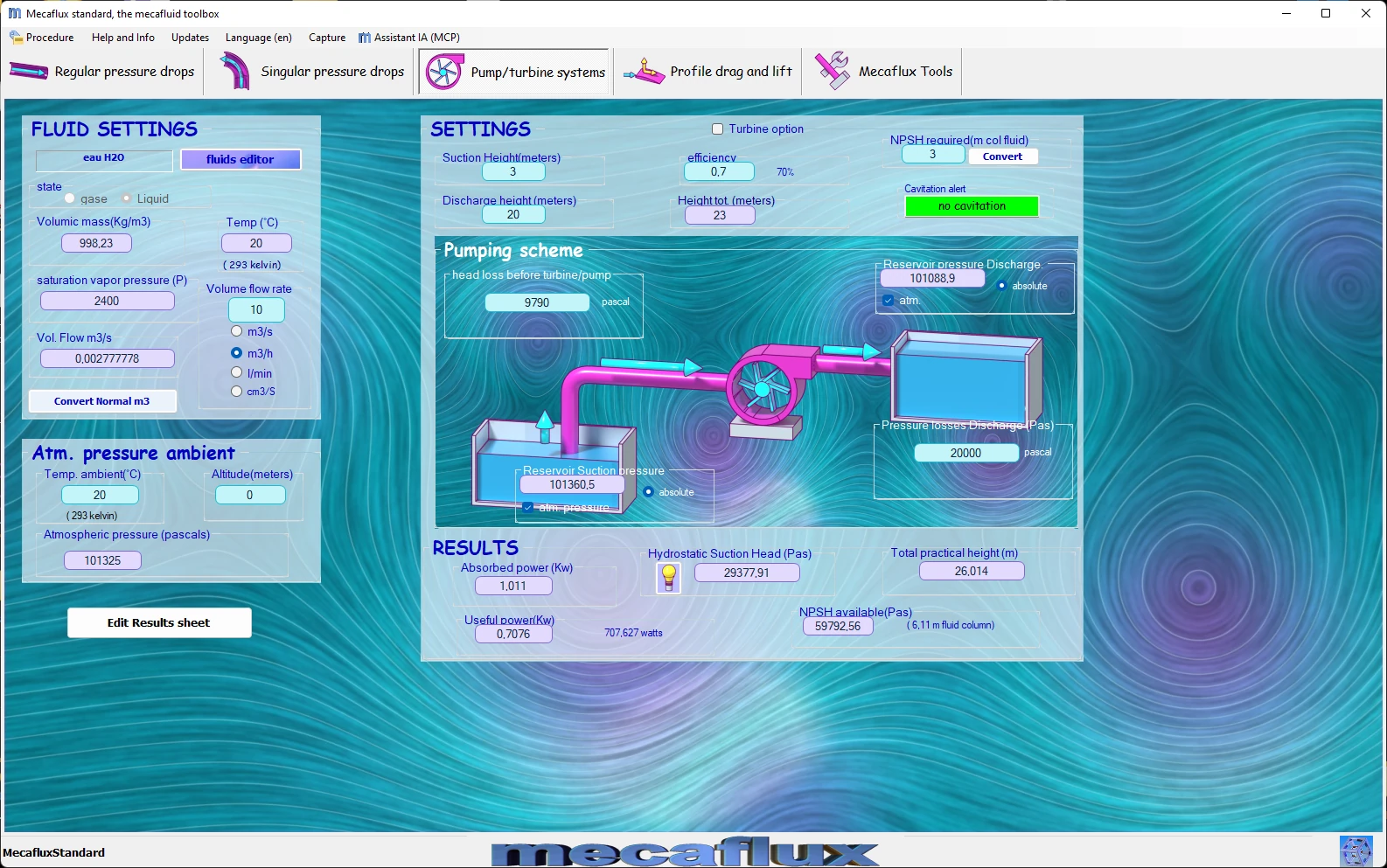
Use and configuration of tanks in computing power pump and turbine in Mecaflux Standard:
The suction and discharge tanks can beings expanses of open water, such as ponds, lakes, reservoirs of dams ... or closed tanks:
- If the tank is open, the reservoir pressure is ambient atmospheric pressure. In mecaflux if you check atm pressure in the reservoirs, the calculations will be based on the atmospheric pressure according, to altitude , and to suction height and discharge height, that you entered.
- If the tanks are pressurized, clear atm in the diagram and enter your pressure values. This is useful if you want to calculate the power of the pump for a given tank's pressure.
For calculations of flow, or operating points of networks, supplied by tanks or pumps, a comparison of the curve of head loss in the network, with the curve of pressure flow, pump or tank, feeding the network.. Graphical analysis and other integrated Mecaflux standard tools allow this kind of calculation:
See: Determining the operating point or flow of a network connected to a pump or tank.
Frequently asked questions
Should absolute or gauge pressure be used?
For the pump head, only the pressure difference between the tanks matters: gauge and absolute pressures give the same result if both are expressed the same way. For NPSH, absolute pressure is required because it is compared with the vapour pressure.
What happens with a suction tank under vacuum?
The vacuum is subtracted from the head available at the suction: the available NPSH falls and the pump may cavitate. The pump then has to be lowered, the suction losses reduced or a pump with a lower required NPSH chosen.
How do I calculate the draining or leakage flow of a tank?
The outlet velocity follows Torricelli's law, V = √(2 g h), corrected by a discharge coefficient; the full calculation is on the tank leakage and draining page.
How do I enter my tanks in a pump calculation?
In the pumps and turbines tab of Mecaflux Standard, tick "atm pressure" for open tanks, the pressure then being calculated from the altitude, or enter the pressure of each closed tank. For a specific case, Mecaflux also offers a study of your project or training on the software.