Page contents
- What is the maximum suction lift of a pump?
- Maximum suction lift formulas
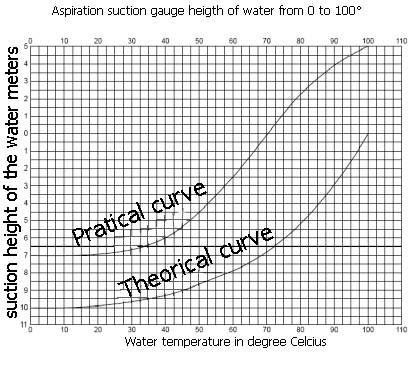
- Maximum suction lift of water against its temperature
- Effect of altitude on the suction lift (water at 20 °C)
- NPSH available and cavitation risk calculator
- Detailed explanations and calculation in Mecaflux
- Frequently asked questions
What is the maximum suction lift of a pump?
A pump does not suck: it is the atmospheric pressure that pushes the liquid towards it. The maximum suction lift is therefore limited by Hmax = (Patm − Pv) / (ρ g) − NPSHrequired − ΔHsuction − margin, where Pv is the saturation vapour pressure of the liquid: below it the liquid boils and the pump cavitates. For water at 20 °C at sea level the theoretical limit is 10.11 m (10.35 m of atmosphere minus 0.24 m of vapour pressure); with a required NPSH of 3 m, 1 m of head loss in the suction piping and a 0.5 m margin, the practical lift falls to 5.6 m. It is only 3.9 m for water at 60 °C and 4.4 m at 1,000 m of altitude. The calculator below works out this balance for your liquid, your altitude and your pump, and compares the available NPSH with the required NPSH.
Maximum suction lift formulas
- Hmax: maximum suction lift, in m, between the liquid surface and the axis of the pump placed above it
- P0: absolute pressure on the liquid, in Pa: the atmospheric pressure Patm for an open tank, which depends on the altitude z (m)
- Pv: saturation vapour pressure of the liquid at its temperature, in Pa (water: 2.34 kPa at 20 °C, 19.9 kPa at 60 °C, 101.3 kPa at 100 °C)
- ρ: density of the liquid, in kg/m³; g = 9.81 m/s²; (P0 − Pv)/(ρ g) is the theoretical limit without flow
- ΔHsuction: head losses of the suction piping (strainer, foot valve, bends, pipe) at the operating flow rate, in m
- NPSHr: NPSH required by the pump at that flow rate, read on its curve, in m; margin: at least 0.5 m
Maximum suction lift of water against its temperature
| Water temperature | Density | Vapour pressure Pv | Theoretical limit (Patm − Pv)/ρg | Practical lift |
|---|---|---|---|---|
| 5 °C | 1,000 kg/m³ | 0.87 kPa | 10.24 m | 5.7 m |
| 10 °C | 999.7 kg/m³ | 1.22 kPa | 10.21 m | 5.7 m |
| 20 °C | 998.2 kg/m³ | 2.33 kPa | 10.11 m | 5.6 m |
| 40 °C | 992.2 kg/m³ | 7.36 kPa | 9.65 m | 5.2 m |
| 60 °C | 983.2 kg/m³ | 19.9 kPa | 8.45 m | 3.9 m |
| 80 °C | 971.7 kg/m³ | 47.3 kPa | 5.67 m | 1.2 m |
| 90 °C | 965.2 kg/m³ | 70.0 kPa | 3.31 m | no suction lift possible: flooded suction |
| 100 °C | 958.1 kg/m³ | 101.3 kPa | 0 m | flooded suction compulsory |
Effect of altitude on the suction lift (water at 20 °C)
| Site altitude | Atmospheric pressure | Theoretical limit | Practical lift |
|---|---|---|---|
| 0 m | 101.3 kPa | 10.11 m | 5.6 m |
| 500 m | 95.5 kPa | 9.51 m | 5.0 m |
| 1,000 m | 89.9 kPa | 8.94 m | 4.4 m |
| 2,000 m | 79.5 kPa | 7.88 m | 3.4 m |
| 3,000 m | 70.1 kPa | 6.92 m | 2.4 m |
Detailed explanations and calculation in Mecaflux
the suction head in a pumping system is the vertical dimension measured between the surface of the suction tank and the axis of the pump. This height is directly related to the hydrostatic loadThis suction height plays a key role in the power of the pump and can not exceed a certain height (due to cavitation). When the maximum height is reached, may be placed an intermediate pump , or pressurize the suction tank, or reducing the temperature of the fluid ...
The maximum suction height depends on the saturated vapor pressure of the fluid and therefore the temperature and ambient pressure.The maximum theoretical suction height of the water, at sea level, is about 10.33 meters. in practice we consider the NPSH of the pump and the pressure losses due to fluid flow.
The practical maximum suction height is located around 7 meters at ambient temperature.
With Mecaflux standard
In pump systems / turbines, suction height, updating the parameters of power interface and raises the alert cavitation if the network or pump generates cavitation:
Frequently asked questions
Why is 7 m quoted in practice when theory gives 10.33 m?
Because 10.33 m is the water height that atmospheric pressure balances in a closed tube, without flow, without pump and without vapour. In a real installation you must subtract the vapour pressure of the liquid (0.24 m at 20 °C, 2 m at 60 °C), the head losses of the suction pipe and strainer, which grow with the flow rate, the required NPSH of the pump (0.5 to 3 m, more for high-speed pumps) and a safety margin. That leaves 6 to 7 m for a small pump with cold water, and much less with hot water or at altitude.
What can be done when the required suction lift exceeds the maximum?
Bring the pump closer to the liquid, or install it with a flooded suction, below the tank level (submersible pump or pump in a pit): the lift becomes negative and adds to the available NPSH. Otherwise, reduce the suction head losses with a short, large-diameter pipe without unnecessary bends, cool the liquid, pressurise the tank, or install an intermediate pump. Choosing a pump with a lower required NPSH (lower rotational speed, suitable inducer) is also a solution.
Does the suction lift change the power of the pump?
Yes: the total head the pump must supply is the sum of the suction lift, the discharge head and the head losses of the whole circuit. Lifting from 5 m instead of 1 m adds 4 m to the total head, hence 4 × ρ g Q of hydraulic power, i.e. 109 W for 10 m³/h of water. A pump with a flooded suction, placed below the tank level, on the contrary benefits from the liquid height pushing it.
How do I check the suction lift of my own pump on my installation?
In Mecaflux Standard you enter the suction lift, the liquid and its temperature, and the software calculates the available NPSH and the total head, updates the power and raises a cavitation warning if the system or the pump causes it; the pumps of the pump editor carry their required NPSH curve. For a pumping station to design or check, Mecaflux carries out the study of your project and delivers the calculation report, or offers training on the software applied to your own installation.