Page contents
How do I calculate the aerodynamic drag and the power consumed by a vehicle?
The aerodynamic resistance of a vehicle is F = ½ ρ V² S Cd: air density (1.2 kg/m³), speed squared, frontal area S and drag coefficient Cd, which expresses how streamlined the shape is. The power absorbed is P = F × V, so it grows with the cube of speed. Example for a saloon car with S Cd = 0.66 m²: 248 N and 6.2 kW at 90 km/h, 518 N and 18.7 kW at 130 km/h: going from 90 to 130 km/h doubles the force and triples the power. Rolling resistance, about 1 % of the weight (150 N for 1,500 kg), adds to it and dominates at low speed.
Aerodynamic drag and power formulas
- F: aerodynamic drag force, in N; P: power consumed to overcome it, in W
- ρ: density of the fluid, 1.204 kg/m³ for air at 20 °C, 1,000 kg/m³ for water
- V: speed of the vehicle relative to the fluid, in m/s (km/h ÷ 3.6); a headwind adds to the speed
- S: frontal area, projected front surface of the vehicle, in m² (1.8 to 2.5 m² for a car, 8 to 10 m² for a lorry)
- Cd: drag coefficient, dimensionless; the product S Cd, in m², is the quantity that really matters
Drag coefficients and frontal areas of common vehicles
| Vehicle | Cd | Frontal area S | S Cd | Force at 90 km/h |
|---|---|---|---|---|
| Cyclist on a road bike | 1.0 | 0.5 m² | 0.50 m² | 188 N |
| Motorcycle with rider | 0.6 | 0.8 m² | 0.48 m² | 181 N |
| Modern saloon car | 0.30 | 2.2 m² | 0.66 m² | 248 N |
| SUV | 0.35 | 2.8 m² | 0.98 m² | 369 N |
| Articulated lorry | 0.7 | 9 m² | 6.3 m² | 2,370 N |
Aerodynamic force and power of a saloon car against speed
| Speed | Speed in m/s | Aerodynamic force F | Aerodynamic power P |
|---|---|---|---|
| 50 km/h | 13.9 | 77 N | 1.1 kW |
| 90 km/h | 25.0 | 248 N | 6.2 kW |
| 110 km/h | 30.6 | 371 N | 11.3 kW |
| 130 km/h | 36.1 | 518 N | 18.7 kW |
| 180 km/h | 50.0 | 993 N | 49.7 kW |
Detailed explanations and calculation in Mecaflux
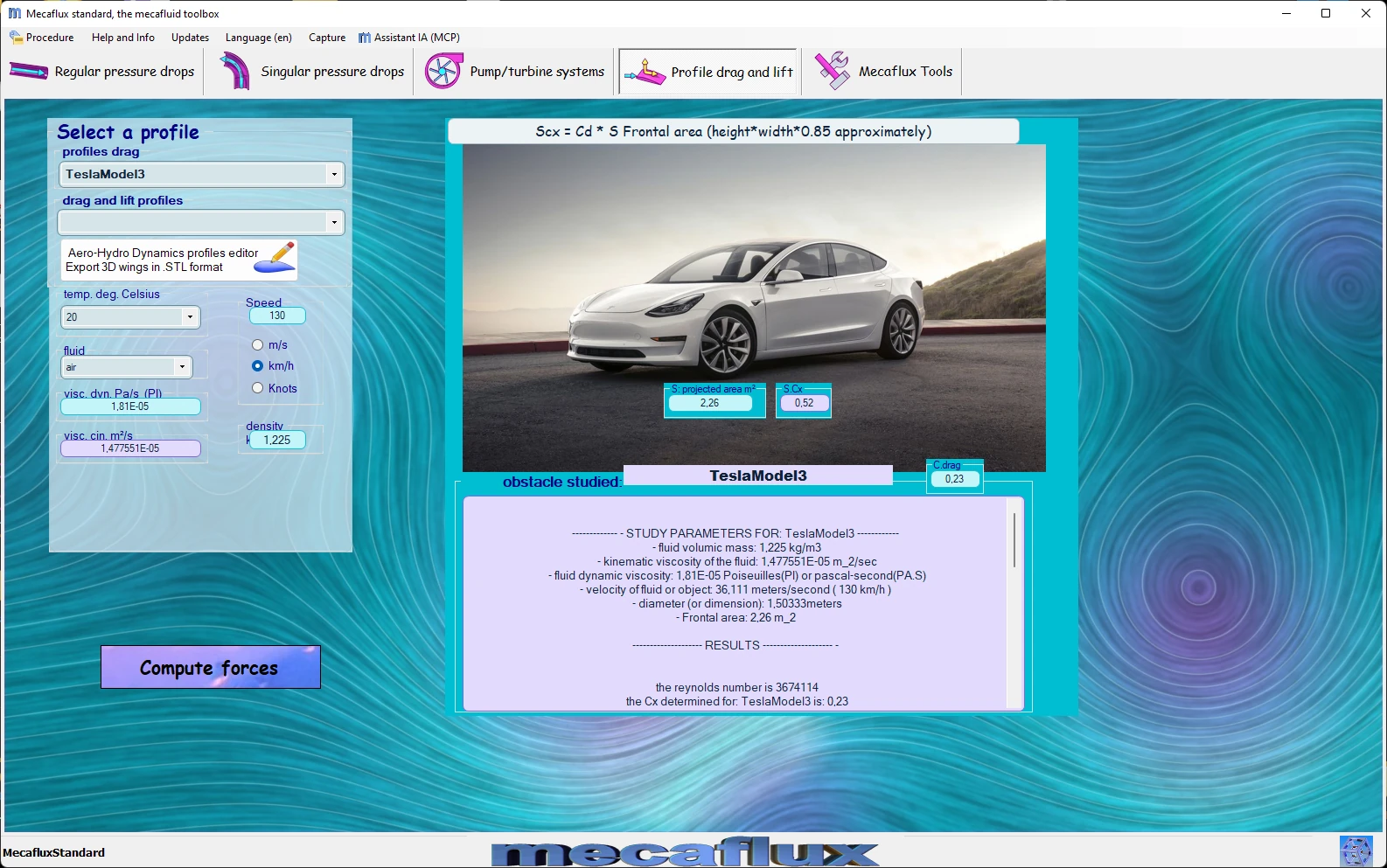
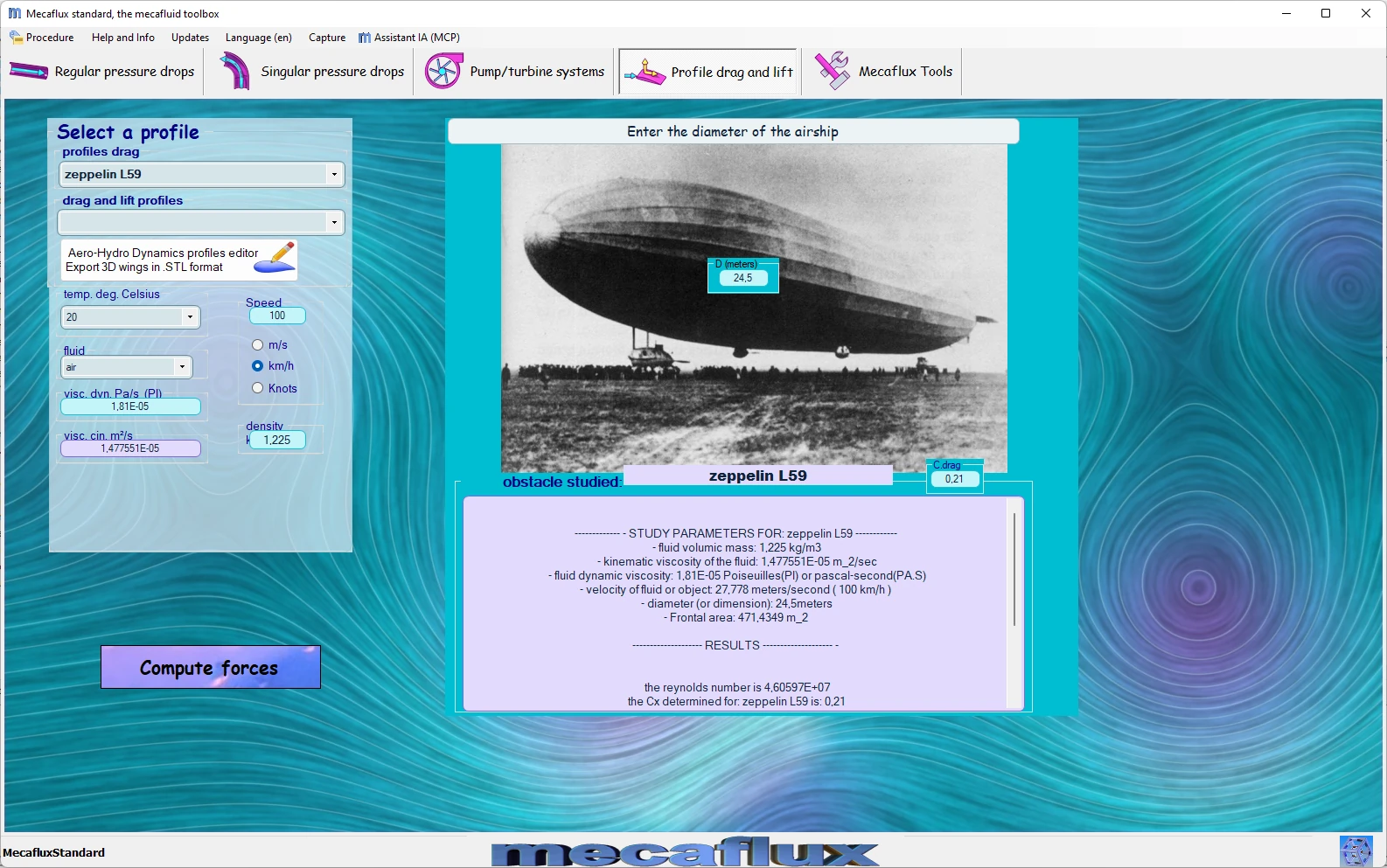
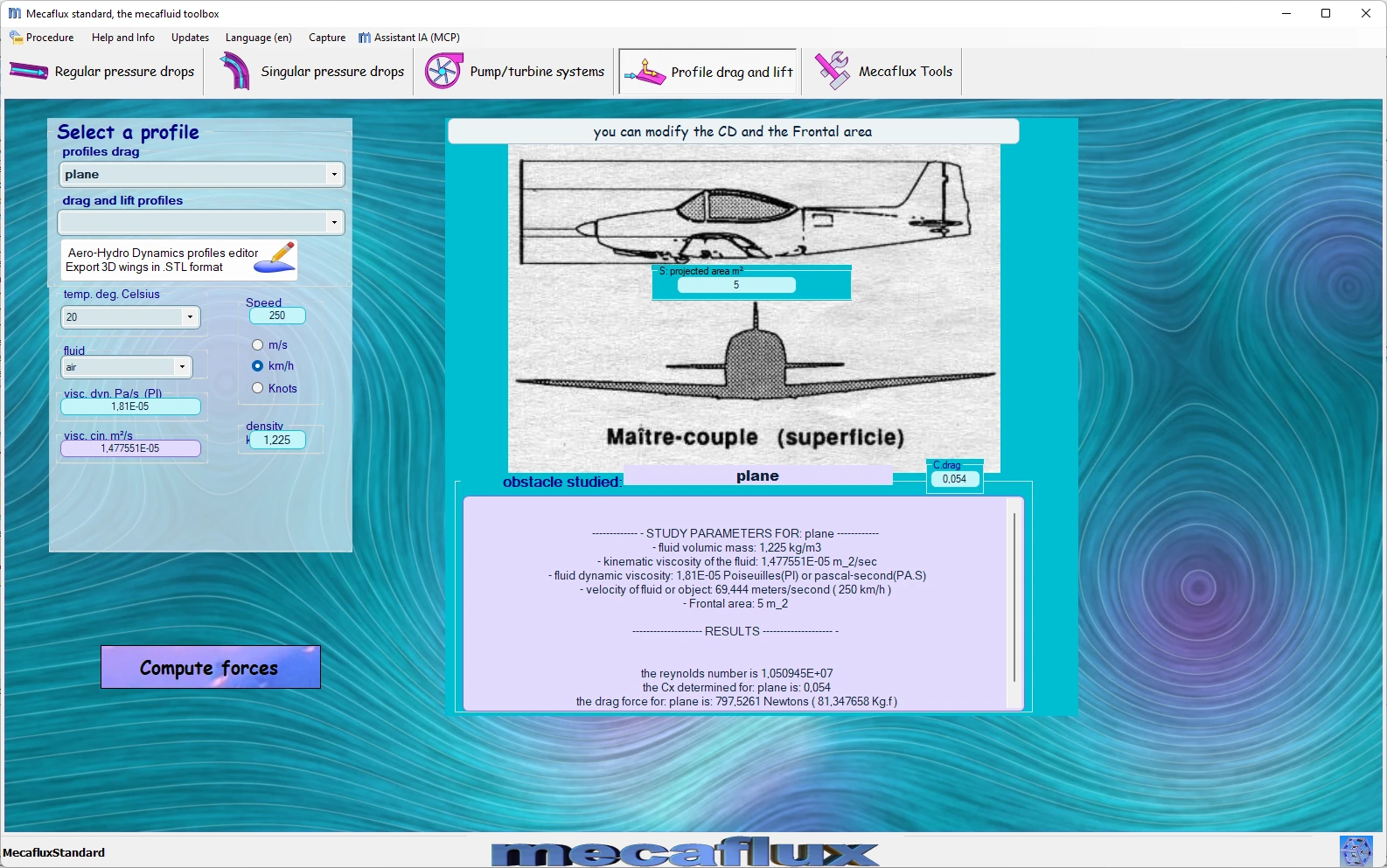
Vehicles, flying, rolling, floating, or rolling, are all subject to the effects of friction and turbulence of the environment in which they operate.a vehicle like a car or a truck car are constantly in contact with the surrounding fluid. This contact generates a resistance force depending on vehicle speed, shape, and the displaced fluid.
This resistance to advancing, aerodynamic drag or hydrodynamic resistance is directly related to the power consumed by the vehicle to move.
To calculate the power consumed by the resistance to progress of a vehicle we use formulas whose parameters are:
- midship area
- the Cd (aerodynamic or hydrodynamic drag coefficient).
- Fluid velocity
- fluid viscosity
- fluid density
With Mecaflux standard:
You choose a vehicle, you change the speed settings, or fluidthe force of resistance and power consumption are given to you ...:

Frequently asked questions
Why does fuel consumption rise so fast with speed?
Because aerodynamic power grows with the cube of speed: at 130 km/h it is three times higher than at 90 km/h, and the energy spent per kilometre (proportional to the force, hence to the square of speed) doubles. Above 70 to 80 km/h, aerodynamic drag exceeds rolling resistance and becomes the first item of a car's consumption.
What is S Cd and why prefer it to Cd alone?
Cd only describes the quality of the shape; the force depends on the product S Cd, frontal area times Cd, in m². An SUV with a Cd of 0.35 and a frontal area of 2.8 m² (S Cd = 0.98 m²) uses 50 % more energy against the air than a saloon of Cd 0.30 and 2.2 m² (0.66 m²), although the Cd values are close.
Is the resistance the same for a vehicle in water?
The formula is the same but water is 830 times denser than air: a body with 1 m² of S Cd feels 3,900 N at 10 km/h in water against 4.7 N in air. This is why boats and submarines have very slender shapes and low hydrodynamic coefficients, and why speed is so costly on water; see naval hydrodynamics.
How do I calculate the drag and power of my own vehicle?
In the drag and lift tab of Mecaflux Standard you choose a type of vehicle (car, lorry, aircraft, airship, ellipsoid…) or a geometric shape, then change the speed, the fluid and the frontal area: the resistance force and the power consumed are displayed at once; the plate study gives the skin friction of a body or hull. For a prototype, an electric vehicle or a machine to optimise, Mecaflux carries out the study of your project, or offers training on the software applied to your own project.