Page contents
How do I calculate the flow rate with a Venturi tube?
A Venturi tube is a gradual pipe contraction followed by a diffuser. In the throat the fluid speeds up (the flow rate is conserved) and its pressure drops (Bernoulli's theorem). The pressure difference measured between the inlet and the throat gives the flow rate directly: Q = C × S2 × √(2 ΔP / (ρ (1 − β⁴))), where β is the throat to inlet diameter ratio and C a coefficient close to 0.98. This is the principle of the Venturi flow meter; the same suction is also used to draw in a second fluid (ejector, carburettor, water jet pump).
Venturi tube formulas
- 1: inlet section, 2: Venturi throat (horizontal tube; otherwise add ρ g (z1 − z2), see Bernoulli)
- S: cross-section area, in m²; D: diameter, in m; V: mean velocity, in m/s
- P1 − P2: differential pressure measured between inlet and throat, in Pa
- ρ: density, in kg/m³; Q: flow rate, in m³/s
- C: discharge coefficient, dimensionless: 0.97 to 0.995 for a machined Venturi (1 for the theoretical calculation)
Example: 100 mm Venturi with a 50 mm throat
| Flow rate Q | Inlet velocity V1 | Throat velocity V2 | Differential pressure P1 − P2 |
|---|---|---|---|
| 10 m³/h | 0.35 m/s | 1.41 m/s | 936 Pa (9.4 mbar, 96 mm of water) |
| 20 m³/h | 0.71 m/s | 2.83 m/s | 3,745 Pa (37 mbar) |
| 40 m³/h | 1.41 m/s | 5.66 m/s | 14,980 Pa (150 mbar, 1.53 m of water) |
| 60 m³/h | 2.12 m/s | 8.49 m/s | 33,700 Pa (337 mbar, 3.44 m of water) |
Detailed explanations and calculation in Mecaflux
according to the Bernoulli's Theorem
The Bernoulli equation can be considered as a principle of conservation of energy, suitable for moving fluids.The behavior usually called "Venturi effect" or "Bernoulli effect" is the reduction of fluid pressure in areas where the flow velocity is increased. This decrease in pressure in a narrowing of the duct may seem contradictory, unless you consider the pressure as an energy density. Passage through the narrowing, the fluid velocity, so its kinetic energy should be increased at the expense of pressure energy.
Assuming that the flow is laminar, the major pressure losses of the duct are negligible, and that the speed is the average speed:
The calculation interface Venturi tube in tools MECAFLUX
This interface is used to calculate a venturi according section, density, flow or pressure measured. Whether for producing a flow meter, a vacuum system ...
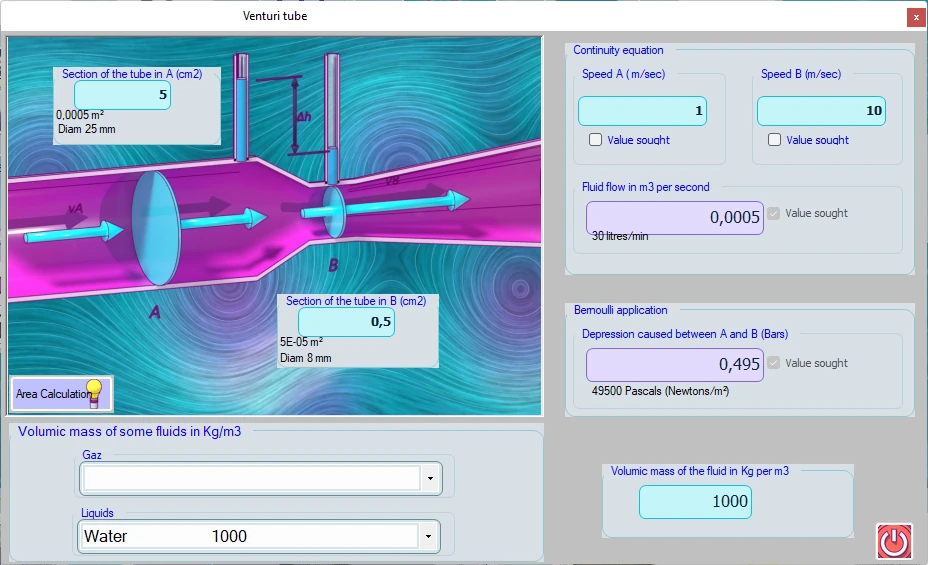
You can set in the "venturi" software tool mecaflux (Tools menu), The parameter desired by checking "sought value". This allows to find a fluid velocity (and thus a flow rate) according to a negative pressure caused, or to determine the depression generated by a certain speed or fluid flow through a cross-sectional constriction.
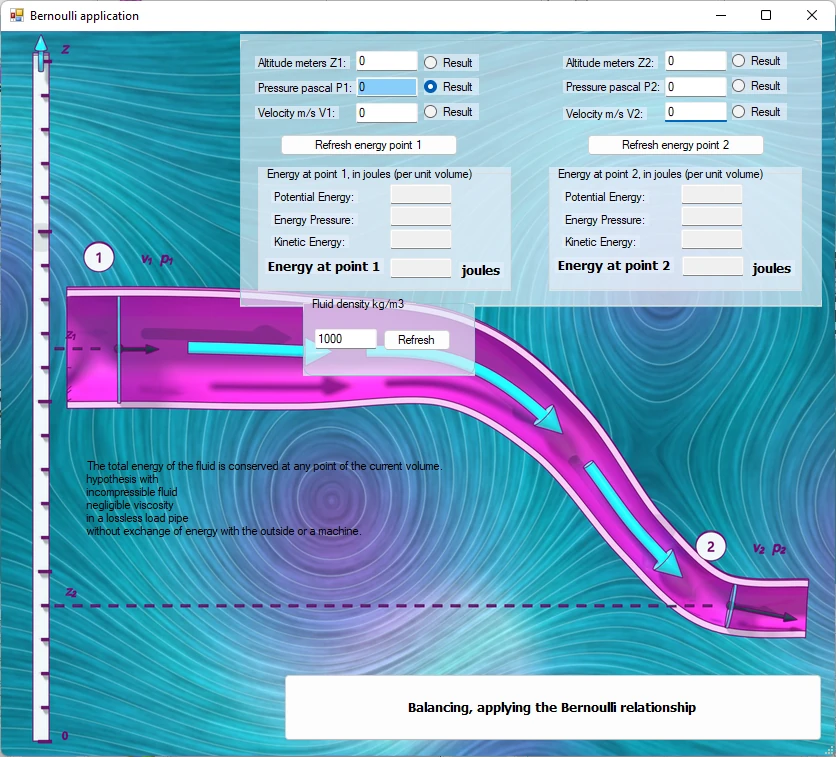
The tool "Bernoulli" of software Mecaflux (tools menu) allows the same type of calculation, but with the ability to define a height difference. Voir Bernoulli
Frequently asked questions
Why does the pressure drop in the Venturi throat?
Since the flow rate is the same through every section, the fluid moves faster in the throat: its kinetic energy increases. As the total energy is conserved (Bernoulli's theorem), this gain is taken from the pressure energy, and the pressure falls by ρ (V2² − V1²) / 2. The differential pressure varies with the square of the flow rate: doubling the flow quadruples it, as the table shows (936 Pa at 10 m³/h, 3,745 Pa at 20 m³/h).
What is the maximum suction obtainable without cavitation?
The absolute pressure in the throat cannot fall below the vapour pressure of the liquid (23 mbar for water at 20 °C), otherwise it boils and the flow meter or ejector loses its prime. With water at atmospheric pressure at the inlet, the differential pressure is therefore limited to about 0.98 bar; beyond that, the inlet pressure must be raised or the flow reduced.
Venturi or orifice plate to measure a flow rate?
Both rely on the same relation between differential pressure and flow. The orifice plate is cheaper and shorter, but it dissipates 50 to 80 % of the differential pressure as permanent head loss. Thanks to its gradual diffuser, the Venturi recovers most of the pressure: its permanent loss is only 10 to 20 % of the measured differential, which matters on an installation running continuously.
How do I size a Venturi for my installation?
The venturi tool of Mecaflux Standard computes the throat diameter needed for the required suction, or the suction obtained for a given flow rate, with the fluid chosen in the editor. For a flow meter, a suction ejector or Venturi dosing, Mecaflux carries out the study of your project and delivers the calculation report, or offers training on the software applied to your own data.