Page contents
How do I calculate the driving force of a sail?
A sail is a vertical wing: the apparent wind creates on it a lift perpendicular to its direction and a drag along its direction. Projected on the boat's axis, these two forces give the driving force, which pushes the boat forward, and the side force, perpendicular to it, which the daggerboard and keel balance. Lift is ½ ρ Va² S CL with the air density (1.225 kg/m³), the apparent wind squared (true wind combined with boat speed), the sail area and a lift coefficient of 1 to 1.5 for a well-trimmed sail. Example: 20 m² of sail in 15 knots of apparent wind at a CL of 1: 730 N, i.e. 74 kgf. Forces grow with the square of the wind: from 20 to 30 knots they are multiplied by 2.25, hence reefing.
Sail lift and driving force formulas
- FL, FD: lift and drag of the sail, in N
- ρ: air density, 1.225 kg/m³ at 15 °C
- Va: apparent wind speed, in m/s (1 knot = 0.514 m/s): vector sum of the true wind and the wind due to the boat's speed
- S: sail area, in m²; CL, CD: lift and drag coefficients of the sail's section at its angle of attack
- β: apparent wind angle from the boat's axis (30 to 40° close-hauled, 90° on a beam reach, about 150° running)
Lift of a 20 m² sail against apparent wind
| Apparent wind | Beaufort force | Speed in m/s | Dynamic pressure ½ ρ Va² | Lift FL | In kgf |
|---|---|---|---|---|---|
| 5 knots | 2 | 2.6 | 4 Pa | 81 N | 8 kgf |
| 10 knots | 3 | 5.1 | 16 Pa | 324 N | 33 kgf |
| 15 knots | 4 | 7.7 | 36 Pa | 729 N | 74 kgf |
| 20 knots | 5 | 10.3 | 65 Pa | 1,297 N | 132 kgf |
| 25 knots | 6 | 12.9 | 101 Pa | 2,026 N | 207 kgf |
| 30 knots | 7 | 15.4 | 146 Pa | 2,918 N | 297 kgf |
Detailed explanations and calculation in Mecaflux
Simplified calculation example of a sail of Sailboat:
Whether it is an airplane wing or sail of a sailboat calculating the lift can be done in the same way (is neglected in this first approach, the aspect ratio and twist, For more advanced calculation, with twisted shapes and distributions of elliptical chords we use Heliciel)
We assume in this example that:
-
the lift of the wing is in the axis of the vessel (for other angles, lift and drag vectors must beings projected on the axis of the boat)
-
speed is the apparent wind speed
-
The strength of resistance to forward is 2100 N.
we seek:
-
-The Lift of the sails wch balances the ship resitance: 2100 N=Lift=ship resitance
To realize this goal, we can play on:
-
-angle of incidence of sail
-
-Height of the sail
-
-the width chord of the sail
-
-wind speed
with Mecaflux
-
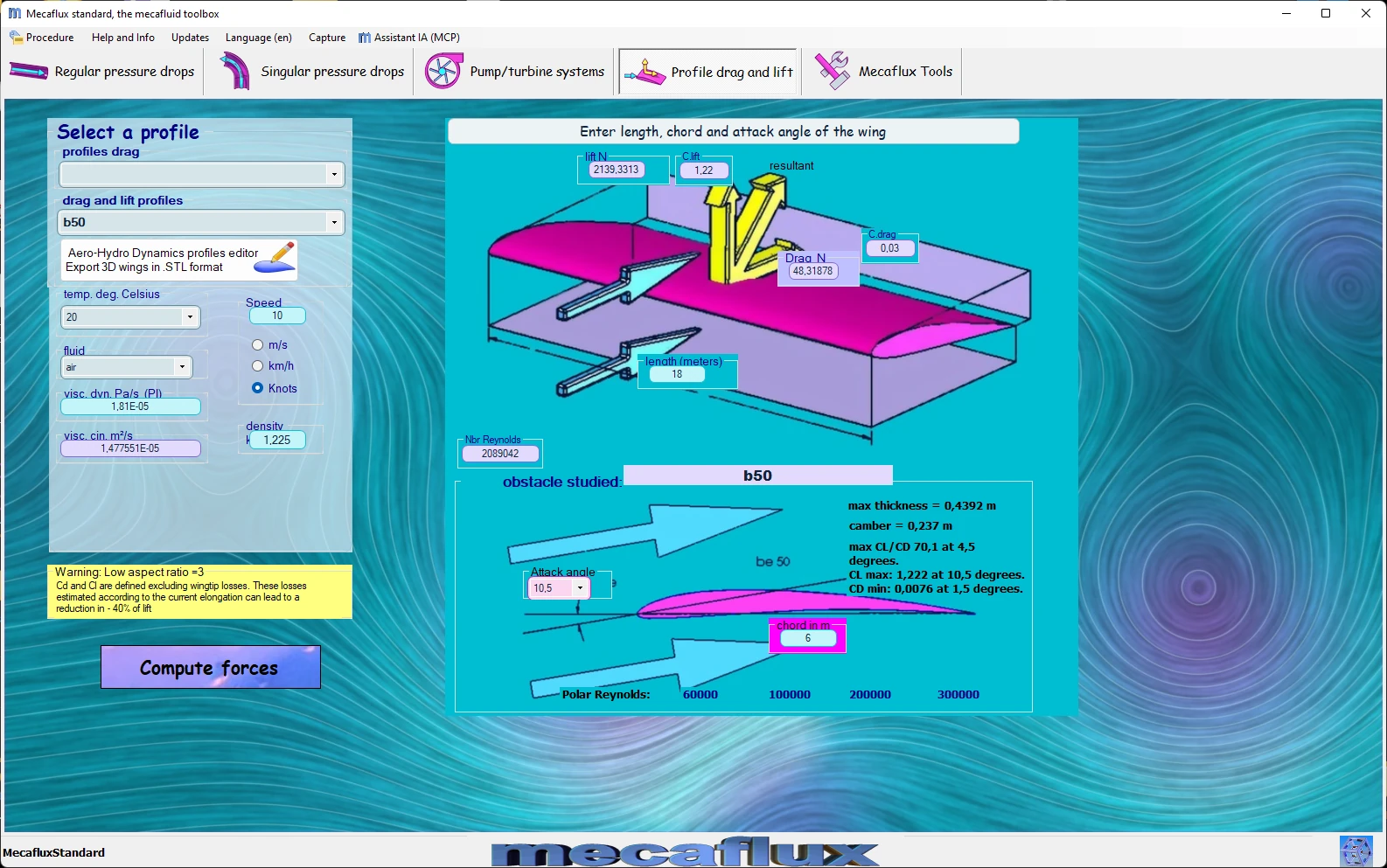
- select a profile with drag and lift ,we use for our sail the profile Be50 (polar profiles are already set in mecaflux but you can change the Cd and Cl)
-
- Enter the parameters of the fluid:
-speed :10 knots FORCE3 small breeze , temperature:20°C, density:air (1.225 Kg/m3)
-
- Enter the profile chord (the width of the sail, take 4 meter)
-
- Enter the height of the sail (say 10 meters)
-
- the angle of incidence of the Sail (try 10.5°)
-
- Click to calculate
The diagram shows the profile BE50 after calculating the value of the lift 782 Newtons with 10 knots of wind
*****************
we seek to balance resistance to the advancement of 2100 N, the wind and the sails are therefore too low
-
- Change the profile chord (the width of the sail, take 6 meter)
-
- Change the height of the sail (say 18 meters)
-
- Click to calculate
the lift force for b50 is 2112 Newtons (215 kg.f) with 10 knots of wind
so we will have almost two times higher than the ship sail for the advance to 10 knots by Force 3
*****************
see by force 7 or 30 knots:
-
- Change the parameters of the fluid-velocity: 30 knots (force7), temperature: 20 ° C, density air (1.225 kg/m3)
-
- we keep 18 m high
-
- the profile chord (the width of the sail,we keep 6 meter)
-
- Click to calculate
The lift force for b50 is 19,013 Newtons (1939 kg.f) with 30 knots of wind:: 19013/2112= 9 times more lift with three times more wind. It's time to reduce sail area.
In fact we see, by changing the height and width of the profile, that with a sail 6 meters high and 2 meters wide by force 7 we have enough lift to propel our boat at 10 knots...
Frequently asked questions
What is the apparent wind?
It is the wind felt on board: the vector sum of the true wind and the wind created by the boat's speed. Close-hauled it is stronger and further forward than the true wind: a boat at 5 knots in 10 knots of true wind at 45° receives an apparent wind of 14 knots at 30° from the axis. Running it is weaker: 10 knots of following wind minus 5 knots of boat speed gives 5 knots apparent. It is always the apparent wind that enters the force calculation.
Which lift coefficient for a sail?
A well-trimmed mainsail or genoa close-hauled reaches a CL of 1.0 to 1.2; a spinnaker running about 1.5, drag then contributing to propulsion; a rigid wing sail of a racing catamaran exceeds 1.8. Beyond the optimum angle of attack the sail stalls: the airflow separates, CL drops and the sheet must be eased. The thin, slightly cambered sections of the Mecaflux database (Be50, Archer) give an order of magnitude.
Why reduce sail when the wind rises?
Because all forces grow with the square of the apparent wind: from 20 to 30 knots they are multiplied by 2.25. The side force heels the boat, the hull becomes less efficient and the rudder loads up; taking a reef reduces the area, hence the force, in the same proportion. In the example above, 20 m² in 30 knots lift as much as 45 m² in 20 knots.
How do I calculate the sail of my own boat?
In the drag and lift tab of Mecaflux Standard you choose a section, air, the apparent wind speed, the chord, the height and the angle of attack of the sail: the software gives the lift and drag to resolve along the boat's axis. Heliciel handles a twisted sail or rigid wing, with an elliptical or free chord distribution and tip losses, and models it in 3D. For a rig, a kite wing or a wing mast to design, Mecaflux carries out the study of your project, or offers training on the software applied to your own project.