Page contents
What is wing area and what is its role in lift?
The wing area S is the area of the wing projected onto a horizontal plane, seen from above, in m²; by convention it includes the part of the wing passing through the fuselage. Lift is directly proportional to it: L = ½ ρ S V² CL. Doubling the wing area doubles the lift at equal speed and angle of attack. It must not be confused with the frontal area (midship section), used for the drag of bluff bodies. It also defines the wing loading (mass carried per m²) and the aspect ratio of the wing.
Lift and wing area formulas
- L: lift, in N (1 kg carried = 9.81 N)
- ρ: density of the fluid, in kg/m³ (air: 1.225 at sea level and 15 °C; sea water: 1,025)
- S: wing area, in m²; b: span, in m; c: chord (wing width), in m
- V: relative velocity of the fluid, in m/s; CL: lift coefficient, dimensionless, depending on the airfoil and the angle of attack (0.2 to 1.5; up to 2.5 with flaps)
- m: mass carried, in kg; wing loading in kg/m²; AR: aspect ratio, dimensionless
Wing area, wing loading and minimum flying speed
| Craft | Mass | Wing area S | Wing loading | CL max | Minimum speed |
|---|---|---|---|---|---|
| Glider | 350 kg | 10 m² | 35 kg/m² | 1.4 | 20 m/s (72 km/h) |
| Three-axis microlight | 450 kg | 14 m² | 32 kg/m² | 1.4 | 19 m/s (69 km/h) |
| Four-seat light aircraft | 1,100 kg | 16 m² | 69 kg/m² | 1.4 | 28 m/s (101 km/h) |
| Narrow-body airliner | 75 t | 122 m² | 615 kg/m² | 1.4 clean / 2.6 flaps down | 84 m/s (302 km/h) / 62 m/s (222 km/h) |
| Sailboat foil (sea water) | 1,500 kg | 0.6 m² | 2,500 kg/m² | 0.8 | 7.7 m/s (15 knots) |
Detailed explanations and calculation in Mecaflux
The wing surface is the surface of the wing, or the generator profile lift should not be confused with the midship area or frontal surface
When the wing surface increases the lift increases. By modifying the surface, the plane or the sailboat changes lift, depending on the relative velocity of the fluid.
The wing area is a parameter of the lift.
- Lift in Newtons
- CL is the lift coefficient, it is determined experimentally in a wind tunnel or with numerical methods
- p is the density of the fluid KG/m3
- S wing surface m²
- v relative velocity of the fluid m/s
The wing area is also involved in the frictional resistance generated by its surface in contact with the fluid.
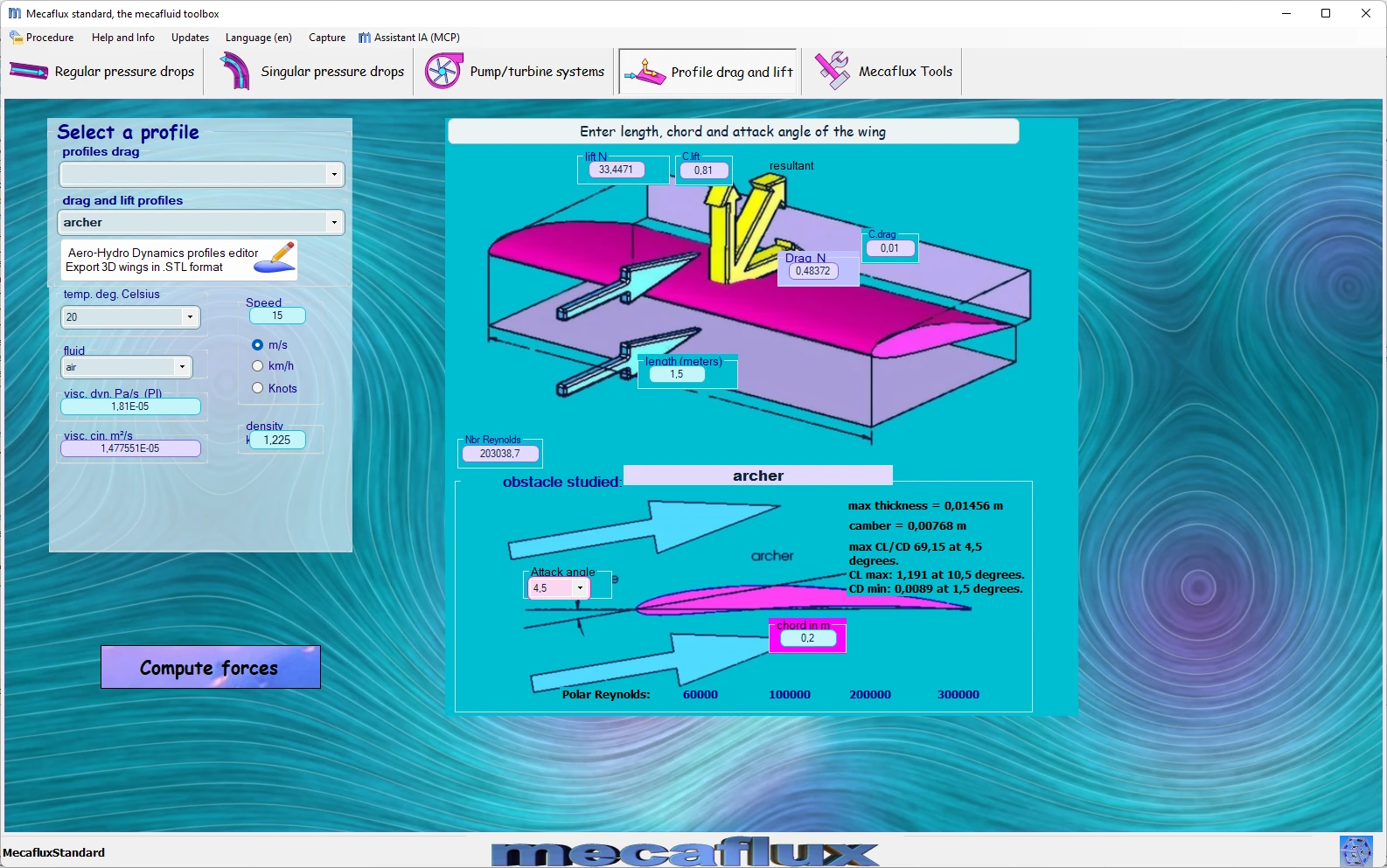
with Mecaflux standard you enter the dimensions of the profile you have chosen, and the wing area and its lift is updated:
Frequently asked questions
How do I calculate the area of a wing?
For a rectangular wing, S = span × chord. For a tapered wing, S = span × (root chord + tip chord) / 2. The projected area seen from above is counted, extending the wing through the fuselage. A wing with a 10 m span and a 1.5 m mean chord has a wing area of 15 m².
What is the difference between wing area and frontal area?
The wing area is the area seen from above: it is used to compute the lift and drag of airfoils (wing CL and CD). The frontal area (midship section) is the area seen from the front, perpendicular to the flow: it is used for the drag of bluff bodies (vehicle, sphere, fuselage). For a wing, the frontal area is 10 to 20 times smaller than the wing area.
What is wing loading?
It is the mass carried divided by the wing area, in kg/m². A low wing loading (30 kg/m² for a glider) gives a low stall speed and good manoeuvrability; a high wing loading (600 kg/m² for an airliner) requires speed but makes the aircraft less sensitive to turbulence. The minimum flying speed grows with the square root of the wing loading.
How do I calculate the area and lift of my wing, foil or keel?
Mecaflux Standard computes the lift and drag of a wing from its dimensions, its airfoil (built-in airfoil database), its speed and its angle of attack; Heliciel models the wing in 3D with twist or variable chord. For a wing, foil or keel project, Mecaflux carries out the study of your project and delivers the calculation report, or offers training on the software applied to your own project.