Page contents
What is density?
The density ρ (rho) of a fluid is the ratio of its mass to its volume, in kilograms per cubic metre (kg/m³). Water is about 1,000 kg/m³, air 1.2 kg/m³ at ambient conditions. Relative density (specific gravity) is the dimensionless ratio of the density of a substance to that of water (or of air for gases). The density of liquids varies little with temperature and hardly at all with pressure; that of gases is proportional to the absolute pressure and inversely proportional to the absolute temperature.
Density and relative density formulas
Density of an ideal gas at absolute pressure P and absolute temperature T:
- ρ: density, in kg/m³ (1 kg/m³ = 1 g/L = 0.001 kg/L)
- m: mass, in kg; V: volume, in m³
- d: relative density, dimensionless; ρwater = 1,000 kg/m³ at 4 °C
- P: absolute pressure, in Pa; T: absolute temperature, in K (°C + 273.15)
- M: molar mass of the gas, in kg/mol (air: 0.029; CO₂: 0.044; methane: 0.016)
- R: ideal gas constant = 8.314 J/(mol·K)
Density of common fluids
| Fluid | Density (kg/m³) | Relative density |
|---|---|---|
| Fresh water (4 °C / 20 °C / 80 °C) | 1,000 / 998 / 972 | 1.000 / 0.998 / 0.972 |
| Sea water | 1,025 | 1.025 |
| Mineral oil, diesel | 850 to 920 / 830 to 850 | 0.85 to 0.92 / 0.83 to 0.85 |
| Petrol (gasoline) | 720 to 760 | 0.72 to 0.76 |
| Pure ethylene glycol | 1,113 | 1.113 |
| Mercury | 13,546 | 13.55 |
| Air (0 °C / 20 °C) | 1.293 / 1.204 | 1 (reference for gases) |
| Steam at 100 °C, methane, CO₂ | 0.598 / 0.668 / 1.84 | 0.50 / 0.55 / 1.53 (relative to air at 20 °C) |
Detailed explanations and calculation in Mecaflux
Mass per unit volume is constantly present in the equations of fluid mechanics.
the Mass per unit volume unit is Kg/m3
The density of a liquid is the ratio of the mass per unit volume of the material on the water mass per unit volume. (for a gas, the ratio will be taken with the mass per unit volume of the air) This gives us a dimensionless number, without unity, which is the density of the material
Exemple: the water mass per unit volume is 1000 Kg/m3
the mass per unit volume of the oil is 800 Kg/m3
the density of the oil is=800/1000= 0.8
Density of water=1000/1000= 1
With Mecaflux standard
The mass per unit volume of the liquid or gas is provided in the fluid editor:
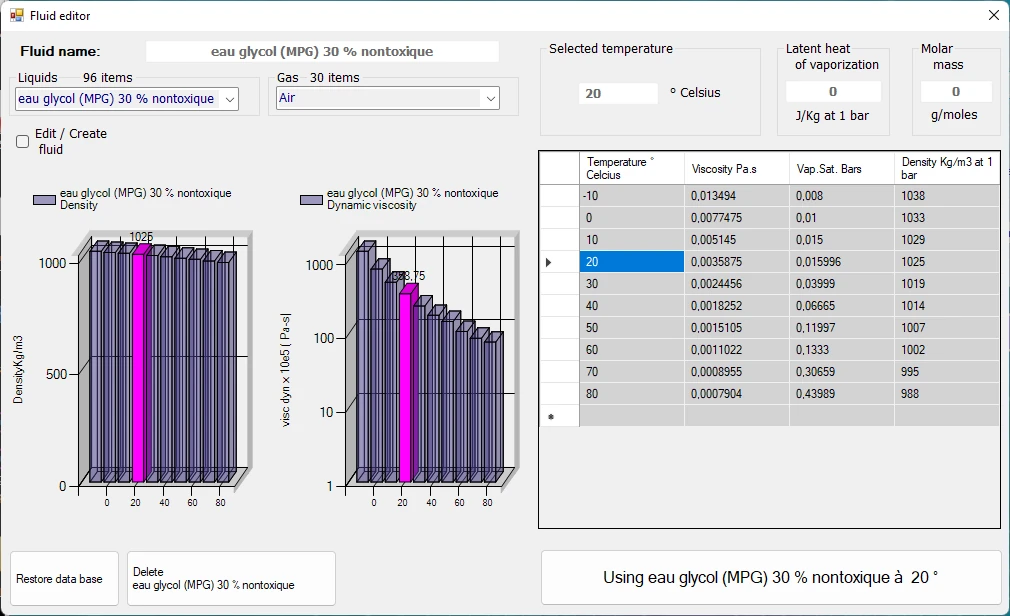
The editor gives the density of the fluid selected depending on the temperature but also its viscosity and saturation vapor pressure.
Frequently asked questions
What is the difference between density and relative density?
Density has a unit (kg/m³); relative density is the dimensionless ratio of the density of the substance to that of water for liquids and solids, or of air for gases. Oil at 800 kg/m³ has a relative density of 0.8; CO₂ at 1.84 kg/m³ has a relative density of 1.53 with respect to air.
How does the density of a gas vary with pressure and temperature?
Proportionally to the absolute pressure and inversely to the absolute temperature: ρ = P M / (R T). Air at 20 °C goes from 1.204 kg/m³ at atmospheric pressure to 8.3 kg/m³ at 6 bar gauge (7 bar absolute), and to 0.95 kg/m³ at 100 °C and atmospheric pressure.
Why does density appear in head loss calculations?
Because the pressure drop in pascals is proportional to the dynamic pressure ρ V²/2: at equal velocity, water produces 800 times more pressure drop than air. Expressed as a head of fluid, however, density cancels out: ΔH = ΔP / (ρ g).
How do I get the exact density of my own fluid for my calculation?
The database of 120 fluids in Mecaflux Standard gives the density and viscosity at the temperature of your installation, the converter computes the density of a gas at any pressure and temperature, and you can add your own fluid from its data sheet. For a special fluid (sludge, brine, mixture, chemical), Mecaflux carries out the study of your project with the right properties, or offers training on the software applied to your own installation.