Page contents
What is the viscosity of water, air and common fluids?
Viscosity measures a fluid's resistance to flow. Dynamic viscosity μ is expressed in Pa·s or mPa·s (1 mPa·s = 1 centipoise); kinematic viscosity ν = μ/ρ is expressed in m²/s or mm²/s (1 mm²/s = 1 centistokes) and it is the one that enters the Reynolds number. Water at 20 °C has a viscosity of 1.0 mPa·s and 1.0 mm²/s; air has only 0.018 mPa·s but, being 830 times less dense, its kinematic viscosity is 15 mm²/s. The viscosity of liquids falls sharply as temperature rises (that of water is halved between 20 and 60 °C, that of an oil divided by ten), while that of gases rises slightly.
Viscosity formulas
- μ: dynamic viscosity, in Pa·s; 1 mPa·s = 10⁻³ Pa·s = 1 cP (centipoise)
- ν: kinematic viscosity, in m²/s; 1 mm²/s = 10⁻⁶ m²/s = 1 cSt (centistokes)
- ρ: density, in kg/m³
- Re: Reynolds number, dimensionless; V velocity in m/s, D diameter in m; it sets the flow regime and the friction factor
Viscosity and density table of common fluids
| Fluid | Temperature | Density ρ (kg/m³) | Dynamic viscosity μ (mPa·s) | Kinematic viscosity ν (mm²/s) |
|---|---|---|---|---|
| Water | 20 °C | 998 | 1.00 | 1.00 |
| Water | 60 °C | 983 | 0.47 | 0.47 |
| Sea water | 20 °C | 1,025 | 1.08 | 1.05 |
| Ethanol | 20 °C | 789 | 1.20 | 1.52 |
| Diesel fuel | 20 °C | 840 | ≈ 3.5 | ≈ 4.2 |
| Hydraulic oil ISO VG 46 | 40 °C | 870 | 40 | 46 |
| Engine oil SAE 30 | 20 °C | 880 | ≈ 300 | ≈ 340 |
| Glycerine | 20 °C | 1,260 | 1,410 | 1,120 |
| Mercury | 20 °C | 13,546 | 1.55 | 0.115 |
| Air | 20 °C | 1.204 | 0.0181 | 15.1 |
| Air | 100 °C | 0.946 | 0.0219 | 23.2 |
| Steam | 100 °C | 0.598 | 0.0123 | 20.6 |
| Carbon dioxide CO₂ | 20 °C | 1.842 | 0.0147 | 8.0 |
| Methane | 20 °C | 0.668 | 0.0110 | 16.5 |
| Hydrogen | 20 °C | 0.084 | 0.0088 | 105 |
Detailed explanations and calculation in Mecaflux
To facilitate data entry of fluids used in the calculation of pressure losses with the softwares of Mecaflux suite,
The database viscosities of fluids, gases or liquids, integrated mecaflux comprises about 100 fluid, and 35 gas whose dynamic viscosity is given as a function of temperature.
The editor of fluids allows you to configure and save a viscosity of a gas or liquid of your choice depending on its temperature. The new fluid can be stored in the database Viscosity of software.
By selecting the temperature of the fluid of your choice, you refresh the dynamic viscosity, kinematic viscosity, temperature and density of your fluid in the calculation of minor or major head loss.
The editor of fluid viscosity:
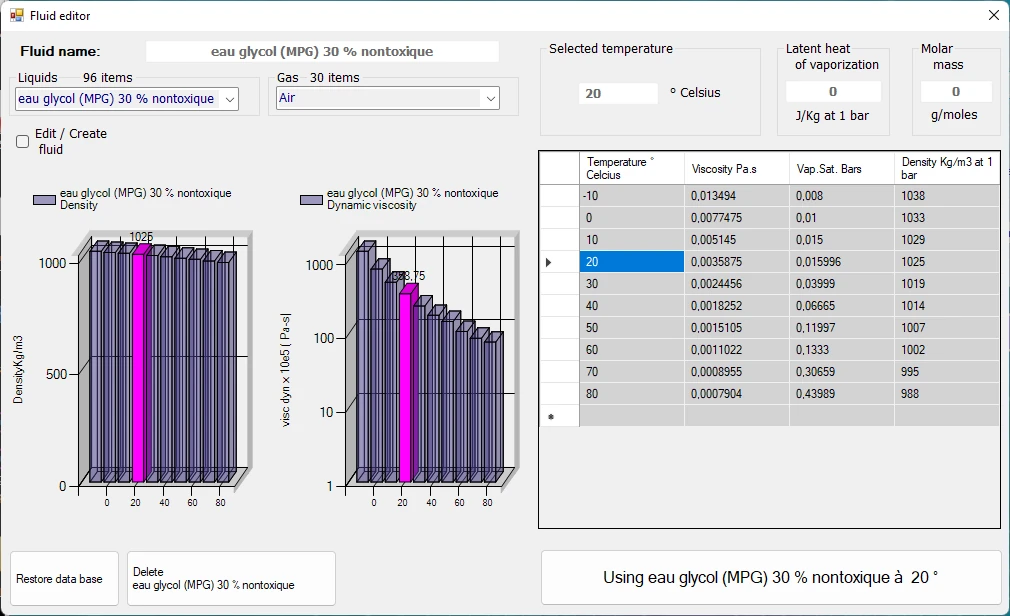
When the fluid is a gas selected, you are asked to enter the operating pressure and the density of the fluid is recalculated.
Particular caution when calculating the pressure drop compressible fluid is to be respected:
The calculation of losses is always based on a volumetric flow rate of fluid , if your data specifications are normal m3 or mass flow, you must convert the flow in m3/hr .A converter has been planned on the software: normal cubic meters converter.
Frequently asked questions
What is the difference between dynamic and kinematic viscosity?
Dynamic viscosity μ is the shear stress needed to slide the layers of fluid over one another; it is expressed in Pa·s. Kinematic viscosity ν is the ratio μ/ρ, in m²/s: it compares viscosity with the inertia of the fluid. For water both are 1 (mPa·s and mm²/s); for air the dynamic viscosity is 55 times lower than that of water but the kinematic viscosity is 15 times higher.
How does viscosity change with temperature?
That of liquids falls quickly: water goes from 1.79 mPa·s at 0 °C to 1.00 at 20 °C, 0.47 at 60 °C and 0.28 at 100 °C; an ISO VG 46 oil goes from 46 mm²/s at 40 °C to about 7 mm²/s at 100 °C. That of gases rises slowly: air gains about 20 % between 20 and 100 °C. A head loss calculation must therefore always be made at the actual temperature of the fluid.
Why does viscosity matter for head losses?
Because it sets the Reynolds number, hence the flow regime and the friction factor. In laminar flow (Re < 2,000) the head loss is directly proportional to viscosity: an oil twice as viscous loses twice as much pressure. In turbulent flow the influence is weaker but remains present in the Colebrook equation through the term 2.51/(Re √λ).
How do I get the properties of my own fluid for my calculation?
The fluid editor of Mecaflux Standard holds about 100 liquids and 35 gases: you pick the fluid and its temperature (and its pressure for a gas) and the dynamic viscosity, kinematic viscosity and density are updated in every head loss calculation; you can save your own fluid from its data sheet. For a special fluid (hot oil, brine, sludge, chemical), Mecaflux carries out the study of your project with the right properties, or offers training on the software applied to your own installation.