Page contents
- How do I calculate the available NPSH and check that a…
- NPSH formulas
- Available NPSH against pump position (water at 20 °C, sea…
- Effect of the liquid temperature on the available NPSH
- NPSH available and cavitation risk calculator
- Detailed explanations and calculation in Mecaflux
- Frequently asked questions
How do I calculate the available NPSH and check that a pump will not cavitate?
The available NPSH (Net Positive Suction Head) is the pressure margin, expressed in metres of liquid column, between the pump inlet and the vapour pressure of the liquid: NPSHa = (P0 − Pv) / (ρ g) − Hsuction − ΔHsuction, where Hsuction is the suction lift (negative for a flooded suction) and ΔHsuction the head losses of the suction pipe. The required NPSH, given by the manufacturer's curve, is the pressure drop the pump itself creates at the inlet of its impeller. To avoid cavitation, you need NPSHa ≥ NPSHr + 0.5 m. Example: water at 20 °C at sea level, (Patm − Pv)/ρg = 10.11 m; pump placed 4 m above the water surface with 0.5 m of suction losses: NPSHa = 10.11 − 4 − 0.5 = 5.61 m. A pump with a required NPSH of 3 m is suitable (margin 2.6 m); at 7 m of lift it would cavitate. The calculator below works out this balance with your liquid, your altitude and your pump, and gives the maximum suction lift.
NPSH formulas
- NPSHa: available NPSH of the installation, in m of pumped liquid column; NPSHr: NPSH required by the pump, read on its curve at the operating flow rate (0.5 to 3 m in general, more for high-speed pumps)
- P0: absolute pressure on the liquid surface, in Pa (atmospheric pressure for an open tank, which depends on the altitude); Pv: saturation vapour pressure at the liquid temperature, in Pa
- ρ: density of the liquid, in kg/m³; g = 9.81 m/s²
- Hsuction: height of the pump axis above the liquid surface, in m; negative for a flooded suction (pump below the level)
- ΔHsuction: head losses of the suction piping at the flow rate considered, in m; margin: at least 0.5 m, or 10 % of the required NPSH
Available NPSH against pump position (water at 20 °C, sea level)
| Pump position | Hsuction | Available NPSH | Margin over required NPSH of 3 m | Verdict |
|---|---|---|---|---|
| 3 m below the level (flooded) | −3 m | 12.61 m | 9.6 m | no risk |
| 1 m below the level | −1 m | 10.61 m | 7.6 m | no risk |
| level with the water surface | 0 m | 9.61 m | 6.6 m | no risk |
| 2 m above | +2 m | 7.61 m | 4.6 m | fine |
| 4 m above | +4 m | 5.61 m | 2.6 m | fine |
| 6 m above | +6 m | 3.61 m | 0.6 m | borderline |
| 8 m above | +8 m | 1.61 m | −1.4 m | cavitation |
Effect of the liquid temperature on the available NPSH
| Water temperature | Vapour pressure Pv | (Patm − Pv)/ρg | Available NPSH |
|---|---|---|---|
| 10 °C | 1.2 kPa | 10.21 m | 6.71 m |
| 20 °C | 2.3 kPa | 10.11 m | 6.61 m |
| 40 °C | 7.4 kPa | 9.65 m | 6.15 m |
| 60 °C | 19.9 kPa | 8.45 m | 4.95 m |
| 80 °C | 47.3 kPa | 5.67 m | 2.17 m |
| 95 °C | 84.5 kPa | 1.79 m | −1.71 m: flooded suction compulsory |
Detailed explanations and calculation in Mecaflux
the required NPSH and NPSH available
Imagine a vertical tube one meter in height filled with water, to raise the water column should be a depression to the top of the column, at least equal to the pressure (generated by the weight of water) at the bottom… the higher the colomn of water is, the higher the depression should be..
If the negative pressure necessary for raising the water column, drops the liquid pressure below the threshold of "saturation vapor pressure" the liquid turns into gas in the region where pressure is the lowest (usually at the point of maximum acceleration of the fluid), the fluid cavitate.
The water level at the suction limits the depression it is possible to create without cavitating
If the water level is too important to be raised without cavitation, it will be necessary to place intermediate pumps ...
This possible depression before cavitation is called NPSH (net positive suction head) available.- Available NPSH value is a meter column fluid (mcf) and it is linked to the water level at the suction

In mecaflux NPSH available is calculated automatically when you enter the suction head.
So far we have only raised the water column without giving it a speed, to moves liquid at a certain rate, the pump must generate additional depression. This pressure must be even greater than the desired flow rate is important.
This additional pressure related to the flow of the pump is called the required NPSH.The pump manufacturer provided a graph where we see the curve binding NPSH required to the flow. Usualy the required NPSH values, vary from 0.5 to 3 mcf
- The required NPSH of a pump is a value in meters of fluid column (mcf)
If the water level is too important to be raised without cavitation, it will be necessary to place intermediate pumps ...
Example curve binding required NPSH, in meters of fluid column (mcf) to flow rate: 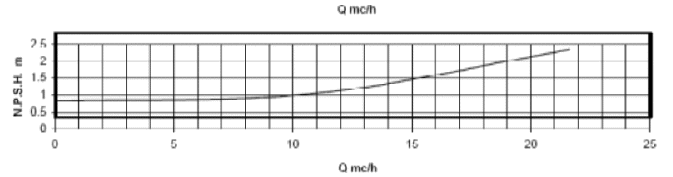
Frequently asked questions
What is the difference between required and available NPSH?
The available NPSH depends on the installation: pressure on the liquid, temperature, suction lift, head losses of the suction pipe; it is calculated, and that is what the calculator above does. The required NPSH depends on the pump alone: it is the internal pressure drop between the suction flange and the lowest-pressure point of the impeller; it is measured on a test bench and the manufacturer plots it against flow rate. The first must always exceed the second, with a margin, over the whole intended flow range.
How can the available NPSH of an installation be increased?
By lowering the pump or giving it a flooded suction below the tank level (every metre gained adds to the available NPSH), by reducing the suction head losses (short pipe, diameter larger than the discharge, clean strainer, no bend close to the flange), by cooling the liquid to lower its vapour pressure, or by pressurising the tank. On the pump side, a lower rotational speed or an inducer impeller reduce the required NPSH.
Why does the required NPSH increase with the flow rate, and what margin should I take?
Because the velocity at the impeller inlet grows with the flow rate, and with it the local pressure drop that starts vaporisation: the required NPSH curve rises steeply to the right of the best efficiency point. At the same time the suction head losses grow as the square of the flow rate and reduce the available NPSH. The check is therefore made at the maximum intended flow rate, with a margin of at least 0.5 m, or 10 to 30 % of the required NPSH for hot liquids and large pumps, because cavitation starts before the 3 % head drop used to define the required NPSH.
How do I check the NPSH of my own pump on my installation?
Mecaflux Standard calculates the available NPSH automatically as soon as you enter the suction lift, the liquid and its temperature, compares it with the required NPSH of the pump chosen in the pump editor and raises a cavitation warning at the calculated operating point. For a pumping station to design or check, Mecaflux carries out the study of your project and delivers the calculation report, or offers training on the software applied to your own installation.