Page contents
How does altitude affect a pumping network?
At altitude the atmospheric pressure falls: 1,013 hPa at sea level, 899 hPa at 1,000 m, 701 hPa at 3,000 m. On an open tank, this pressure pushes the liquid to the pump suction: at altitude the available NPSH drops by about 1.1 m of water per 1,000 m, and water boils earlier (93 °C at 2,000 m). A network that works well at the seaside may therefore cavitate once installed in the mountains. Example: a pump lifting water at 20 °C from 4 m below, with 1 m of suction loss, has 5.1 m of NPSH at sea level but only 1.9 m at 3,000 m.
Altitude formulas
- Patm(z): standard atmospheric pressure at altitude z in metres, in Pa
- NPSHa: net positive suction head available, in m; Pvap: saturated vapour pressure of the liquid, in Pa
- hs: suction lift (pump above the liquid level), in m; ΔHs: suction head loss, in m
- ρ: density, in kg/m³; g = 9.81 m/s²
Atmospheric pressure and altitude
| Altitude (m) | Patm (hPa) | Water head (m) | Boiling (°C) |
|---|---|---|---|
| 0 | 1,013 | 10.35 | 100.0 |
| 500 | 955 | 9.75 | 98.3 |
| 1,000 | 899 | 9.18 | 96.7 |
| 1,500 | 846 | 8.63 | 95.0 |
| 2,000 | 795 | 8.12 | 93.4 |
| 3,000 | 701 | 7.16 | 90.0 |
Detailed explanations and calculation in Mecaflux
- The difference in elevation between the point of exit and entry point of a network determines the elevation and the hydrostatic pressure of the system. The hydrostatic pressure can be used to generate the flow. We then have a gravity flow will produce a flow ratewhich stabilizes when pressure losses + the dynamic pressure of the system, will be equivalent to hydrostatic pressure, provided by the height between the altitude of entry and exit.
- The geographical altitude (relative to sea level) is a factor that may be important in the parameters of a pumping system.
a pressure drop can therefore cause boiling of the liquid without changing its température.This is what happens in a pipe or pump when the depression is too high. We say that the pipe or pump cavitate.
The fall of atmospheric pressure is usually never enough to generate cavitation ,but a network, dimensioned to operate at sea level may cavitate, if it is installed in the same configuration at 3000 meters altitude
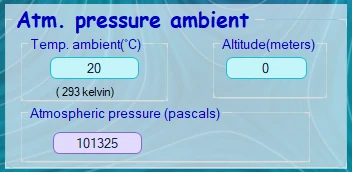
Altitude is a parameter to be included in the tab system of pumps and turbines, a value of ambient pressure is given as a function of temperature and altitude
Frequently asked questions
Why does altitude matter for a pump?
On an open tank, atmospheric pressure is the only force pushing the liquid up to the impeller. The weaker it is, the less high the pump can lift before the local pressure falls below the vapour pressure.
Does altitude change the pump head?
Not for two open tanks at the same place: atmospheric pressure acts on both and cancels out. What matters is the elevation difference between inlet and outlet, the hydrostatic head, which can by itself drive a gravity flow.
At what temperature does water boil in the mountains?
About 96.7 °C at 1,000 m, 93.4 °C at 2,000 m and 90 °C at 3,000 m: the temperature at which the saturated vapour pressure equals the local atmospheric pressure.
How do I take altitude into account in my calculation?
In the pump and turbine systems tab of Mecaflux Standard, you enter the altitude: the software proposes the matching ambient pressure and uses it in the available NPSH. For a specific case, Mecaflux also offers a study of your project or training on the software.