Page contents
What is Bernoulli's theorem?
Bernoulli's theorem expresses the conservation of energy of a moving fluid: along a streamline, the sum of the static pressure, the dynamic pressure (ρV²/2) and the pressure due to elevation (ρgz) stays constant. It applies to an incompressible fluid in steady flow, without friction or energy exchange. Where the velocity increases, for example in a narrowing, the static pressure decreases: this is the Venturi effect.
Bernoulli's equation
Between two points A and B on the same streamline:
Divided by ρg, the same relation is written in metres of fluid, which defines the head H:
- P: static pressure of the fluid, in pascals (Pa)
- ρ (rho): density of the fluid, in kg/m³ (water: 1,000 kg/m³)
- V: velocity of the fluid, in m/s
- g: acceleration of gravity, 9.81 m/s²
- z: elevation of the point, in metres
- ½ ρ V²: dynamic pressure (kinetic energy per unit volume), in Pa
- ρ g z: elevation pressure (potential energy per unit volume), in Pa
The three terms of Bernoulli's equation
| Term | Name | Unit | Meaning |
|---|---|---|---|
| P | Static pressure | Pa | Pressure read by a gauge fitted on the wall |
| ½ ρ V² | Dynamic pressure | Pa | Kinetic energy of the fluid; rises with velocity |
| ρ g z | Elevation pressure | Pa | Potential energy linked to height |
| P + ½ ρ V² + ρ g z | Total pressure | Pa | Constant along a streamline without losses |
Detailed explanations and calculation in Mecaflux
Bernoulli Théorèm
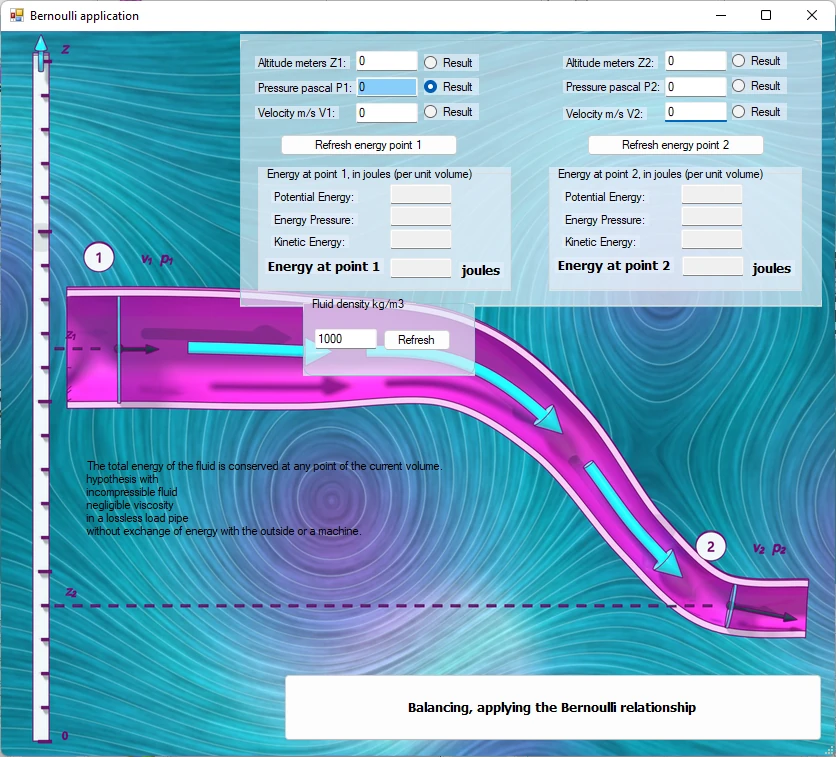
The sum of the pressures and mechanical energy per unit volume, is constant along the flow tube.
or: FORMULA Bernoulli
r is the density in Kg/m3.
V is fluid velocity in m/s.
g is the gravity 9.81 m/s².
Z is the vertical drop of the pipe in meters.
P is the static pressure in pascals.
is the pressure of weight or potential energy.
is the kinetic energy or kinetic pressure.
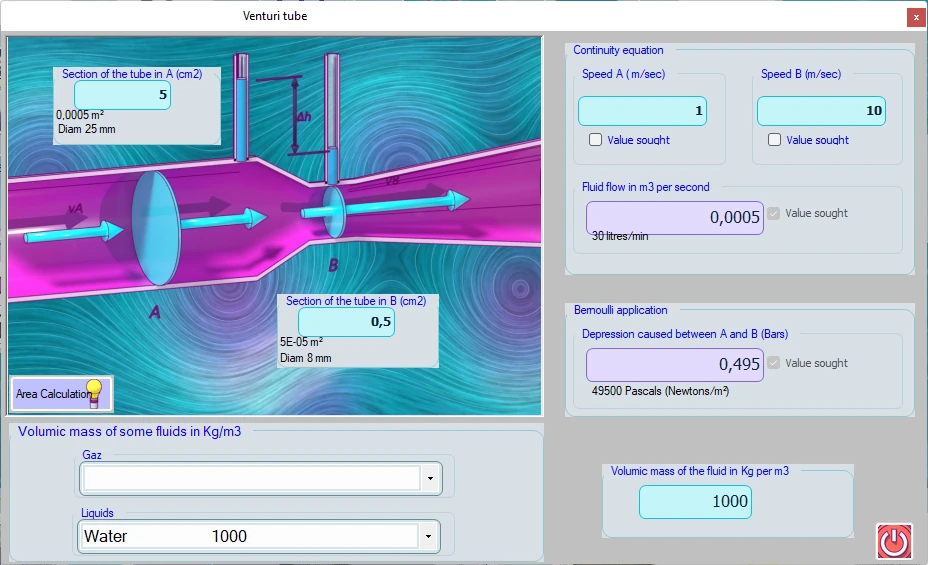
The Bernoulli equation can be considered as a principle of conservation of energy, suitable for moving fluids.The behavior usually called "Venturi effect" or "Bernoulli effect" is the reduction of fluid pressure in areas where the flow velocity is increased. This decrease in pressure in a narrowing of the duct may seem contradictory, unless you consider the pressure as an energy density. Passage through the narrowing, the fluid velocity, so its kinetic energy should be increased at the expense of pressure energy.Assuming that the flow is laminar, the major pressure losses of the duct are negligible, and that the speed is the average speed:
The Tools menu mecaflux software contains an application for, use the Bernoulli to determine the operating conditions of a system, according to the parameters of variation of speed, altitude and pressure between two points of a fluid stream.. like a venturi system
Frequently asked questions
When is Bernoulli's theorem valid?
For an incompressible fluid (a liquid, or a gas at low speed), in steady flow, along a streamline, without friction and without a pump or turbine between the two points. In a real pipe, a head loss term ΔH is added to the right-hand side.
How are head losses included in Bernoulli's equation?
The equation is written in metres of fluid and the head loss between A and B is added: PA/ρg + VA²/2g + zA = PB/ρg + VB²/2g + zB + ΔH. ΔH is calculated with the major and minor head loss formulas.
Why does the pressure drop when the velocity increases?
Because the sum of the three terms stays constant: if the velocity increases, the dynamic pressure ½ρV² increases and the static pressure P must decrease by the same amount. This is the principle of the Venturi tube, the carburettor and the lift of a wing.
How do I apply Bernoulli's theorem to my own installation?
The Bernoulli tool in the Tools menu of Mecaflux Standard computes the unknown quantity (velocity, pressure or elevation) at one point from the known values at another point, and the Venturi tool applies the same relation to a pipe narrowing; the head losses of the network are then added in the inventory. For a complete network to size or check, Mecaflux carries out the study of your project and delivers the calculation report, or offers training on the software applied to your own installation.