Page contents
What is the Froude number?
The Froude number Fr is a dimensionless number comparing inertia forces with gravity forces in a flow: Fr = V / √(g L). For a ship, L is the waterline length and Fr governs wave-making resistance: two geometrically similar hulls make the same waves at the same Froude number, which makes model tests in a towing tank possible. A displacement hull reaches its speed limit at about Fr = 0.40, when the wavelength of its bow wave equals its length. In open-channel hydraulics, Fr compares the water velocity with the speed of surface waves: Fr < 1 subcritical flow, Fr > 1 supercritical flow.
Froude number formula
- Fr: Froude number, dimensionless
- V: speed of the ship through the water (or flow velocity), in m/s; 1 knot = 0.5144 m/s
- g = 9.81 m/s²; L: waterline length of the ship, in m (hydraulic depth for a channel or a river)
- Hull speed (Fr ≈ 0.40): V ≈ 1.25 √L in m/s, i.e. 2.43 √L in knots (L in metres)
- Froude similarity: a 1/k scale model must be towed at Vmodel = Vship / √k
Froude number of a few ships
| Ship | Length L | Speed V | Froude number | Hull speed |
|---|---|---|---|---|
| Cruising sailboat | 10 m | 6 knots (3.09 m/s) | 0.31 | 7.7 knots |
| Same sailboat pushed hard | 10 m | 8 knots (4.12 m/s) | 0.42 (wave wall) | 7.7 knots |
| Trawler | 25 m | 10 knots (5.14 m/s) | 0.33 | 12.2 knots |
| Ferry | 150 m | 25 knots (12.9 m/s) | 0.34 | 29.8 knots |
| Container ship | 300 m | 22 knots (11.3 m/s) | 0.21 | 42.2 knots |
| Planing speedboat | 8 m | 30 knots (15.4 m/s) | 1.74 (planing) | 6.9 knots (exceeded by planing) |
Detailed explanations and calculation in Mecaflux

William Froude(1810- 1878) English engineer and naval architect
creator of the first Towing tank for testing models
Essential in the hydrodynamics study, the Froude Number (Fr) is a dimensionless number linking gravity(g), velocity(v), and boat Length (L) :
Fr= v/√(g.L)
While the architects of the time argued that only the experience of the real, could give applicable results, and considered experiments on models, such as " nice little fun experience" , William Froude developed laws of similarity and practiced work on friction.
William Froude expressed the fundamental hypothesis, stating that the resistance to the advancement of vessels is the sum of:
-
direct resistance mainly due to waves
This resistance is a function of nombre de Froude
- resistance to friction
This resistance is a function of Reynolds number and roughness coefficient of the hull
Although this division of the resistance in distinct parts, is theoretically questionable, thus separating these two components and assuming them independent, it is possible to determine the rules of similarity between resistance to the advancement of scale models and prototypes of actual size.
Predictions he made on models, Verified by towing a ship in sea, (the Greyhound) were successful, giving ship resistance, only 10% below the actual observations.
The method models, then entered the era of practical applications. 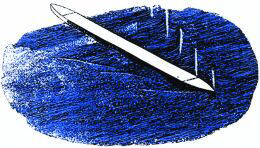
W.Froude sketch representing the wave train due to the bow
Despite advances in theory and computer means, this method is still valid, and it is still practiced nowadays in the design of modern ships:
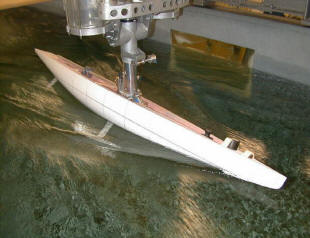
voir hydrodynamic naval :testing model Towing tank
Frequently asked questions
What is the Froude number used for in towing tank tests?
It ensures wave similarity between the model and the full-size ship: tests are run at the same Froude number, hence at a speed reduced by √k for a 1/k scale. A 1/25 model of a ship sailing at 20 knots is towed at 4 knots. The measured wave resistance is then scaled up to the ship, and the frictional resistance, which depends on the Reynolds number, is computed separately: this is Froude's hypothesis.
What is hull speed?
The bow wave of a hull has a wavelength λ = 2π V² / g that grows with speed. When λ reaches the hull length, i.e. Fr = 1/√(2π) ≈ 0.40, the ship sits between two crests and has to climb its own wave: resistance rises steeply. For a displacement hull, Vhull ≈ 2.43 √L knots (L in metres): 7.7 knots for 10 m, 12.2 knots for 25 m. Only planing or very slender hulls go beyond this limit.
What does the Froude number mean for a channel or a river?
It is written Fr = V / √(g h) with h the hydraulic depth. If Fr < 1 (subcritical flow), surface waves can travel upstream and a downstream obstacle influences the upstream flow; if Fr > 1 (supercritical flow), the water moves faster than the waves. The change from supercritical to subcritical happens abruptly through a hydraulic jump, visible at the foot of a weir.
How do I estimate the resistance of my hull?
Mecaflux Standard computes the frictional and form resistance of a hull from its wetted surface, length and speed (Reynolds number), and Heliciel sizes the propeller that must deliver that thrust. For a boat or float project, Mecaflux carries out the study of your project (hull, propeller, engine) and delivers the calculation report, or offers training on the software applied to your own hull.