Page contents
How do I size an extraction system (conveying velocity, duct diameter, fan)?
An extraction system is sized in three steps. First set the air velocity required in the ducts: high enough to convey the particles without letting them settle (from 10 m/s for vapours to 25 m/s for wet chips, according to their settling velocity), or limited by noise if the aim is only to renew the air. The flow to capture and this velocity give the diameter D = √(4 Q / (π V)). Finally calculate the pressure losses along the route (duct friction, bends, hood, filter) at the chosen flow: this is the suction pressure the fan must provide, and its absorbed power is Q ΔP/η. Example: 1,000 m³/h of sawdust at 20 m/s calls for a 133 mm duct; 20 m of galvanised duct with hood and bends (K = 2) lose 1,270 Pa, i.e. 590 W at the fan with an efficiency of 60 %. If the network is branched, the flow splits between the branches according to their pressure losses and has to be balanced.
Extraction sizing formulas
- Q: extracted air flow, in m³/s (1,000 m³/h = 0.278 m³/s); V: chosen conveying velocity, in m/s; D: duct bore, in m
- ΔP: total suction pressure of the network, in Pa; λ: Colebrook friction factor (galvanised duct: roughness 0.15 mm); L: duct length, in m
- Σ K: sum of the minor loss coefficients: hood or entry 0.5 to 1, bend 0.3 to 1, outlet 1, plus the losses given by the manufacturer for the filter or cyclone
- ρ: density of air, 1.2 kg/m³; ½ ρ V²: dynamic pressure, 240 Pa at 20 m/s
- Pfan: absorbed power, in W; η: overall efficiency of the fan and its motor (0.4 to 0.7)
Recommended conveying velocities according to the material extracted
| Material extracted | Examples | Conveying velocity |
|---|---|---|
| Vapours, gases, smoke | solvents, combustion fumes | 5 to 10 m/s |
| Very fine, light dusts | flour, powders, welding fumes | 10 to 15 m/s |
| Ordinary dry dusts | fine sawdust, sanding, cotton, rubber | 15 to 18 m/s |
| Average industrial dusts | dry wood chips, grinding, granules | 18 to 20 m/s |
| Heavy dusts | metal chips, sand, shot blasting | 20 to 23 m/s |
| Heavy or moist materials | wet chips, cement, quicklime | 23 m/s and above |
Duct diameter and suction pressure for 20 m of extraction at 20 m/s
| Flow Q | Diameter D | Reynolds Re | λ | Major losses | Minor losses | Total suction pressure | Fan power |
|---|---|---|---|---|---|---|---|
| 500 m³/h | 94 mm | 1.3 × 10⁵ | 0.0237 | 1,212 Pa | 482 Pa | 1,694 Pa | 392 W |
| 1,000 m³/h | 133 mm | 1.8 × 10⁵ | 0.0217 | 785 Pa | 482 Pa | 1,267 Pa | 586 W |
| 2,000 m³/h | 188 mm | 2.5 × 10⁵ | 0.0199 | 510 Pa | 482 Pa | 992 Pa | 918 W |
| 3,000 m³/h | 230 mm | 3.1 × 10⁵ | 0.0190 | 397 Pa | 482 Pa | 879 Pa | 1,221 W |
| 5,000 m³/h | 297 mm | 3.9 × 10⁵ | 0.0179 | 290 Pa | 482 Pa | 772 Pa | 1,787 W |
Detailed explanations and calculation in Mecaflux
The suction or ventilation is produced by a vacuum generated by a pump or turbine propeller fan. The suction velocity must be sufficient to perform particle transport, that we must aspire, or ventilate the area with sufficient capacity meeting the standards.
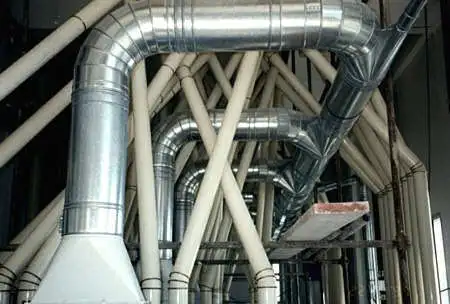
In the case of a vacuum for carrying particles, the conveying speed is calculated in relation to the speed of sedimentation . We seek a maximum speed in the ducts, and the limit is imposed by the vacuum generated by the turbine.
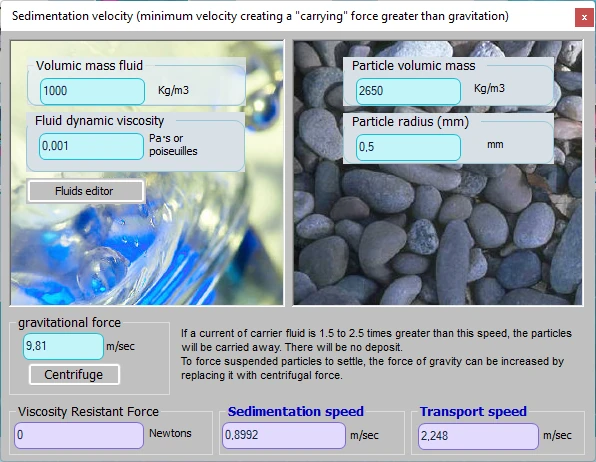
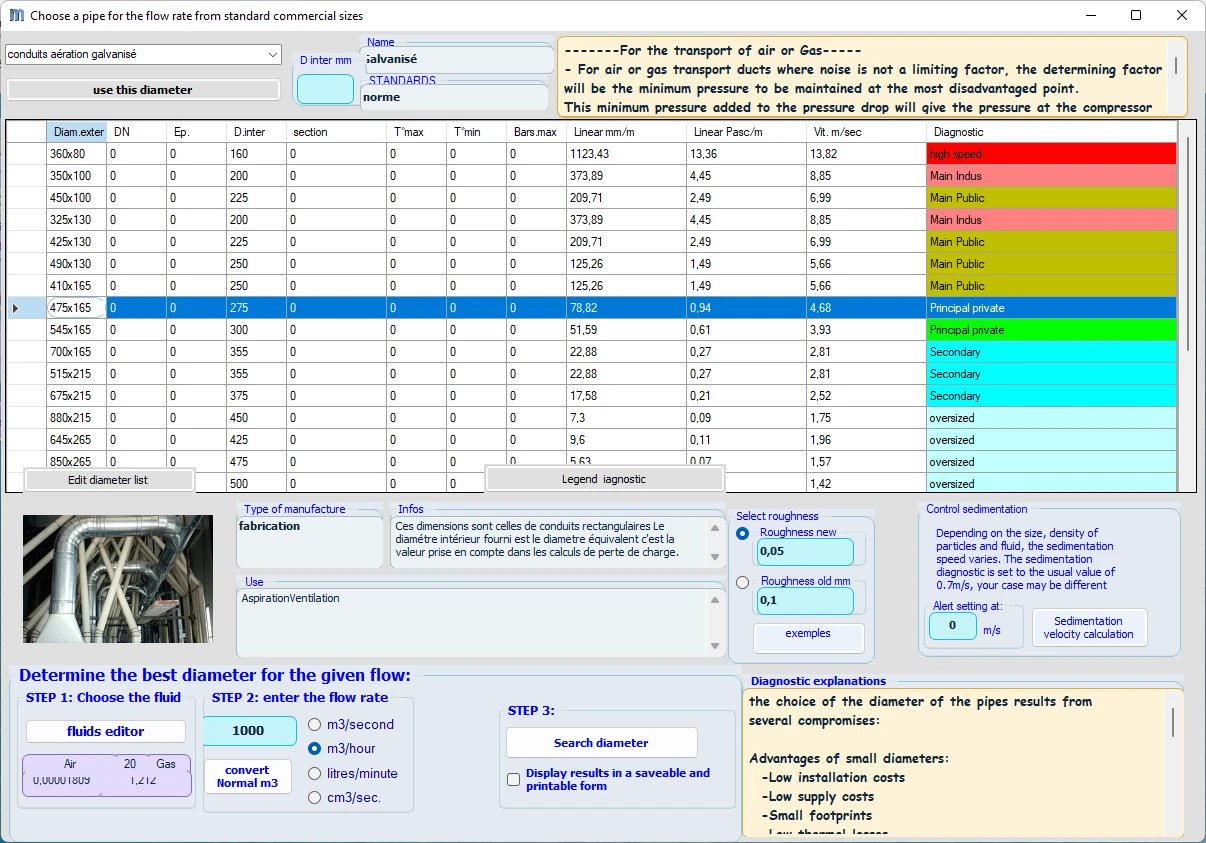
The suction speed and therefore transport of dust, chips or other materials, is simply calculated using this interface. Suffice it then ensure that this minimum requirement is met. For this, the pump or fan of aspiration, should be strong enough to balance the the head loss in the extraction system. A calculation of losses, in accordance with the flow rate of minimum suction must be made.
If one wishes to make the propeller axial fan, generating pressure balancing the pressure drop at the desired speed we can use the software to design propellers and fans, héliciel.
In cases where ventilation is intended to renew, or filter, the air in a volume defined, lThe speed is limited by the noise and it meets standards according to local.
To find a good compromise between the purchase price, installation, operation, pumping, roughness, trade stock, An interface to aid sizing the ventilation ducts, or hydraulic, is integrated into mecaflux.
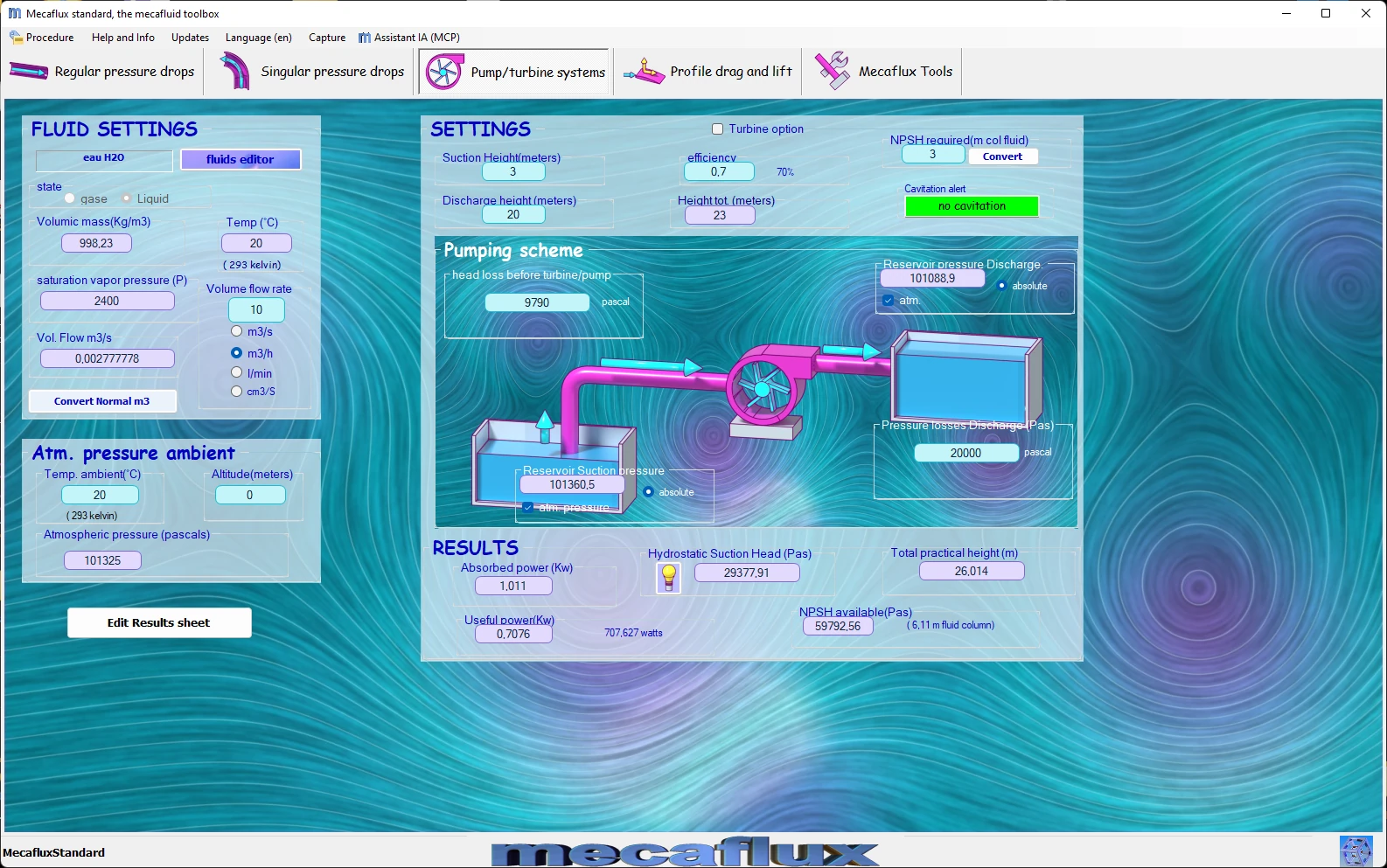
lthe energy consumed by the pump and the efficiency of the vacuum are related:
- To the head loss in the suction conduits
- the pressure in the tank of aspiration
- Performance of this pump
- the suction head for heavy fluids such as liquid (vertical dimension from the pump shaft to the surface of the suction tank) this height is directly related to the hydrostatic load
Parameters basics of power 'aspirations are easily found in the pump / turbine systems interface after a calculation of losses.
- If the network suction is branched, the balancing of the the head loss in the branches determines the suction flow in the branches. For branched systems we save time with Mecaflux pro 3D because its 3D interface is suitable for branched networks. See tutorial system aspiration mecaflux pro 3D
- With mecaflux standard, we can do several iterations to calculate the head loss in each branch to find the flow balance, But it gets complicated when the number of branches to balance increases.
Tutorial mode selection aspiration: use the aspiration mode to create the suction systems
Networks and suction Air and water systems AERAULIC or hydraulic systems
For the calculation of the propeller optimum for aspiration, we can use the software to design propellers and fans:Heliciel
Frequently asked questions
Why impose a minimum velocity in extraction ducts?
Because below the conveying velocity the heavier particles settle in the horizontal runs, reduce the section, increase the pressure losses and end up blocking the duct or creating a fire risk. The required velocity depends on the settling velocity of the particles (size, density); it is maintained throughout the network by reducing the diameter of the branches that capture less flow.
How do I balance a branched extraction network?
At each junction the suction pressure is the same for all the branches meeting there: the flow splits by itself in inverse proportion to their resistances. For each hood to receive its flow, adjust the diameters (balancing by design) or add dampers on the least resistant branches. The calculation is iterative, since the pressure losses of each branch depend on the flow passing through it: this is the job of network software.
What suction pressure can a fan provide?
An axial fan gives large flows at low pressure, 100 to 300 Pa: it suits general ventilation. A centrifugal fan provides from 500 Pa to several thousand pascals, needed for chip or dust extraction with a filter. The actual operating point is the intersection of the fan's pressure-flow curve and the system curve; a filter that clogs shifts this point towards a lower flow.
How do I size my own extraction installation?
Mecaflux Standard chains the steps: the sedimentation tool gives the conveying velocity of your particles, the duct sizing tool proposes the diameter for the flow and this velocity, the head loss inventory adds up ducts, bends, hood and filter, and the pump and turbine tab finds the operating point of the fan. For a branched network with several hoods, Mecaflux Pro3D, standalone-licensed network software, draws the installation in 3D in extraction mode and balances the branch flows itself. For a workshop or a plant to equip, Mecaflux carries out the study of your project and delivers the calculation report, or offers training on the software applied to your own installation.