Page contents
How do I calculate the head losses of a fluid network (internal flows)?
An internal flow is a flow confined in pipes or ducts. The total head loss of the network is the sum of the major losses (friction along the straight runs, Darcy-Weisbach formula) and the minor losses (bends, tees, valves, check valves, changes of section, each characterised by a coefficient K). The static head and the tank pressures are added to obtain the total head the pump must supply at the required flow rate: this is the operating point. Example: 10 m³/h of water in 50 m of DN 50 steel pipe with four bends, a valve, a check valve and 8 m of elevation: 2.2 m of head loss, i.e. a total head of 10.2 m.
Head loss and total head formulas
- ΔH: head losses in metres of fluid (× ρ g to get them in Pa); TDH: total dynamic head of the pump, in m
- λ: friction factor, dimensionless, given by the Colebrook equation from the Reynolds number and the relative roughness
- L and D: length and inside diameter of the run, in m; V: average velocity, in m/s; g = 9.81 m/s²
- K: minor loss coefficient of each fitting (90° bend: 0.3 to 1; open valve: 0.2; check valve: 2; pipe entrance: 0.5; exit into a tank: 1)
- Δz: level difference between suction and discharge, in m; P₁, P₂: pressures in the upstream and downstream tanks, in Pa
Example of a head loss balance for a pumping network
| Network element | Coefficient | Head loss (m) | Pressure loss (Pa) |
|---|---|---|---|
| Straight run of 50 m | λ L/D = 21.8 | 1.80 | 17,650 |
| Pipe entrance | K = 0.5 | 0.04 | 405 |
| 4 bends at 90° | K = 4 × 0.3 | 0.10 | 971 |
| Open gate valve | K = 0.2 | 0.02 | 162 |
| Check valve | K = 2 | 0.17 | 1,618 |
| Exit into the tank | K = 1 | 0.08 | 809 |
| Total head loss | 2.21 | 21,600 | |
| Static head (elevation) | 8.00 | 78,300 | |
| Total dynamic head TDH | 10.2 | 99,900 |
Detailed explanations and calculation in Mecaflux
- Exemple of major head loss calculation: pressure loss in pipe
- Exemple of minor head loss calculation: losses in a valve, elbow...
- Evaluate the parameters of a pumping system: Sizing a pump
this hydraulic diagram illustrates these examples :
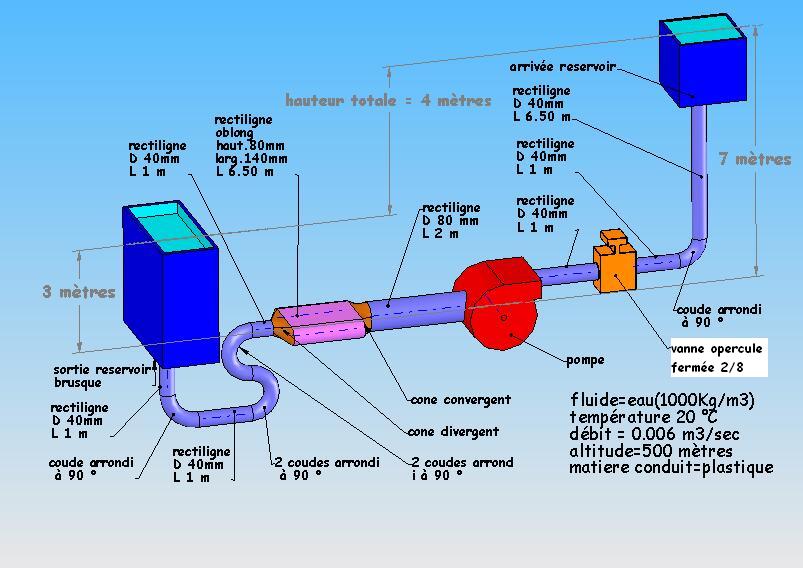
- Mecaflux standard used to model the sections in a spreadsheet with a row for each element: see Inventory pressure load head loss
- Mecaflux PRO3D has a 3D engine, it models the network and its eventual ramifications in three dimensions: See aeraulic hydraulic network modeling
Frequently asked questions
What is the difference between major and minor head losses?
The major (or friction) loss is due to the fluid rubbing on the wall all along a straight run: it is proportional to the length and depends on the diameter, the roughness and the Reynolds number. The minor loss is localised in a fitting that disturbs the flow (bend, valve, tee, enlargement): it equals K times the dynamic pressure ρ V²/2. In the example above the straight run accounts for 80 % of the losses.
How does head loss change with flow rate?
In turbulent flow it grows roughly with the square of the flow rate: doubling the flow multiplies the head loss by about four (slightly less, since λ decreases a little as Re increases). In the example, going from 10 to 20 m³/h raises the losses from 2.2 to about 8.4 m. This is why the system curve is a parabola H = Hstatic + k Q².
How do I choose the pump for a network?
Plot the system curve (static head plus head losses against flow rate) and overlay the head-flow curve of the pump: their intersection is the operating point, which should fall near the pump's best efficiency. Then check the available NPSH at the suction to avoid cavitation, and the absorbed power to select the motor.
How do I calculate the head losses and the pump of my own network?
The head loss inventory of Mecaflux Standard models your network in a spreadsheet, one row per run or fitting, with its database of K coefficients and its 120 fluids, then plots the system curve and finds the operating point of the pump chosen in the pump editor. Mecaflux Pro3D does the same balance on a network drawn in 3D, with its branches and loops. For an existing network to diagnose or an installation to design, Mecaflux carries out the study of your project and delivers the calculation report, or offers training on the software applied to your own installation.