Page contents
How do you calculate the head loss of a straight round or rectangular duct?
The head loss of a straight duct is calculated with the Darcy-Weisbach formula, ΔP = λ × (L / Dh) × ρ V² / 2. For a round duct, Dh is the inside diameter; for a rectangular or oval duct, the hydraulic diameter Dh = 4 S / P is used, but the velocity V is always calculated with the actual area S. The friction factor λ comes from the Colebrook equation, from the Reynolds number and the roughness. Example: 6 L/s of water at 20 °C in 11.5 m of 40 mm plastic pipe flows at 4.8 m/s (Re = 190,000, λ = 0.016) and loses 52,600 Pa, or 5.4 m; in a 140 × 80 mm duct (Dh = 102 mm), the same flow at 0.54 m/s loses only 190 Pa over 6.5 m.
Straight duct formulas
- ΔP: head loss, in Pa; λ: friction factor, dimensionless
- L: duct length, in m; Dh: hydraulic diameter, in m (inside diameter for a round pipe)
- S: flow area, in m²; P: wetted perimeter, in m; a, b: sides of the rectangle
- V: mean velocity, in m/s, with the actual area; Q: flow rate, in m³/s; ρ: density, in kg/m³
Example: three straight sections
| Section | Dh (mm) | Velocity (m/s) | Reynolds | λ | Loss (Pa) |
|---|---|---|---|---|---|
| Round Ø 40 mm, 11.5 m | 40 | 4.77 | 190,000 | 0.016 | 52,600 |
| Round Ø 80 mm, 2 m | 80 | 1.19 | 95,000 | 0.018 | 325 |
| Rectangular 140 × 80 mm, 6.5 m | 102 | 0.54 | 54,000 | 0.021 | 188 |
Detailed explanations and calculation in Mecaflux
head loss in straight pipes with Mecaflux standardSee also: calculate the flow in a hydraulic or aeraulic duct system with mecaflux Pro 3D
If the ducts are not of circular section (rectangular or oblong-type aeration or ventilation), the diameter used is the equivalent diameter, or the hydraulic diameter
Example of calculation of losses in the pipes of a network:
display the diagram in a window
For this scheme the fluid network is computable in three straight parts :
- a portion combining 11.5 meters diameter circular section 40 mm-
- a portion 2 meters in diameter circular section 80 mm
- a portion 6.5 meters oblong section width 140 mm and height 80 mm
Detailed procedure rectilinear part 1:
Select the tab major regular head loss and enter:
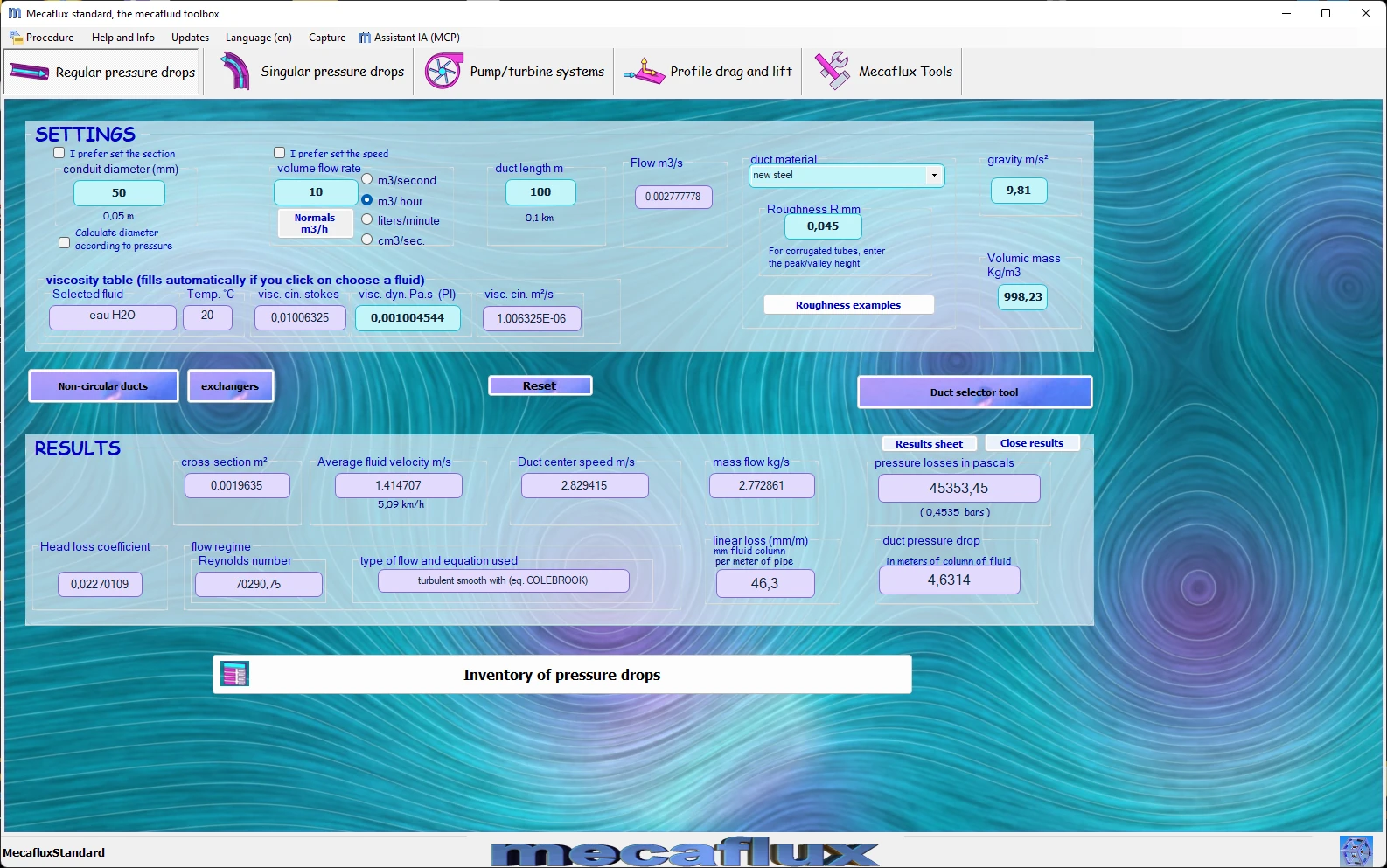
1 - the diameter :40 mm
2 - the flow : 0.006 m3/sec
3 - the length of pipe:11,5 mètres
4 - :material: plastic (the proposed roughness can be changed)
5 - density (default) water :1000Kg/m3
6 - the fluid and temperature: water 20°C
7 - gravity ( 9.81m/s²)
- Click calculate the results sheet appears:
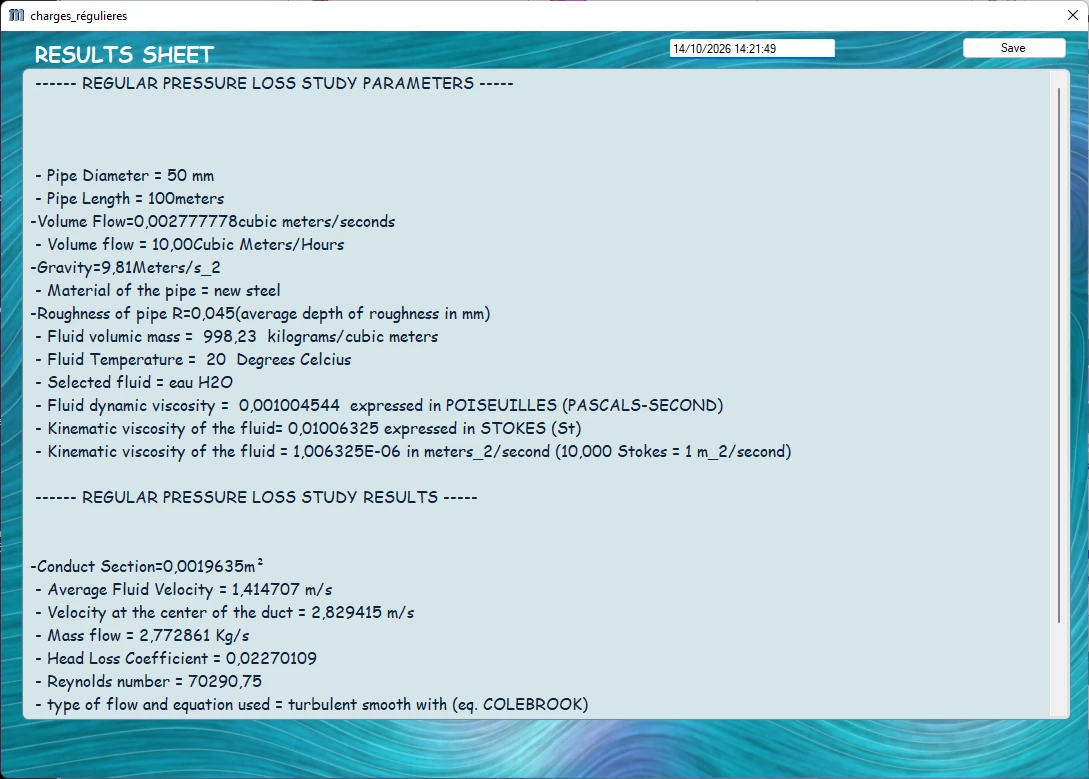
-Record your results in a file by clicking on Register in the toolbar (you are invited to add your file to an existing file, click no and create a file example1). it is advisable to save all your results on the same network in the same file..
-Close the "results sheet" window, the results are displayed in the inventory of head loss.
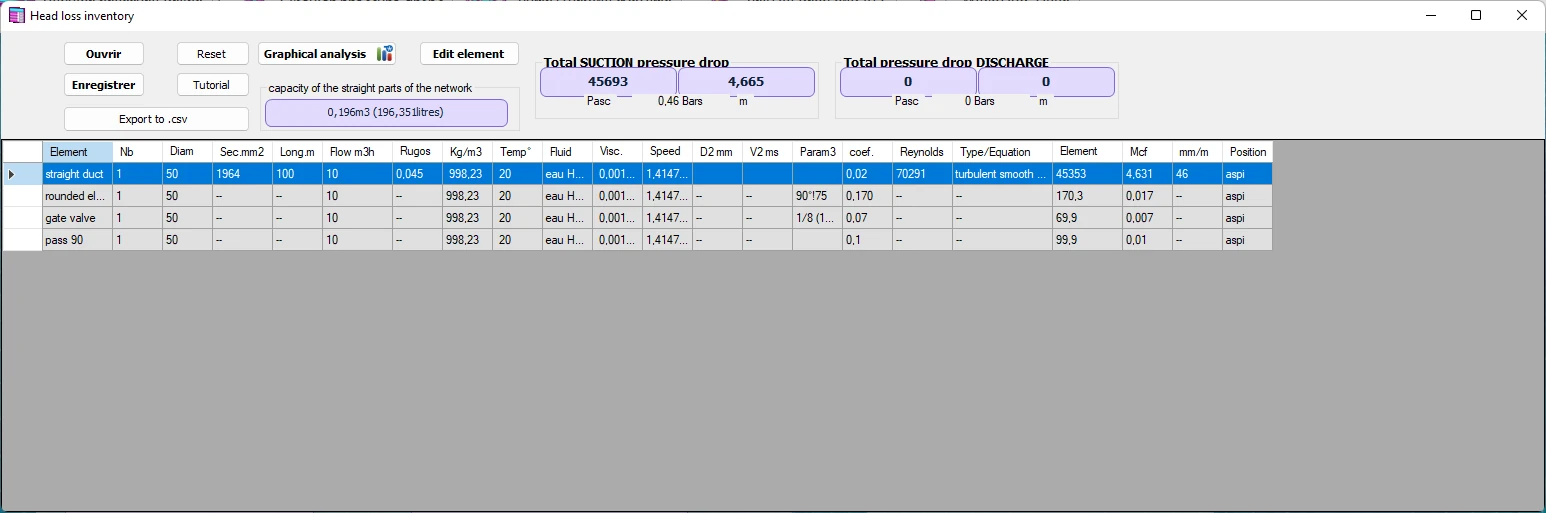
- In the inventory you can add successive results you will now calculate:
- For the straight sections 2 and 3, perform Part 1 (data change erases previous results)
- for the part 3 click on "non-circular section" and enter the height and width of the duct for the equivalent diameter of the oblong section
The results of calculations are in inventory
now proceed to the singular pressure minor head loss caused by the accidents on path:
following: losses in the valve and elbows
Frequently asked questions
Hydraulic or equivalent diameter: which one should be used?
The hydraulic diameter 4S/P is used in Darcy-Weisbach with the velocity of the actual area. The equivalent diameter (Huebscher formula, 115 mm for 140 × 80 mm) is the round duct that would have the same head loss at the same flow: useful to choose a duct, not to replace the area in the velocity calculation.
What roughness should be used for a plastic pipe?
About 0.0015 mm for new PVC or HDPE, against 0.05 mm for new steel and several tenths of a millimetre for old cast iron; the usual values are on the pipe roughness page.
Why is the loss so high in the 40 mm pipe?
Because the velocity is high: 4.8 m/s, four times more than in the 80 mm pipe. The loss follows roughly the square of the velocity and the inverse of the diameter, hence 160 times more loss per metre.
How do I calculate the sections of my network?
The major head loss tab of Mecaflux Standard calculates each section, round or rectangular, saves its result sheet and adds it to the network head loss inventory. For a specific case, Mecaflux also offers a study of your project or training on the software.