Page contents
What is the value of gravity g and where does it appear in fluid mechanics?
Gravity, or the acceleration due to gravity g, has a standard value of 9.80665 m/s²; it ranges from 9.78 m/s² at the equator to 9.83 m/s² at the poles, because of the Earth's rotation and flattening, and decreases slightly with altitude. In fluid mechanics it links a pressure to a fluid height: P = ρ g h. It therefore appears in hydrostatic head, Bernoulli's theorem (the ρ g z term), the conversion of a head loss into metres, the Froude number and hydraulic power ρ g Q H. Example: a 10 m column of water exerts 1,000 × 9.81 × 10 = 98,100 Pa, about 1 bar; on the Moon (g = 1.62 m/s²), the same column would exert only 16,200 Pa.
Formulas involving g
- g: acceleration due to gravity, in m/s² (9.81 in everyday calculations)
- P: pressure due to a fluid column of height h, in Pa; ρ: density, in kg/m³
- ΔH: head loss in metres of fluid, from a pressure loss ΔP in Pa
- Fr: Froude number, ratio of inertial to gravity forces (V: velocity, L: characteristic length)
- Phyd: hydraulic power, in W (Q: flow rate in m³/s, H: head in m)
Values of g
| Location | g (m/s²) |
|---|---|
| Equator, sea level | 9.780 |
| Paris | 9.809 |
| Poles | 9.832 |
| Standard (conventional) value | 9.80665 |
| Summit of Everest | ≈ 9.76 |
| Mars | 3.71 |
| Moon | 1.62 |
Detailed explanations and calculation in Mecaflux
The gravity plays a key role in the equations of fluid mechanics, the density of the fluid is gravity factor in the equation of the theorem Bernoulli
- Gravity or acceleration is measured in meters / second² )
- on the earth it is 9.81m/s² to the poles and 9.78m/s² at the equator (the effect of centrifugal force)
- on the moon that acceleration is 1.62m/s²
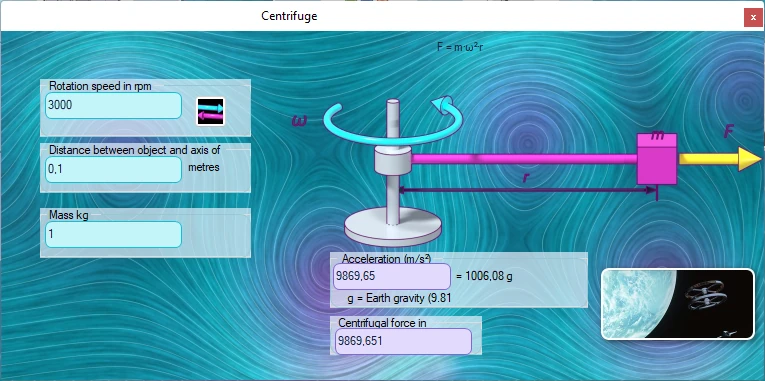
- gravity acceleration g : Based on the assumption :"any force acting alone is proportional to the acceleration" and considering that " the weight of an object (the force applied thereto) is the force, gravity is determined as the acceleration of the mass of an object , which gives the weight of the object
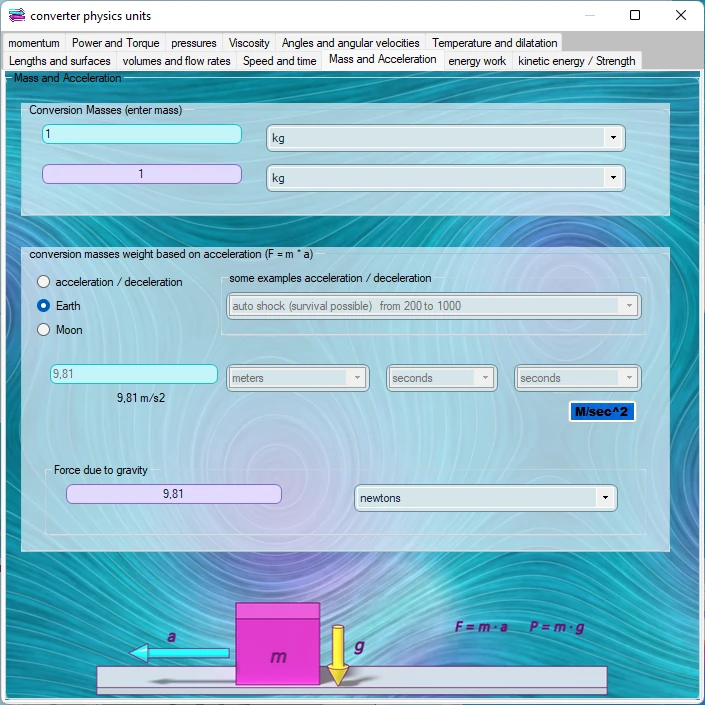
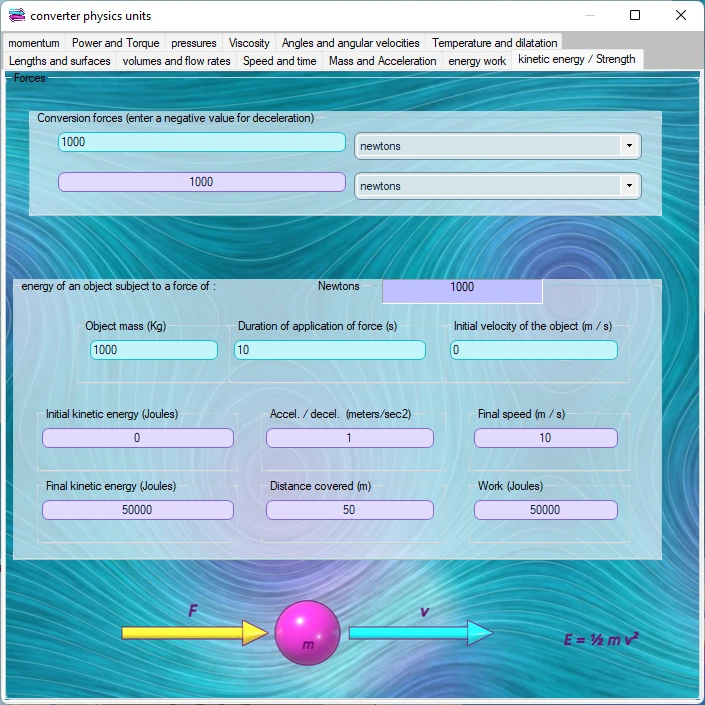
Mecaflux standard is supplied with the converter that allows the various calculations in conjunction with acceleration..
mass acceleration deceleration relationship weight / shock in the converter
relation kinetic energy acceleration in the converter
Frequently asked questions
Why does g vary with latitude?
The Earth's rotation creates a centrifugal acceleration that is greatest at the equator and reduces apparent weight, and the Earth is slightly flattened: a point on the equator is further from the centre than a pole. Together these give 9.78 m/s² at the equator against 9.83 m/s² at the poles.
Should g be corrected in network calculations?
Rarely: the difference between 9.78 and 9.83 m/s² is under 0.6%, far less than the uncertainty on a roughness or a loss coefficient. The value 9.81 m/s² is suitable anywhere on Earth.
Why is 10 m of water said to equal 1 bar?
Because ρ g h = 1,000 × 9.81 × 10 = 98,100 Pa, or 0.98 bar: it is the practical rule for converting a head in metres into a pressure, within 2%.
How do I take gravity into account in my calculations?
Mecaflux Standard uses g = 9.81 m/s² by default and lets you change it, for example for a high-altitude project or a demonstration on another planet. For a specific case, Mecaflux also offers a study of your project or training on the software.