Page contents
How do you calculate the efficiency of a pump?
The efficiency of a pump is the ratio between the power it transfers to the fluid and the power it consumes: η = Poutput / Pinput, with Poutput = ρ g Q H. Measured at the shaft, it gives the efficiency of the pump alone; measured at the electricity meter, it gives the overall efficiency, motor included, the product of both efficiencies. It varies with the flow rate and peaks at the best efficiency point, around which a well-chosen pump should run. Example: 36 m³/h (0.01 m³/s) of water lifted 25 m requires an output power of 1,000 × 9.81 × 0.01 × 25 = 2,450 W; if the motor draws 3.8 kW from the grid, the overall efficiency is 2.45 / 3.8 = 0.65, or 65%.
Efficiency formulas
- η (eta): efficiency, dimensionless, between 0 and 1 (or in %)
- Poutput: power transferred to the fluid, in W; Pinput: power drawn at the shaft or from the grid, in W
- ρ: density, in kg/m³; g = 9.81 m/s²; Q: flow rate, in m³/s; H: pump head, in m
- Output, input and recovered power are detailed on the absorbed and useful power page
Typical efficiencies
| Machine | Efficiency |
|---|---|
| Domestic heating circulator (overall) | 20 to 40% |
| Small centrifugal pump, under 5 kW | 50 to 70% |
| Medium or large centrifugal pump | 75 to 90% |
| Reciprocating positive displacement pump | 80 to 90% |
| IE3 electric motor, 5 to 50 kW | 88 to 94% |
| Centrifugal fan | 60 to 85% |
Detailed explanations and calculation in Mecaflux
The ratio: output power / input power, gives the efficiency of the pump.
The output power is the power applied to the fluid to meet the requirements of network throughput..
- if the power consumption is measured at the shaft of the pump, the ratio of the output power by the power consumption gives the performance of the pump body without the engines
- If the power consumption is measured by power consumption of the pump motor, the ratio of effective power by the power input gives you the efficiency of your pump including engine efficiency.
Example of pump performance curve given in%:
Here the maximum efficiency is 57% (pump + motor)

Pump efficiency according to the flow in m3/heure
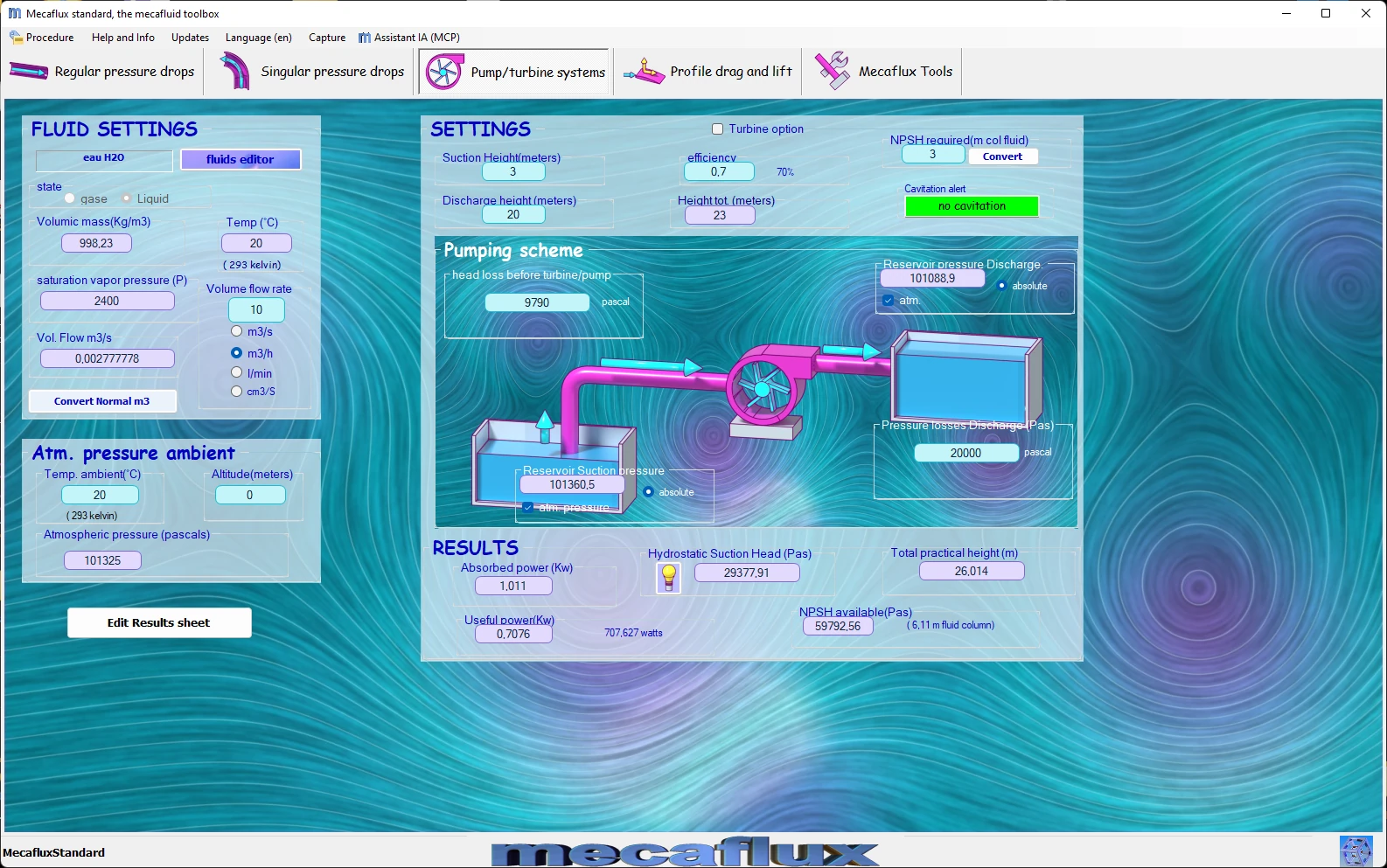
with Mecaflux standard
if you enter the efficiency of your turbine or pump, you will have, the power output or power consumption.

Frequently asked questions
What is the difference between pump efficiency and overall efficiency?
Pump efficiency compares the output power with the power received at the shaft. Overall efficiency starts from the electrical power drawn: it also includes the motor losses and equals the product of both efficiencies, for example 0.73 × 0.88 = 0.64.
Why run a pump at its best efficiency point?
It is the flow rate at which it uses the least energy for the service delivered and wears the least: away from this point, recirculation increases noise, vibration and the risk of cavitation. The operating point is used to check that it is close.
What does a better efficiency bring?
For 2.45 kW of output power over 8,000 hours a year, going from 50% to 75% efficiency reduces the power drawn from 4.9 kW to 3.3 kW, saving 13,000 kWh every year.
How can I calculate the efficiency and power of my pump?
In Mecaflux Standard you enter the efficiency of your pump or turbine and the software gives the input or recovered power, with the operating point on the system curve. For a specific case, Mecaflux also offers a study of your project or training on the software.