Page contents
What is the difference between useful, absorbed and delivered power?
The useful power (hydraulic power) is the power actually transmitted to the fluid by a pump or a fan: flow rate multiplied by the pressure supplied (in watts when the flow is in m³/s and the pressure in pascals). The absorbed power is what the machine draws on its shaft or from the mains; it is always larger, and the ratio of the two is the efficiency. The delivered power is the mechanical power a turbine extracts from the fluid: the available hydraulic power multiplied by the turbine efficiency.
Hydraulic power formulas
- P: power, in watts (W); 1 kW = 1,000 W; 1 hp = 746 W
- Q: volume flow rate, in m³/s (1 m³/h = 1/3,600 m³/s)
- ΔP: pressure supplied or extracted, in pascals: the sum of the head losses, the static head and the dynamic pressure
- H: equivalent head, in metres of fluid (ΔP = ρ g H)
- ρ: density of the fluid, in kg/m³; g = 9.81 m/s²
- η (eta): efficiency, dimensionless, between 0 and 1
Worked examples
| Case | Flow rate | Pressure or head | Useful power | Absorbed or delivered power |
|---|---|---|---|---|
| Circulation pump | 10 m³/h (0.00278 m³/s) | ΔP = 50,000 Pa (5.1 m) | 139 W | absorbed: 199 W |
| Lift pump | 0.1 m³/s | H = 10 m (98,100 Pa) | 9,810 W | absorbed: 14,000 W |
| Network component | 2 m³/s | head loss 100 Pa | 200 W | absorbed: 286 W |
| Small hydro turbine | 0.05 m³/s | net head 20 m | 9,810 W available | delivered: 8,340 W |
Detailed explanations and calculation in Mecaflux
The output power is the power applied to the fluid to meet the requirements of network throughput. The output power can be calculated as a function of flow and pressure:
output power Watt = flow rate (m3/sec) x Pressure (pascals)
The energies of pressure being in 3 forms (see Bernoulli), In a complete study we add the three energies pressure: head loss + hydrostatic load + dynamic pressure: output power ( Watt) = flow rate (m3/sec) x (head loss+ hydrostatic load + dynamic pressure)(pascals)
Example Output power with head loss: The output power of a fluid flow through a 2 m3/sec element generating a loss of 100 Pascals is 2x100 = 200
Example Output power with hydrostatic head pressure: calculating the power output of a water flow of 0.1 m3/sec from an altitude of 0 to 10 meters: start by turning the height of hydrostatic pressure in pascals: assume for simplicity that 1 bar = 100 000 pascals = 10 meters column water (see hydrostatic head) This gives us an output power: 0.1 x 100 000 = 10 000 watts
Example Output power with dynamic pressure: A pump delivers a flow rate of 1 m3/sec by tapping into a lake, and rejected the water at the same level through an output section of pipe 0.1m ².(pressure losses are neglected) This system generates a dynamic pressure as it brings the speed to the fluid, which was at rest
- Velocity given to the fluid is: flow (m3/sec) / section (m²)= 1/0.1=0.1m/sec
- The dynamic pressure energy is equal to 0.5 x density(kg/m3) x velocity(m/sec)²= 0.5 x 1000 x 0.1²=5 pascals
- Output power Watt = flow (m3/sec) x dynamic Pressure (pascals) =1x5=5 watts
In a complete study we add the three energies pressure: output power Watt = flow (m3/sec) x (head loss + hydrostatic head (pascals) + dynamic Pressure )
The ratio of the useful power by power consumption gives the efficiency of the pump.
- if the power consumption is measured at the shaft of the pump, the ratio of the output power by the power consumption gives the performance of the pump body without the engines
- If the power consumption is measured by power consumption of the pump motor, the ratio of effective power by the power input gives you the efficiency of your pump including engine efficiency.
This curve indicates for a given pump, the flow rates achieved according to power consumption..
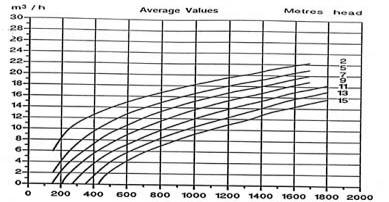
It can be seen for example with a power of 175W about this pump delivers: 6 M3 /h with 2 meters HMT, 2m3 with 5 mètres...
Frequently asked questions
How do I calculate pump power from flow rate and head?
P = ρ × g × Q × H / η. For 20 m³/h of water (0.00556 m³/s) at 30 m of head with an efficiency of 0.65: P = 1,000 × 9.81 × 0.00556 × 30 / 0.65 = 2,517 W, i.e. a 3 kW motor. Without the efficiency you get the useful power: 1,636 W.
Why is the absorbed power higher than the useful power?
Because part of the energy supplied is lost in mechanical friction, internal recirculation and fluid friction in the impeller. The overall efficiency of a centrifugal pump is typically 0.5 to 0.85 depending on its size and operating point; it peaks at the design point.
What is the power delivered by a turbine?
It is the mechanical power available on the shaft: the hydraulic power ρ g Q H multiplied by the turbine efficiency (0.7 to 0.9). A generator downstream adds a second efficiency, so the electrical power is slightly lower again.
How do I calculate the power of the pump or turbine of my own installation?
The pumps and turbines tab of Mecaflux Standard adds the network head losses, the static head and the dynamic pressure at the required flow rate, derives the useful power, then the absorbed power with the efficiency of the selected pump or the delivered power with the turbine efficiency. To select a pumping unit or estimate the output of a small hydro plant, Mecaflux carries out the study of your project and delivers the calculation report, or offers training on the software applied to your own installation.