Page contents
What is the difference between density and specific gravity?
Density is the mass of a unit volume of a substance, in kg/m³. Specific gravity (relative density) is a dimensionless number: the ratio of the density of a substance to the density of a reference. For liquids and solids the reference is water (1,000 kg/m³ at 4 °C); for gases it is air at the same pressure and temperature. To go from specific gravity to density of a liquid, multiply by 1,000: an oil of specific gravity 0.8 has a density of 800 kg/m³. Density changes with temperature, and so does specific gravity.
Specific gravity formula
- SG: specific gravity (relative density), dimensionless
- ρ: density of the substance, in kg/m³ (1 g/cm³ = 1,000 kg/m³)
- ρreference: 1,000 kg/m³ (water at 4 °C) for liquids and solids; density of air at the same conditions for gases (1.204 kg/m³ at 20 °C and 1,013 mbar, 1.293 kg/m³ at 0 °C)
- For an ideal gas, the specific gravity relative to air is also the ratio of molar masses: SG = M / 28.96
Density and specific gravity of common fluids
| Fluid | Density ρ (kg/m³) | Specific gravity |
|---|---|---|
| Fresh water | 998 | 0.998 |
| Sea water | 1,025 | 1.025 |
| Gasoline | 750 | 0.75 |
| Diesel fuel | 840 | 0.84 |
| Ethanol | 789 | 0.79 |
| Mineral oil | 880 | 0.88 |
| Glycerine | 1,260 | 1.26 |
| Mercury | 13,546 | 13.55 |
| Air | 1.204 | 1 (reference for gases) |
| Methane | 0.668 | 0.55 |
| Carbon dioxide CO₂ | 1.842 | 1.53 |
| Hydrogen | 0.084 | 0.07 |
Detailed explanations and calculation in Mecaflux
Fluid density is constantly present in the equations of fluid mechanics.
The mass per unit volume is the ratio of the mass by its volume the unit used is Kg/m3
For purists, I met some, I specify that the density of a liquid is the ratio of the mass per unit volume of the material on the water mass per unit volume. (for a gas, the ratio will be taken with the mass per unit volume of the air) This gives us a dimensionless number, without unity, which is the density of the material
Exemple: the water mass per unit volume is 1000 Kg/m3
the mass per unit volume of the oil is 800 Kg/m3
the density of the oil is=800/1000= 0.8
Density of water=1000/1000= 1
With Mecaflux standard
The density of the liquid or gas is provided in the fluid editor:
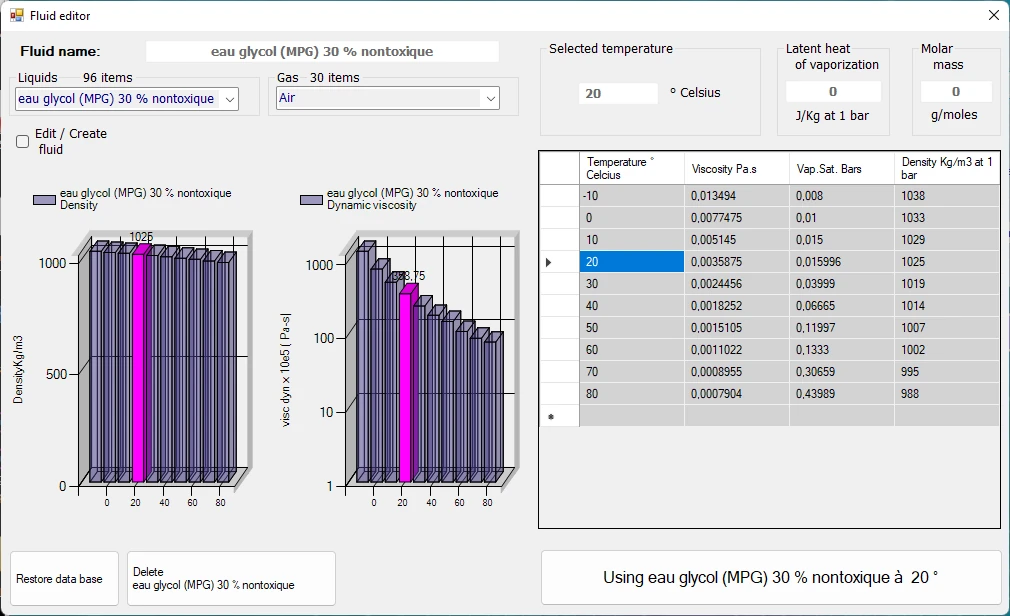
The editor gives density , mass per unit volume of the fluid selected depending on the temperature but also its viscosity and saturation vapor pressure.
Frequently asked questions
Is specific gravity the same as density?
No. Density is a physical quantity with a unit (kg/m³, g/cm³, kg/L): the mass of one cubic metre of matter. Specific gravity is the ratio of that density to the density of water (or of air for a gas) and has no unit. For liquids, specific gravity and density in kg/L share the same numerical value: 0.84 for diesel fuel, i.e. 840 kg/m³.
What is the density of water?
Its specific gravity is 1 by definition at 4 °C, the temperature at which water is heaviest (999.97 kg/m³). At 20 °C water weighs 998 kg/m³ (specific gravity 0.998), at 60 °C 983 kg/m³ and at 100 °C 958 kg/m³. Sea water, being salty, has a specific gravity of about 1.025.
How do I calculate the specific gravity of a gas relative to air?
For an ideal gas it is the ratio of molar masses: SG = M / 28.96 g/mol. CO₂ (44 g/mol) has a specific gravity of 1.52 and collects near the floor; methane (16 g/mol) has 0.55 and rises; hydrogen (2 g/mol) 0.07. The density of the gas then depends on pressure and temperature (see normal cubic metres).
How do I get the exact density of my fluid for my calculation?
In Mecaflux Standard, the fluid editor gives the density, viscosity and vapour pressure of 120 liquids and gases at the temperature of your installation, and you can add your own fluid from its data sheet. For a special fluid (sludge, mixture, chemical), Mecaflux carries out the study of your project with the right properties and delivers the calculation report, or offers training on the software applied to your own case.