Page contents
How is centrifugal force calculated?
Centrifugal force is the inertial force felt by a rotating mass, directed outwards from the axis. It equals the mass multiplied by the square of the angular velocity and by the radius of rotation: F = m ω² R, or equivalently F = m V² / R with V the tangential speed. The centrifugal acceleration ω² R is often expressed in multiples of g (9.81 m/s²): this is the "g-number" of a centrifuge, which speeds up particle settling by the same factor.
Centrifugal force formulas
Relative centrifugal acceleration (g-number), with N in revolutions per minute and R in metres:
- F: centrifugal force, in newtons (N)
- m: mass of the object or particle, in kg
- ω (omega): angular velocity, in radians per second (rad/s)
- N: rotational speed, in revolutions per minute (rpm)
- R: distance from the axis of rotation to the centre of gravity of the object, in metres
- V: tangential speed, in m/s; g = 9.81 m/s²
Centrifugal acceleration versus speed and radius
| Speed N | Radius R | ω | Tangential speed | Acceleration | g-number |
|---|---|---|---|---|---|
| 100 rpm | 0.5 m | 10.5 rad/s | 5.2 m/s | 55 m/s² | 5.6 g |
| 1,000 rpm | 0.1 m | 105 rad/s | 10.5 m/s | 1,097 m/s² | 112 g |
| 3,000 rpm | 0.1 m | 314 rad/s | 31.4 m/s | 9,870 m/s² | 1,006 g |
| 10,000 rpm | 0.05 m | 1,047 rad/s | 52.4 m/s | 54,800 m/s² | 5,590 g |
Detailed explanations and calculation in Mecaflux
Expression of the centrifugal force is :
Force (Newton) = m x ω² x R
Where
- a is the normal acceleration as a=v²/R
- m is the mass of the object studied ;
- ω is the speed of rotation such that ωR=v ;
- R is the distance from the axis of rotation to the center of gravity of the object ;
The centrifuges are used to modify sedimentation rate particles of a heterogeneous environment to separate them: see Sedimentation
Centrifuge: Tool to calculate the centrifugal force in Mecaflux standard
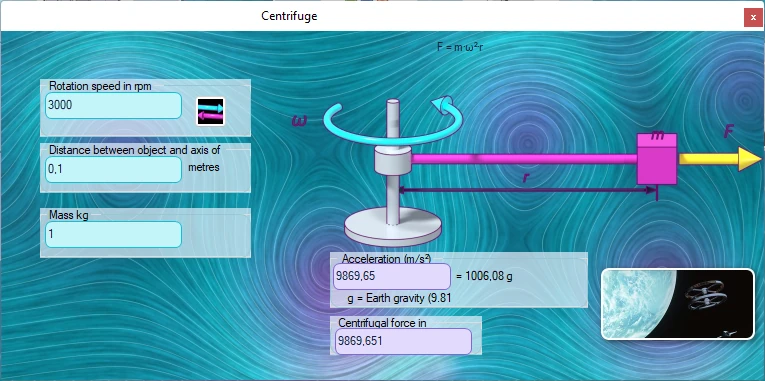
Mecaflux standard is supplied with the converter, and computing functions related to the acceleration.
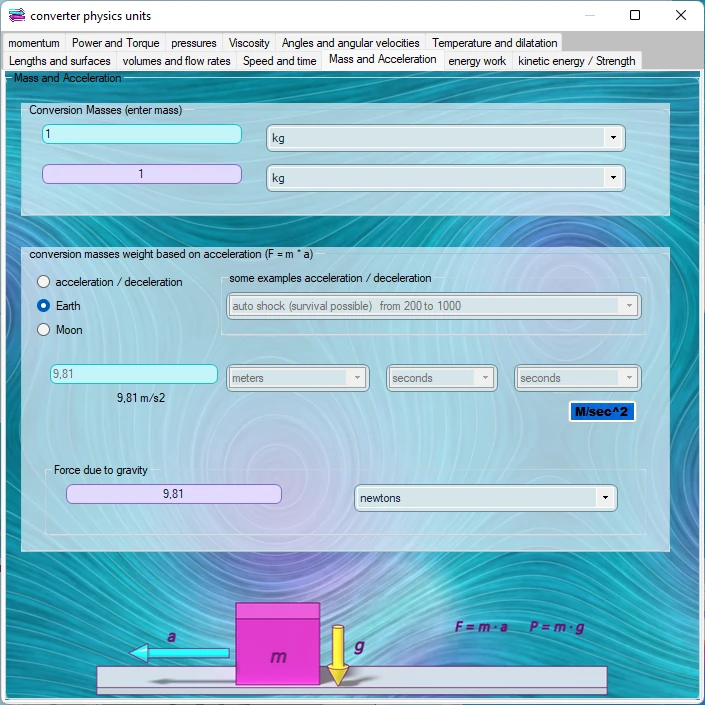
mass acceleration deceleration relationship weight / shock in the converter
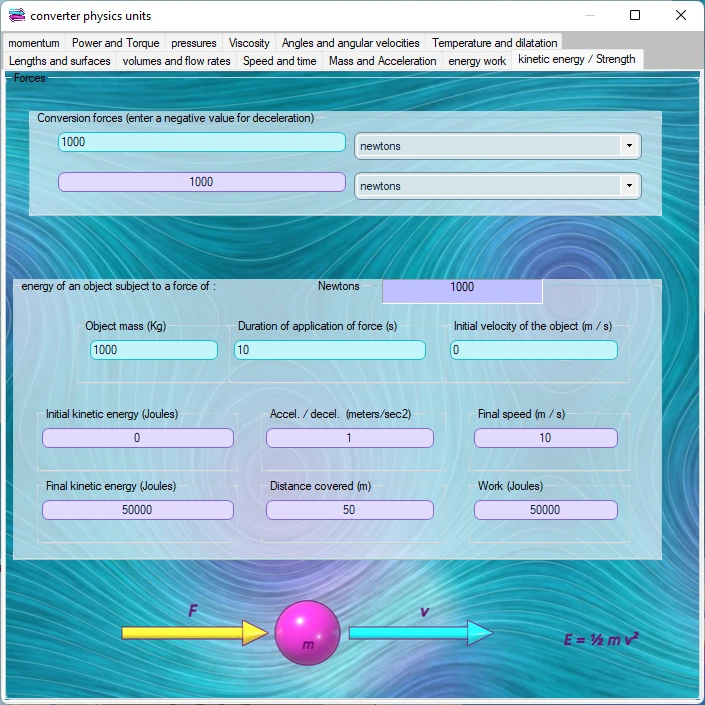
relation kinetic energy acceleration in the converter
Frequently asked questions
Is centrifugal force a real force?
It is an inertial force: it only exists in the rotating frame of reference. Seen from outside, it is the centripetal force m V²/R exerted by the link (arm, wall, cord) that keeps the mass on its circular path. Both have the same value and opposite directions, and for sizing an arm or a wall this value is what matters.
How do I convert revolutions per minute to radians per second?
ω = 2 π N / 60 = 0.1047 × N. So 3,000 rpm = 314 rad/s. The tangential speed at the end of a radius R is then V = ω R: 31.4 m/s at 0.1 m from the axis.
Why does a centrifuge speed up sedimentation?
Because the settling velocity of a particle is proportional to the acceleration acting on it. At 1,000 g a particle settles a thousand times faster than under gravity alone, which separates in minutes what would take days of decantation (see the sedimentation page).
How do I calculate the centrifugal force of my own machine or test?
The centrifuge tool in the Tools menu of Mecaflux Standard computes the force, the acceleration and the g-number from the mass, the rotational speed and the radius of your machine; the unit converter also links mass, weight, acceleration and kinetic energy. For a particular piece of rotating equipment (separator, spin dryer, test rig), Mecaflux carries out the study of your project, or offers training on the software applied to your own case.