Page contents
- How do I choose my surf fins?
- How many fins: single, twin, thruster, quad or in line?
- What fin size for the surfer's weight and the board
- Fin size guide by surfer weight
- Where to place the fins: position, toe and cant
- Which setup for which board
- Recommended setup by board type
- Which fitting: FCS, Future or US box
- Frequently asked questions
How do I choose my surf fins?
Choosing a surf fin set comes down to four questions. How many? One central fin (single) for glide and long curves, two (twin) for speed and freedom, three (thruster) for the balance between grip and manoeuvrability, four (quad) for power in a straight line and on fast waves. What area? Proportional to the surfer's weight and to speed: the heavier the surfer or the bigger the board, the more area is needed to get support. What position? Moving the fins forward makes the board more manoeuvrable, moving them back gives drive and stability. Which fitting? The one of the board's boxes: FCS, Future or US box. Variable-geometry fins change part of these rules: since their angle adapts by itself, they are mounted parallel, without toe or cant, and one well-sized dynamic centre fin can replace two side fins that contradict each other.
How many fins: single, twin, thruster, quad or in line?
Each setup distributes the support area and the board's centre of rotation differently.
- Single (1 centre fin): centred support, no heeling, long and smooth lines; the setup of longboards, guns and glide boards. A centre fin stays immersed 99.9 % of the time, even in tubes.
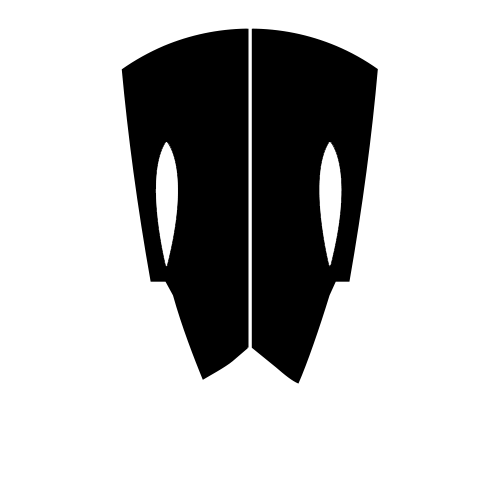
- Twin (2 side fins): Simmons' answer to the risk of ventilation of a centre fin on a wide board; speed and freedom, less directional stability. With a fixed toe angle the two fins work in opposition.
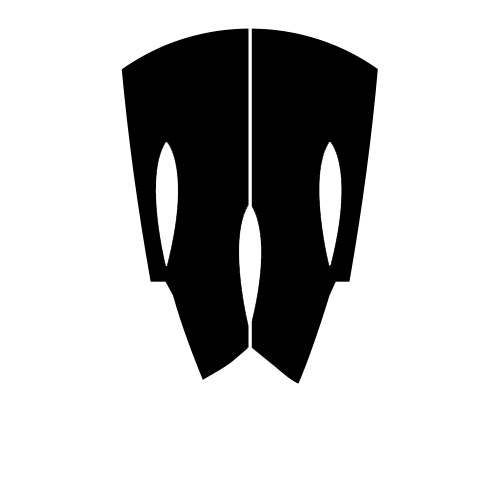
- Thruster (2 side + 1 centre): the standard since 1980, a compromise between grip and manoeuvrability; the three fins are in the water 90 % of the time.
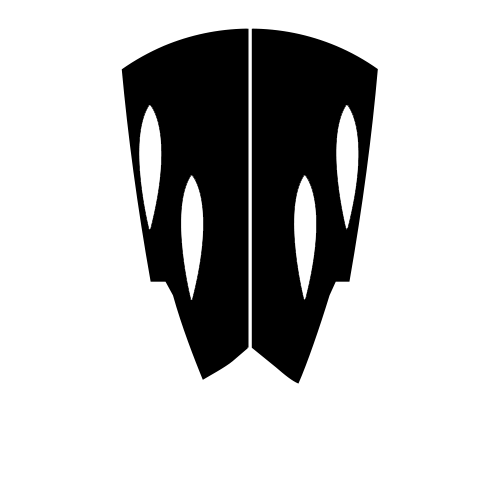
- Quad (4 side fins): a lot of area near the rails, drive and speed on fast, hollow waves.
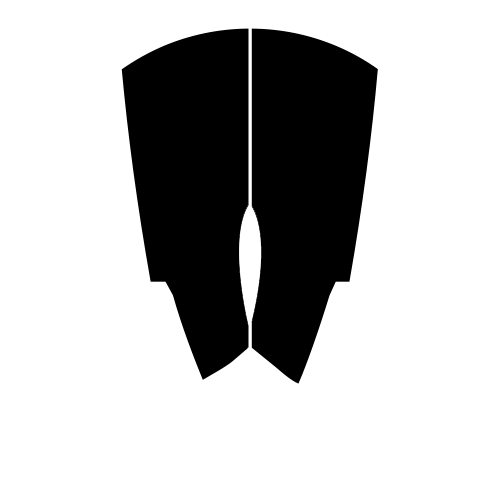
- In line (2 or 3 centred fins, one behind the other): a setup specific to variable-angle fins, combining centred support and the slot effect between profiles; reserved for narrow boards and smooth surfing.
What fin size for the surfer's weight and the board
The lift of a fin grows with its area and with the square of speed. A heavy surfer, a bulky board or soft waves need more area; a light surfer, a thin board or fast waves need less. Manufacturers grade their fins in sizes (S, M, L) indexed on the surfer's weight; the orders of magnitude below are a reference.
Fin size guide by surfer weight
| Surfer weight | Usual size | Area per fin | At FYN |
|---|---|---|---|
| under 55 kg | XS / S | ≈ 80 cm² | Static Small (56 cm²) or Dynamic |
| 55 to 70 kg | S / M | ≈ 90 cm² | Static (80 cm²) or Dynamic |
| 70 to 85 kg | M / L | ≈ 100 cm² | Dynamic; 2 Dynamics in line if area is short |
| over 85 kg | L / XL | ≈ 110 cm² and more | Dynamic Longboard (180 × 227 mm) in US box |
| Longboard, SUP | 8 to 10 inch centre fin | Dynamic Longboard + 2 Static Small |
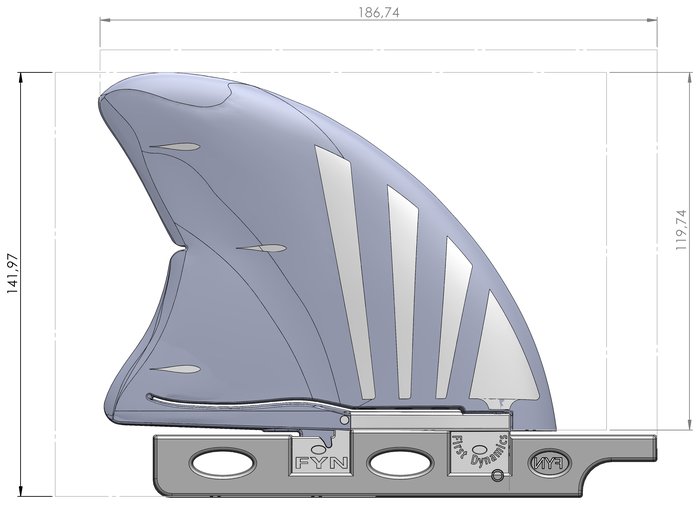
A dynamic fin does not need a high aspect ratio to grip, since its camber adapts; its area can be spread closer to the board, which raises the centre of lift and limits heeling. The standard Dynamic measures 119.6 × 151.4 mm, the Dynamic Longboard 180.3 × 227.4 mm.
Where to place the fins: position, toe and cant
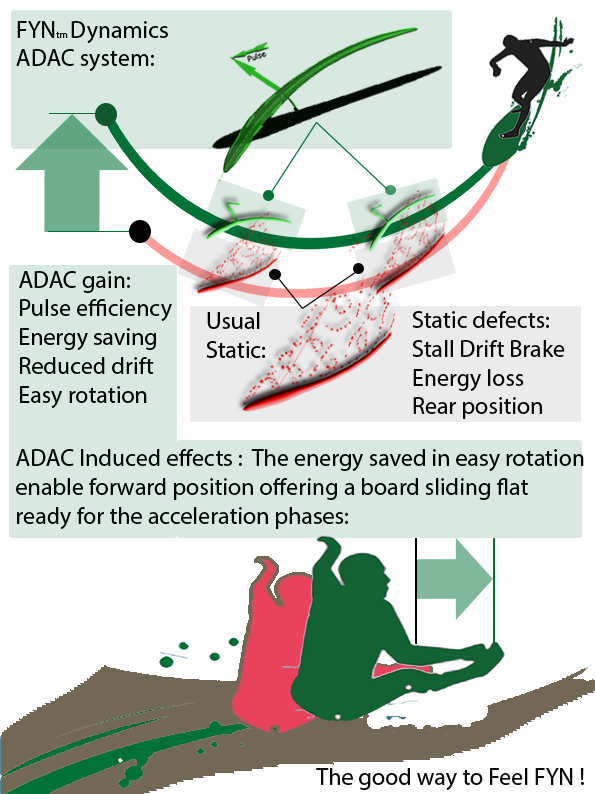
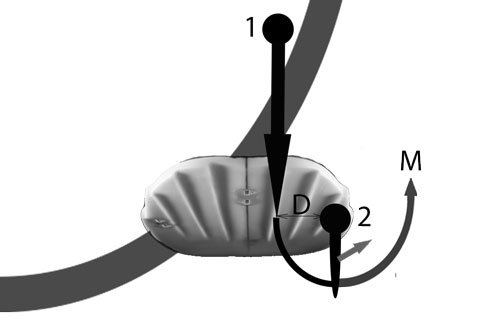
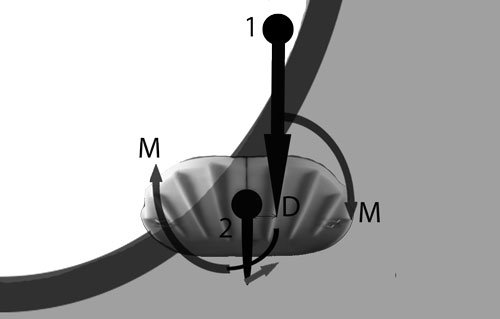
Three settings define the fitting: the longitudinal position (forward for manoeuvrability, back for drive), the toe angle (the nose of the side fins turned towards the axis, 1 to 3° in general) and the cant (outward tilt of the side fins, 7 to 8°). Toe and cant delay the stall of rigid fins in curves, at the price of permanent drag: a twin with 4° of toe drags 18 N in a straight line, nearly 2 kg.
With variable-geometry fins these two angles become unnecessary: the fin takes the right angle by itself. FYN recommends boxes parallel to the axis (toe 0°) and perpendicular to the board (cant 0°); classic boxes with toe work too, the fin adapting.
Which setup for which board
Recommended setup by board type
| Board | Classic setup | With FYN dynamic fins |
|---|---|---|
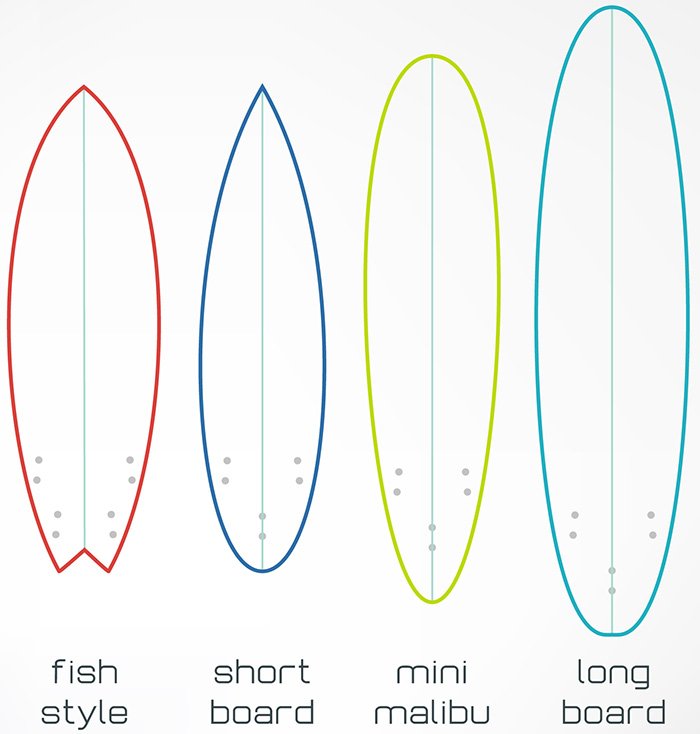
| Shortboard | thruster | Classic Thruster (2 statics + 1 dynamic) or Parallel Dynamics (3 dynamics) |
| Fish, hybrid | twin or quad | New Fish (2 parallel dynamics); in line if the board is narrow |
| Mini-malibu, egg | thruster | Classic Thruster; Powerful Quad for fast waves |
| Longboard, SUP | single + 2 side fins (2+1) | Longboard set: 1 Dynamic Longboard in US box + 2 Static Small |
| Gun | single | Dynamic Longboard centre fin, or 2 Dynamics in line |
| School board, summer | soft fins | Summer Safety: 3 statics with soft parts |
Which fitting: FCS, Future or US box
The three box systems coexist. FCS (two plugs per fin, side screws; FCS II without screws), Future (one long box, one screw; ½-inch base at the centre, ¾-inch on the sides) and US box (the adjustable centre rail of longboards, which lets you move the fin forward or back with conditions). A fin is chosen in the board's fitting; FYN fins exist in all three, and the Dynamic Longboard in US box.
For a longboard or a gun, FYN advises a US box at the rear: it allows the longitudinal adjustment which, with in-line fins, changes the character of the board (spread for pumping and fast waves, tightened for manoeuvrability).
Frequently asked questions
One fin or three: which should I choose?
A centre fin gives a centred support, no heeling and long curves; three fins give more grip on the back foot at the price of side fins that contradict each other in a straight line. Greenough showed in the 1960s that one well-sized centre fin beats two badly matched side fins; with dynamic fins, the thruster keeps its three fins synchronised.
What fin size for my weight?
Count about 80 cm² per side fin under 55 kg, 90 cm² up to 70 kg, 100 cm² up to 85 kg and 110 cm² above, adjusted for board volume and wave speed. A dynamic fin grips with less area; if area is short, two Dynamics in line complete it.
Do I need fins with toe and cant angles?
For rigid fins, yes: 1 to 3° of toe and 7 to 8° of cant delay stall in turns. For variable-geometry fins, no: they take their own angle, and FYN recommends parallel and perpendicular boxes.
How do I calculate the lift of my fins before buying?
Use the online calculator. The online lift and drag calculator gives the forces on a profile from its area, speed and angle of attack, and the Heliciel software plots the complete curves of a fin, foil or keel. For a specific project, Mecaflux also offers the study of your project or training on the software.