Page contents
- How do you fit dynamic fins to a surfboard?
- What changes with a variable-geometry fin
- Toe and cant: zero
- Centred or close to the rail: heeling
- Longitudinal position: aligning the three centres of rotation
- The in-line setup (FYN line)
- Centre twin and compatibility
- Hydrodynamic appendices (Heliciel calculations)
- Frequently asked questions
How do you fit dynamic fins to a surfboard?
Variable-geometry fins are simpler to fit than rigid fins: since their angle of attack and camber adapt by themselves, the shaper no longer has to set toe or cant. FYN recommends boxes parallel to the board axis (toe 0°) and perpendicular to the bottom (cant 0°); classic boxes with toe work too. The work concentrates on the longitudinal position, which places the pivot under the surfer's centre of gravity, and on the choice between traditional setups (thruster, quad, twin), the in-line setup (two centred fins, trailing edge of the first at least 40 mm from the leading edge of the second, plugs at a 106 mm pitch) and the centre twin for wide boards. FYN fins are compatible with FCS, Future and US box; the full guide is available as a PDF.
What changes with a variable-geometry fin
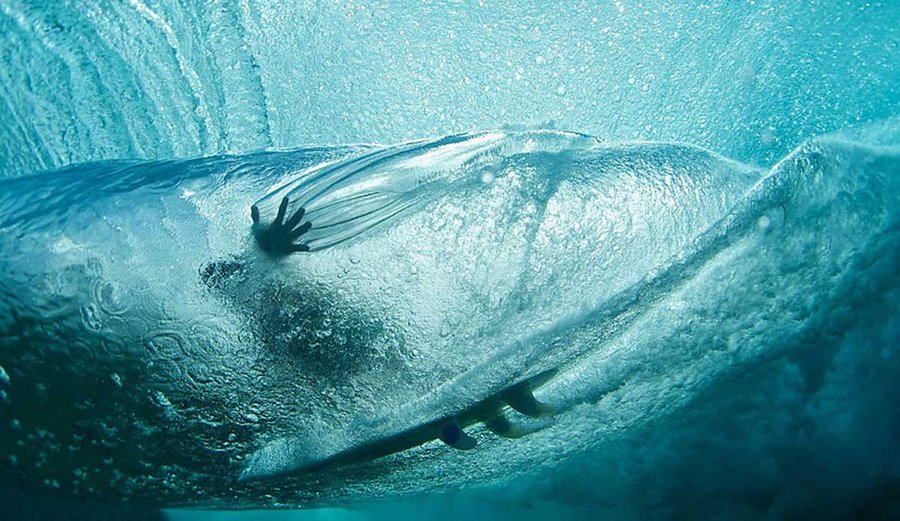
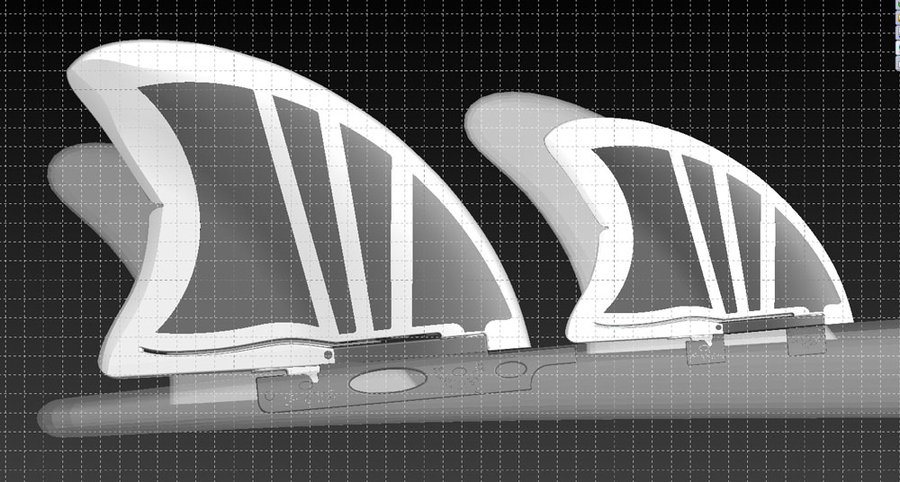
Classically, the toe angle gives manoeuvrability and delays stall by reducing the apparent angle of attack in curves; an upper surface cambered towards the intended lift increases support. But these settings impose an antagonistic symmetry of the side fins: the opposite fin works against the flow and would have to be lifted out of the water for clean manoeuvres. In reality, thrusters keep their three fins immersed 90 % of the time, and the centre fin 99.9 %.
Dynamic adaptation of angle and camber removes this antagonism: all fins steer together with the line. The shaper is freed from the bilateral compromise, and a new question arises: is proximity to the rail still necessary?
Toe and cant: zero
Toe: FYN recommends no toe angle, as the ADAC system adapts it dynamically. If the traditional shape has one, it is not a problem, the fins will adapt; but alignment parallel to the stringer is preferable.
Cant: for a thruster, quad or twin setup, the usual 7 to 8° can be kept, but the parameter is neutral for fins that all work together by adaptation; the effect of cant on one side is cancelled by the opposite side. FYN therefore advises fins perpendicular to the board surface (cant 0°).
Centred or close to the rail: heeling
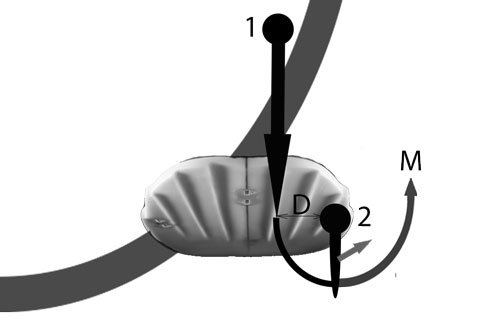
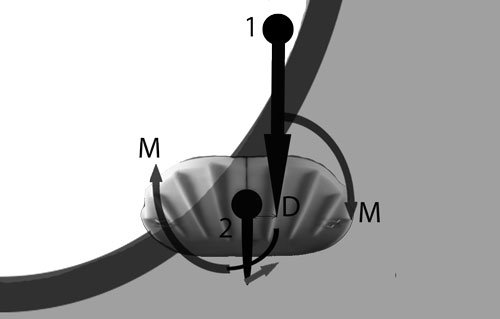
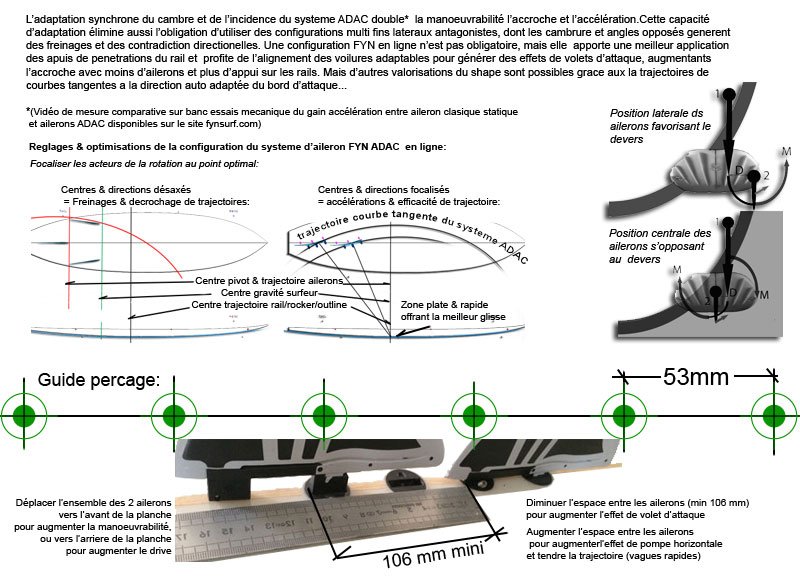
With a fin close to the rail, the surfer's centre of gravity (1) is applied at a distance (D) from the centre of lateral resistance (2) in a direction away from the rail: the moment (M) tends to heel the board and reduces the intended support. With a centred fin, the same moment naturally increases the rail support. If camber and angle are dynamic, the bilateral setup is therefore no longer necessary, and even less good than the centre position: some single-fin surfers have known it for a long time.
The dynamics of FYN fins are moreover independent of aspect ratio: an area spread close to the board raises the centre of lift and limits heeling further. Centred position + raised centre of lift = optimal management of rail support.
Longitudinal position: aligning the three centres of rotation
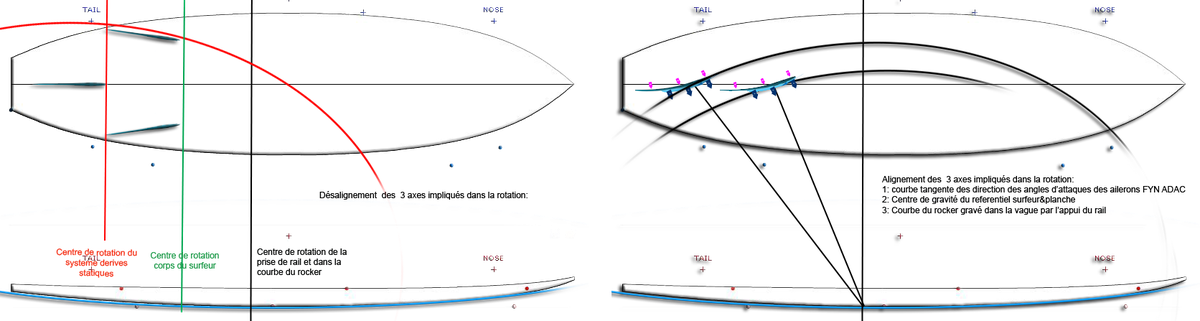
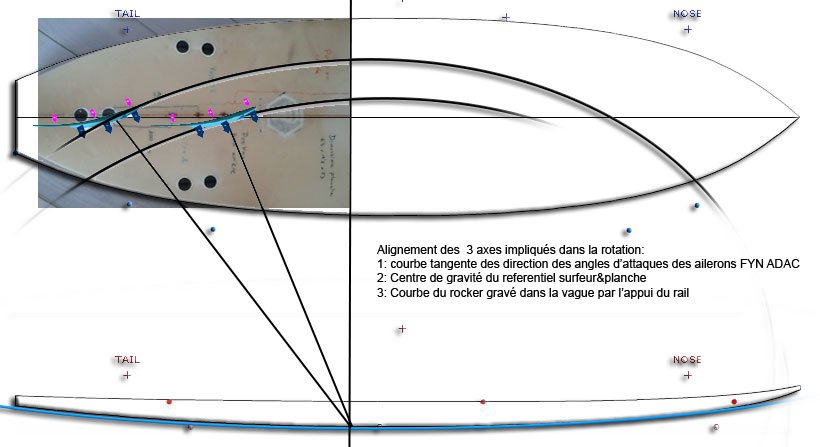
When the leading edge of the ADAC system pivots, it directs the grip force forward, but also the theoretical axis of rotation of the surfer + board assembly. Three curves are involved: the tangent to the fins' directions of attack, the surfer's centre of gravity and the rocker curve engraved in the wave by the rail. On a static set they are misaligned; the fitting of dynamic fins seeks to focus them at the surfer's natural balance point.
Expected effects: surfing more often on the flat, fast zone of the board, sequences with fewer front-back weight transfers, instinctive lateral movements ("the board sticks to the feet"), and the disappearance of the centre of rotation that locks the back foot. Rule: move the whole forward for manoeuvrability, back for drive.
The in-line setup (FYN line)
Introduced by FYN in 2016, it consists in fitting two (or three) dynamic fins centred one behind the other, to combine centred support and the slot effect between profiles: like a jib in front of a mainsail, the upstream fin injects a compressed flow onto the leading edge of the downstream one, and the whole lifts more than the sum of the two (Marchaj). It is reserved for narrow boards and smooth surfing, without roll angles that would lift the centre of the board out of the water.
- Short, hybrid, evolutive, fish: if the area of one fin is insufficient for the board or the surfer's weight, two centred Genomes, trailing edge of the upstream one at least 40 mm from the leading edge of the downstream one.
- Longboard, paddle: one Genome Longboard at the rear, trailing edge about 40 mm from the tail, and optionally a standard Genome whose trailing edge sits about 80 mm from the leading edge of the Longboard.
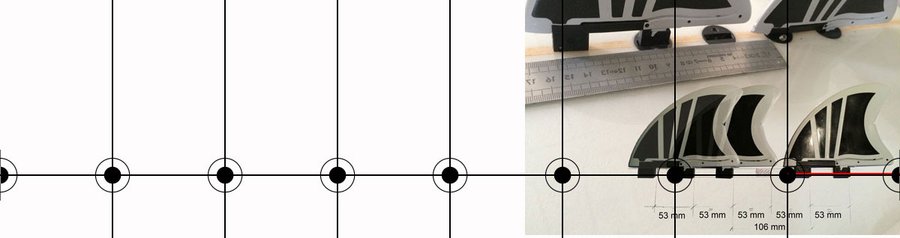
- Plugs: mount the rear fin in the existing plugs and place the second set at 106 mm (constant 53 mm pitch). With FCS, fit 3 or 4 plugs for the second fin so it can be moved one notch forward.
- Tuning: spreading the fins increases the conversion of horizontal pumping into propulsion and lengthens the radius of carved turns (fast waves); tightening them increases the slot effect and manoeuvrability. A US box at the rear of longboards and guns allows this adjustment with conditions.
Centre twin and compatibility
A centred in-line setup can ventilate (suck surface air) on a wide board or in fast turns with little immersion: stall is guaranteed. The twin, Simmons' answer to this problem, then regains its interest as a centre twin: two dynamic fins brought close to the centre, whose angles the ADAC system adjusts simultaneously. The drive effect of toe is multiplied by the joint work of the two fins, and the position close to the centre keeps the rail-support lever.
Rigid fins in line would form a straight rail that destroys manoeuvrability; the in-line setup only works with dynamic angle and camber. FYN advises keeping traditional positions on shapes, so that the choice of the Genome remains free and motivated by an understanding of what it brings.
Hydrodynamic appendices (Heliciel calculations)
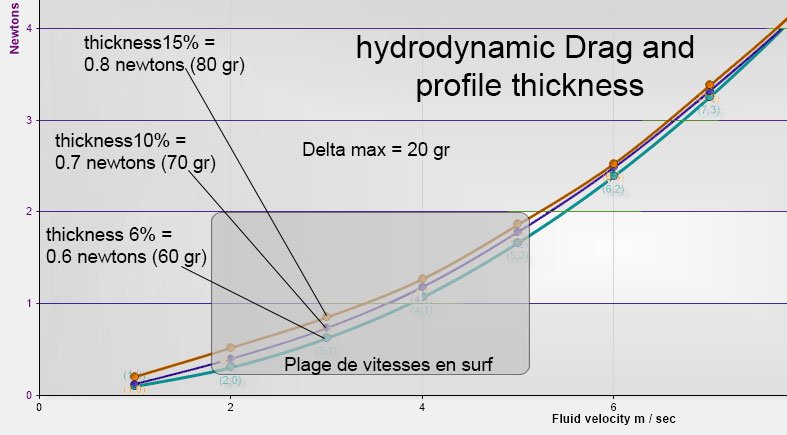
- Thickness: between 6 % and 15 % relative thickness, 20 g of drag difference at 6 m/s; 16 N (1.6 kg) more lift at 15 % at low angles. FYN chose a thickness that exploits this gain, combined with adaptive camber.
- Camber: the symmetrical NACA 0008 drags 0.7 N at zero angle, the cambered NACA 9505 8 N; the cambered one gives 120 N of lift at 10° where the symmetrical one reaches them at 40°. ADAC combines both depending on the phase.
- Stall: beyond about 30°, any fixed profile stalls; the pivoting profile keeps an efficient relative angle down to the tightest curves.
These curves are detailed on the high-performance fins page. Download the shaper's guide (PDF, in French). To integrate the ADAC concept into a brand's own boxes, the FYN team works to ensure compatibility: contact@fynsurf.com. Professional prices from 50 pieces of the same model in the store.
Frequently asked questions
Do dynamic fins need a toe angle?
No: the fin takes its own angle. FYN recommends boxes parallel to the axis (toe 0°) and perpendicular to the bottom (cant 0°); a shape with toe works too, the fins adapting.
How far apart should two in-line fins be?
Trailing edge of the upstream fin at least 40 mm from the leading edge of the downstream one; with FCS, second set of plugs 106 mm from the first (53 mm pitch), with 3 or 4 plugs so the front fin can be moved forward.
Does the in-line setup suit every board?
It is reserved for narrow boards and smooth surfing: on a wide board or in fast turns with little immersion, a centre fin can ventilate. The centre twin, two dynamics close to the centre, is then preferable.
How do I check the fin sizing of a shape?
With the tools used for the appendices of this guide. The online lift and drag calculator gives the forces on a profile from its area, speed and angle of attack, and the Heliciel software plots the complete curves of a fin, foil or keel. For a specific project, Mecaflux also offers the study of your project or training on the software.