Page contents
What is a biomimetic surf fin?
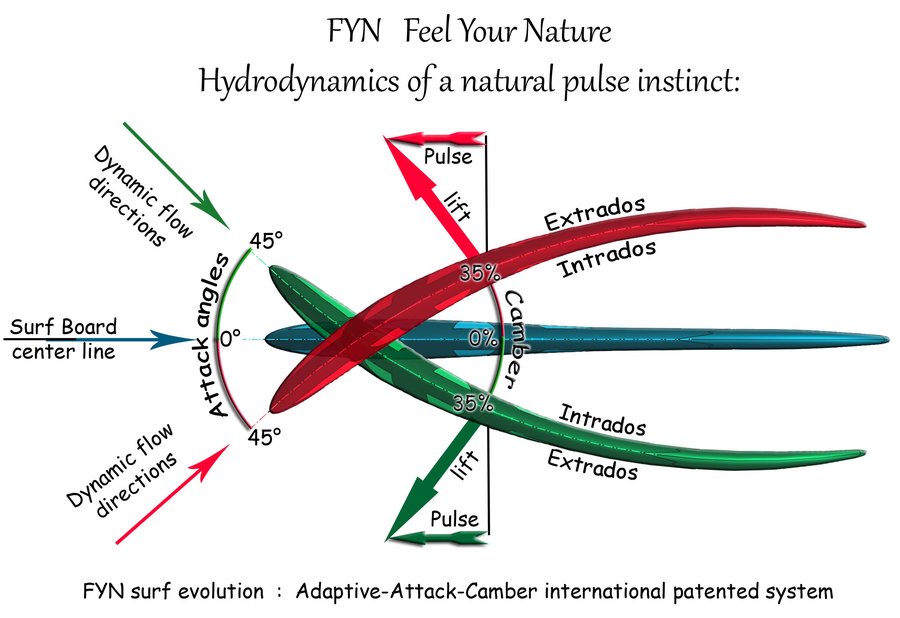
A biomimetic surf fin takes up the principles that make animal fins efficient after hundreds of millions of years of evolution: a profile that changes camber and angle of attack with the water direction, a flexibility controlled by a skeleton, and a smooth, elastic skin that does not cut. The tail fluke of a dolphin or a tuna is never rigid: it cambers on the loaded side, aligns with the flow in a straight line and turns every oscillation into propulsion. These are exactly the functions the ADAC system (Adaptive Dynamics Attack & Camber) of FYN builds into a surf fin: an articulated skeleton under a soft skin, which steers and cambers itself up to 35 % with the line. The name of the first fin in the range, Genome, pays tribute to that observation of nature.
Why no animal fin is rigid
From the first armoured fish to cetaceans, evolution selected flexible fins, not rigid plates. The reason is hydrodynamic: a fixed profile can only be optimal for a single flow direction. As soon as the animal turns or oscillates, the water arrives at another angle; a rigid profile stalls, or drags. A fin deforms instead, to stay in the range of angles where lift is high and drag low.
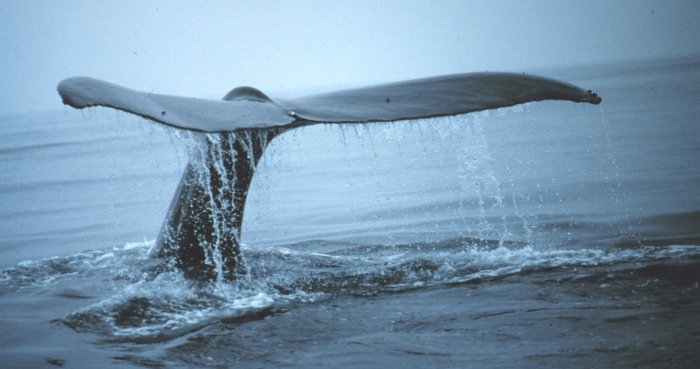
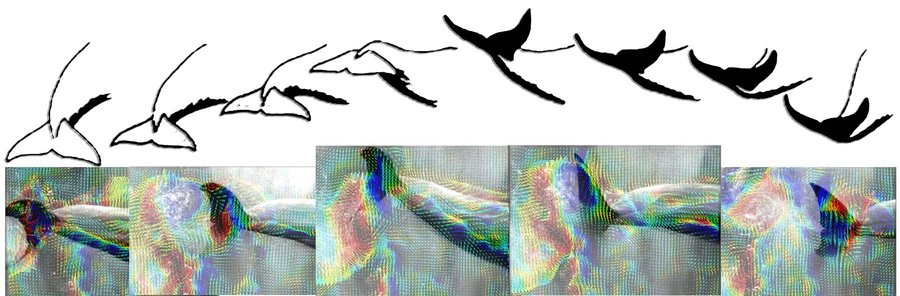
Studies of humpback whale, dolphin or tuna fins show the same pattern: an internal structure that controls bending, a smooth surface, and a camber that reverses at every beat. Lift is then projected forward and becomes propulsion. That is what the surfer looks for under the board: grip in turns, glide in a straight line and drive at every movement.
Three lessons from the fin for the surf fin
1. Camber follows the load
A cambered profile bites hard from low angles; a symmetrical profile drags little in a straight line. The fish fin gets both by cambering only when the lateral load appears. On a rigid fin, the shaper must choose a fixed compromise: symmetrical for glide, or cambered with a toe angle for grip, at the price of a fin working against the flow in every turn.
2. The angle adapts to the line
The fin pivots to stay in the flow. It does not stall, even in a half-turn on the spot. Transposed to surfing, it is the end of the spin out: the fin turns towards the water direction and keeps its grip in tight turns (see fin performance).
3. Flexibility is controlled, not suffered
A fin is not limp: bony or cartilaginous rays guide its deformation. A soft surf fin without a skeleton would bend any way and lose its support. The technical challenge of biomimicry lies there: an articulated structure that imposes the right deformation at the right moment, under a continuous skin.
From the natural model to the fin: the ADAC system
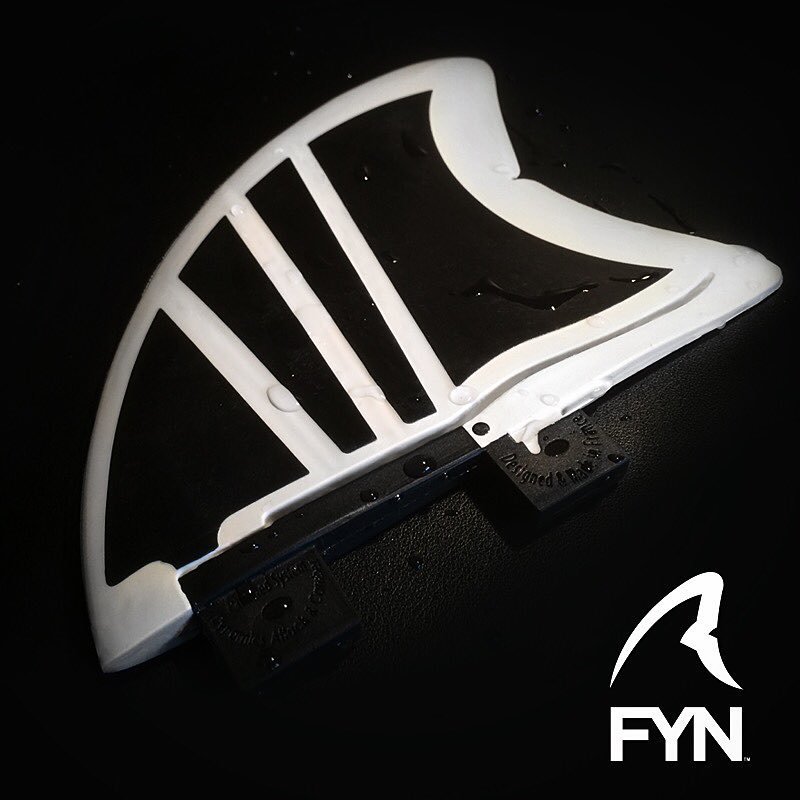
The ADAC system applies these three lessons with an articulated kinematic loop: a multi-material skeleton whose elastic deformation is mechanically programmed, wrapped in a soft skin. When the line is parallel to the board axis, the profile is symmetrical and aligned: residual drag is almost nil (0.7 N at 4 m/s). As soon as a lateral component appears, the leading edge pivots and the upper surface cambers on the loaded side, up to 35 %. Lift increases, hence camber, hence lift: this feedback loop restores the line almost immediately.
As with the dolphin, the board's alternating lateral movements become propulsion: this is horizontal pumping, a marine oscillation that replaces the vertical pumping of rigid fins. The designers spent ten years tuning this "structural intelligence", then validated it in a test tank and in wake surf on a constant wave, before surfers tested it in France, Spain, Portugal, the Caribbean, Brazil, the United States and Canada.
Several profiles in line: the slot effect of fins and sails
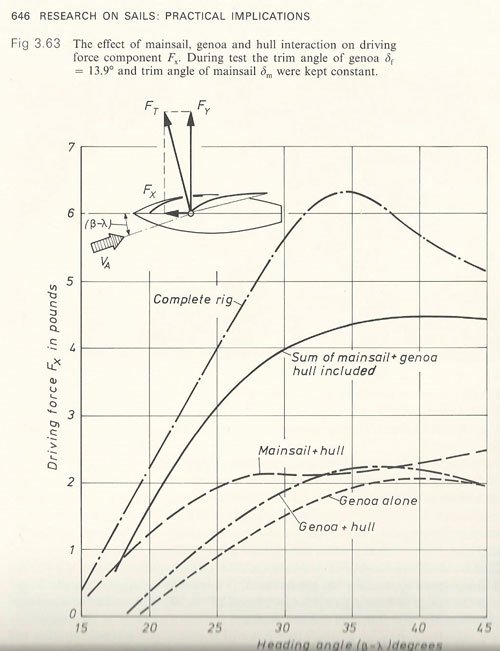
A fish aligns its dorsal, pelvic and tail fins on one axis. Sailors know the phenomenon as the slot effect: close-hauled, the jib injects a compressed stream onto the leading edge of the mainsail, and the whole rig drives more than the sum of the two sails. Marchaj's measurements (Aero-Hydrodynamics of Sailing) put a figure on it: (1 + 1) > 2.
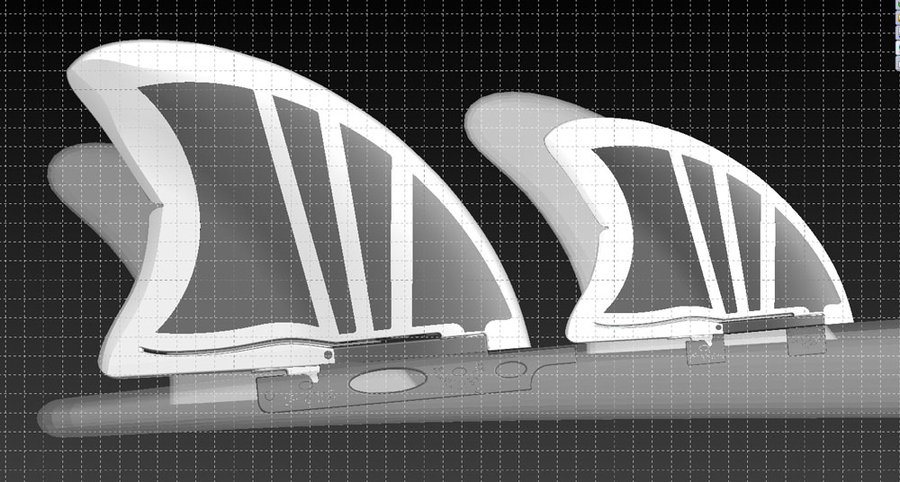
Rigid fins in line would form a straight rail that kills manoeuvrability. Variable-angle fins, on the other hand, steer together on the curve of the line: this is the "FYN line" setup, two dynamic fins centred one behind the other, combining the slot effect and a rail support without heeling. The shaper's guide gives the fitting dimensions.
A soft skin: safety is part of the model
Nature's last lesson: no fin is sharp. The soft skin of the biomimetic fin removes cuts, absorbs part of the impacts and, together with a fuse part, protects the board's fin box. A fin that twists without breaking stays attached to its board and does not end up as debris on the sea floor: this is the subject of the surf fin safety page.
Frequently asked questions
Is a flexible fin necessarily biomimetic?
No. The animal fin is flexible in a controlled way: rays guide its deformation. A biomimetic fin therefore combines an articulated skeleton, which imposes the intended camber and angle, with a soft skin; a merely flexible fin bends without control and loses its grip.
Which animals inspired dynamic fins?
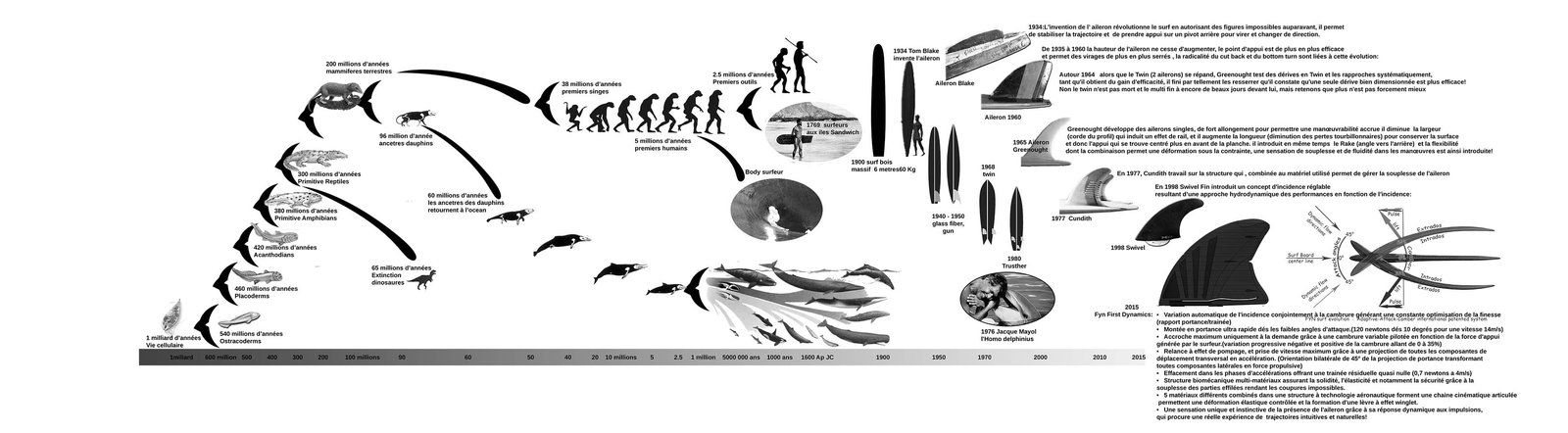
The tail flukes of dolphins and whales, whose beat reverses the camber at every phase and projects lift forward, and fast fish such as tuna, whose aligned fins exploit the slot effect. The evolution timeline published by FYN traces these lineages back to the first fish.
What do you actually gain with a fin inspired by the fish fin?
Almost no drag in a straight line (aligned profile), immediate grip from 5° of angle of attack (cambered profile), no sharp stall in tight turns, and drive at every lateral movement. In the test tank, FYN measures 2 N of thrust for the dynamic fin against 1 N for a static fin of the same area.
Can the behaviour of a fin be simulated?
Yes. The online lift and drag calculator gives the forces on a profile from its area, speed and angle of attack, and the Heliciel software plots the complete curves of a fin, foil or keel. For a specific project, Mecaflux also offers the study of your project or training on the software.