Page contents
- Who invented the surfboard fin, and how did it evolve?
- Before the fin: instinct, the hand and the paddle
- 1934: Tom Blake invents the fin
- 1935-1960: the fin grows, then thinks about safety
- The 1960s-1970s: Greenough, the twin and flexibility
- 1980-1998: thruster, winglets and adjustable angle
- 2015: the dynamic fin, synthesis of the eleven genes
- Further reading
- Frequently asked questions
Who invented the surfboard fin, and how did it evolve?
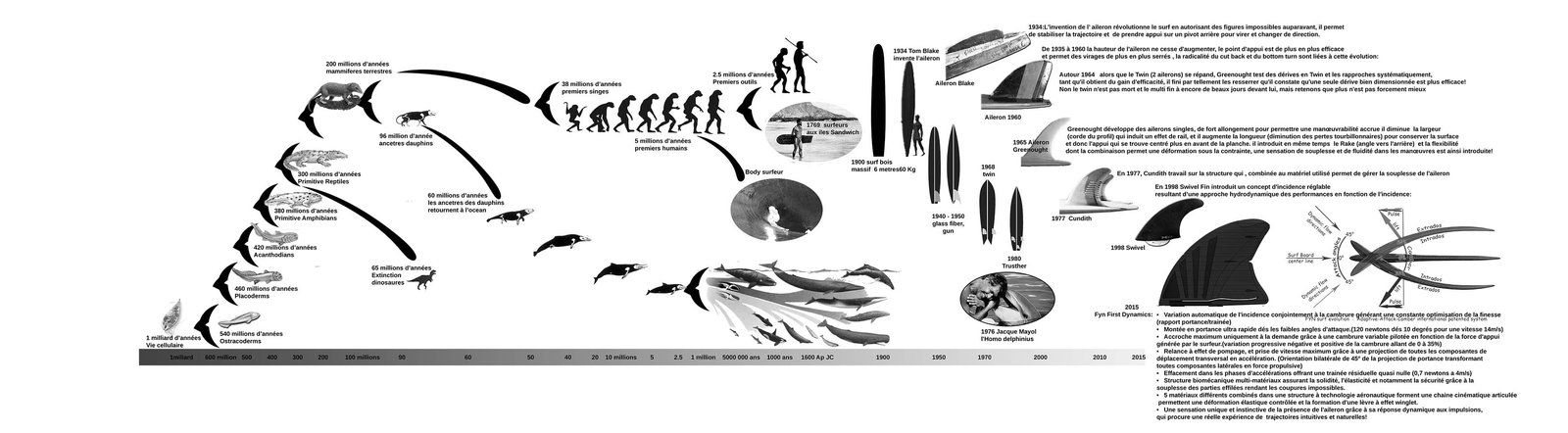
The surfboard fin is credited to Tom Blake, who in 1934 fixed a boat keel under his paddleboard at Waikiki: the board held its line and found a pivot to turn. Before him, the Hawaiian surfers of 1769 and the alaias of 1890 glided without a fin, and the canoe paddlers of West Africa steered their paddle to drive the canoe in the wave. Blake's invention was ignored for nearly ten years, then the fin grew (1935-1960), became removable and safe (popout, 1960), doubled (twin, 1960s), thinned and flexed with George Greenough, gained a structure (Cundith, 1977), tripled (thruster, 1980), gained winglets (1984-1986) and an adjustable angle (swivel, 1998). In 2015 the FYN dynamic fin added variable camber and angle of attack: each step left a "gene" that today's fins keep.
Before the fin: instinct, the hand and the paddle
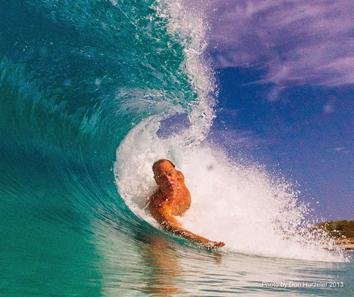
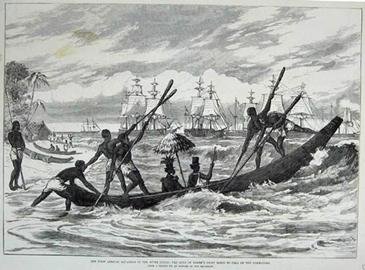
The need to steer in the wave long predates the fin. A bodysurfer angles their hands and changes their shape to hold a line; that is already a variable-geometry profile. Travel accounts from West Africa around 1600 describe canoe paddlers catching waves while angling their paddle like a fin. In Martinique, the bwa flo, a tapered log, was used to cross the shore-break and bring goods back from the ships.
In Hawaii, the boards described during Cook's voyages (1769) are long and finless; the first photographs of surfers (1890) show flat alaias, steered with the rail and the foot. To turn, surfers of the 1930s briefly dipped a foot in the water.
1934: Tom Blake invents the fin
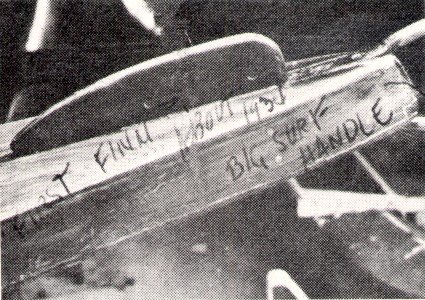
Tom Blake, surfer, lifeguard and builder of hollow boards, fixed a 30 cm keel under his paddleboard in 1934. The effect was immediate: the board held its course and offered a rear pivot to turn without sliding. Figures impossible until then became accessible. Adoption was slow nonetheless: the fin was hard to fit and looked dangerous to the surfers of the time. It took about ten years for it to spread.
1935-1960: the fin grows, then thinks about safety
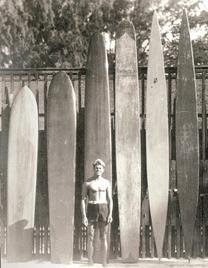
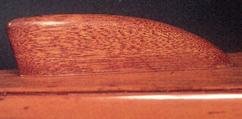
From 1935 to 1960 the height of the fin kept increasing: the pivot became more efficient, turns tighter; the radicality of the cut-back and the bottom turn was born from this evolution. In the 1960s, new materials allowed high aspect ratios, and safety became an argument: the popout of 1960 was designed to come off on impact.
The 1960s-1970s: Greenough, the twin and flexibility
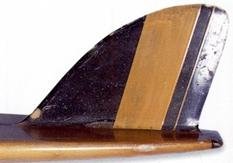
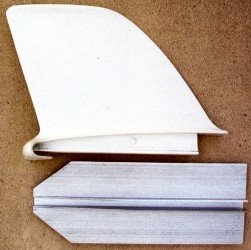
Around 1964, as the twin fin spread, George Greenough tested twin fins by bringing them closer as long as he gained efficiency, until he found that one well-sized fin did better: one good fin beats two that contradict each other. In the 1970s he developed high-aspect-ratio singles, narrow at the chord for manoeuvrability, tall to keep the area, with rake and flexibility: under load the tip of the fin bends into the flow. Variable geometry under load was born. In 1977, Cundith worked on the internal structure of the fin to control that flexibility without excessive drift.
1980-1998: thruster, winglets and adjustable angle
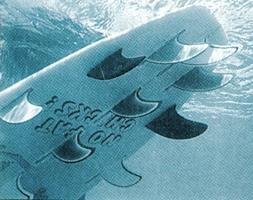
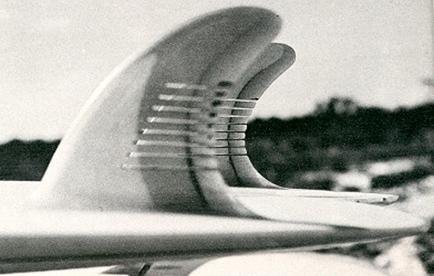
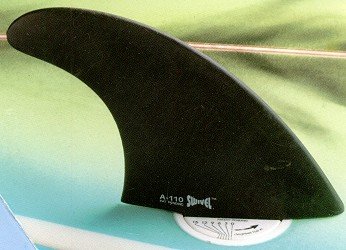
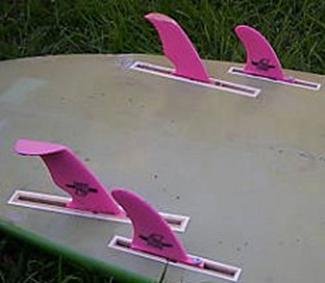
In 1980 Simon Anderson established the thruster, three fins reconciling the grip of the single and the speed of the twin; it remains the standard. Around 1984-1986, winglets inspired by aeronautics appeared at the fin tip to reduce the tip losses of low-aspect-ratio fins. In 1998 the Swivel Fin introduced an adjustable angle: the approach became hydrodynamic, the angle of attack recognised as the key parameter of lift and drag.
2015: the dynamic fin, synthesis of the eleven genes
Each step left a principle: variable shape (bodysurfing), adjustable angle (paddle), transparency in a straight line (alaia), the pivot (Blake), the support area, safety (popout), one good fin rather than two contradictory ones (Greenough), variable geometry under load, the structure that controls deformation (Cundith), the angle (Swivel) and the control of tip losses (winglets).
The ADAC system (European patent 2014 and USPTO 2015), developed by the designers of the Mecaflux and Heliciel software, brings them together in the FYN Genome fin: an articulated skeleton under a soft skin automatically varies the angle and the camber (up to 35 %) with the line, aligns the profile in a straight line, cambers it under load and projects lift forward. Like Blake's fin in its time, it asks the surfer for new supports, centred on the spine rather than on the back foot. The performance and biomimicry pages detail how it works.
Further reading
- Surfresearch (Australia), detailed fin chronology.
- Tom Blake, Hawaiian Surfboard, 1935; Surfer Magazine, March 1981 (photo of the first fin).
- Nicolas Labat, the bwa flo of Martinique (blog).
- C. A. Marchaj, Aero-Hydrodynamics of Sailing (slot effect between profiles in line).
Frequently asked questions
Who invented the surfboard fin?
Tom Blake, in 1934 at Waikiki, by fixing a boat keel under his paddleboard. The invention took nearly ten years to be adopted.
When did the thruster appear?
In 1980, with Simon Anderson: two side fins and a centre fin, reconciling the grip of the single and the speed of the twin. It remains the most common setup.
Why did Greenough go back to the single fin?
By bringing the two fins of a twin closer he gained efficiency, until he found that a single well-sized fin did better: two fixed-angle fins contradict each other, one brakes while the other grips.
What is the latest evolution of the surf fin?
The dynamic fin with variable camber and angle of attack (ADAC system, 2015), which brings together the principles of the previous steps. The online lift and drag calculator gives the forces on a profile from its area, speed and angle of attack, and the Heliciel software plots the complete curves of a fin, foil or keel. For a specific project, Mecaflux also offers the study of your project or training on the software.