Page contents
How do I estimate the resistance of a boat hull?
The resistance of a hull is the sum of a viscous resistance (friction of the water on the wetted surface, plus a form allowance) and a wave resistance that depends on the Froude number V/√(g L). The viscous part is calculated like that of a flat plate of the same wetted surface: RF = ½ ρ V² S CF, with CF given by the ITTC-57 formula from the Reynolds number V L/ν. The quick method on this page replaces the hull by its "double model", a submerged ellipsoid of the same length and beam whose drag, available in Mecaflux, is halved; it includes friction and form but not waves. Example: hull of 10 m × 2 m (25 m² wetted) at 10 knots at sea: friction alone 800 N, half-ellipsoid 2,100 N; at Fn = 0.52 the wave resistance can double that figure again. The effective power is R × V: 11 kW at 10 knots for 2,100 N.
Ship resistance formulas
- RT: total resistance, in N; RF: frictional (viscous) resistance; Rwave: wave resistance, zero in deep immersion, read on Froude curves at the surface
- ρ: density of water, 1,000 kg/m³ in fresh water, 1,025 at sea; V: ship speed, in m/s (1 knot = 0.514 m/s)
- Sw: wetted surface of the hull, in m²; CF: ITTC-57 friction coefficient, dimensionless
- Re: Reynolds number based on the waterline length L (m), ν kinematic viscosity (1.19 × 10⁻⁶ m²/s at sea at 15 °C)
- Fn: Froude number, dimensionless; g = 9.81 m/s²; PE: effective towing power, in W
Frictional resistance of a 10 m hull against speed
| Speed | Speed in m/s | Reynolds Re | Froude Fn | CF | Frictional resistance RF | Power RF × V |
|---|---|---|---|---|---|---|
| 4 knots | 2.06 | 1.7 × 10⁷ | 0.21 | 0.00273 | 149 N | 0.31 kW |
| 6 knots | 3.09 | 2.6 × 10⁷ | 0.31 | 0.00256 | 314 N | 0.97 kW |
| 8 knots | 4.12 | 3.5 × 10⁷ | 0.42 | 0.00244 | 532 N | 2.2 kW |
| 10 knots | 5.14 | 4.3 × 10⁷ | 0.52 | 0.00236 | 804 N | 4.1 kW |
| 12 knots | 6.17 | 5.2 × 10⁷ | 0.62 | 0.00230 | 1,125 N | 6.9 kW |
Drag of the 10 m × 2 m half-ellipsoid (double model method)
| Speed | Dynamic pressure ½ ρ V² | Drag of the half-ellipsoid | Effective power |
|---|---|---|---|
| 4 knots | 2,170 Pa | 341 N | 0.7 kW |
| 6 knots | 4,882 Pa | 767 N | 2.4 kW |
| 8 knots | 8,679 Pa | 1,363 N | 5.6 kW |
| 10 knots | 13,561 Pa | 2,130 N | 11 kW |
| 12 knots | 19,528 Pa | 3,067 N | 19 kW |
Detailed explanations and calculation in Mecaflux
Exemple Ship Resistance and hydrodynamic drag with the software Mecaflux Standard.
To evaluate the resistance of a ship hull shape , In naval hydrodynamics, the method of "Double model" are used. This method of calculating resistance, use to towing in deep immersion, a form, composed of the ship's hull model , and its symmetry, to the waterline.The measured drag is then halved. This experiment at sea is expensive and complex, it is carried in the wind tunnel.
profiles, tested in the wind tunnel or geometrically simple, whose drag (Cd) is already set in Mecaflux Standard , can therefore help us to evaluate the viscous hydrodynamic resistance. We can evaluate a "order of magnitude" for the force with MECAFLUX , this method does not take into account the wave resistance (see hydrodynamic resistance naval froude) .
Example of calculation of hull resistance with Mecaflux Standard:
The simple method presented here is to choose a geometric object as close as possible to the "Double model" of the boat hull: Mecaflux standard offers in the tab "drag and lift" , a series of database objects for which the drag parameters are included. You can quickly evaluate the resistance to the advancement of the object in a fluid of your choice, by entering the dimensions in the diagram.
Imagine that we need an order of magnitude of the resistance to the advancement of a boat hull 10m long by 2m wide by 1m deep.
- We can use an ellipsoid of 10m by 2m and halve the drag found: half ellipsoid like our hull. (This method does not take into account surface effects)
- -select an ellipse in "body drag"
- -Enter a length of 10 meters
- -Enter a diameter of 2 m
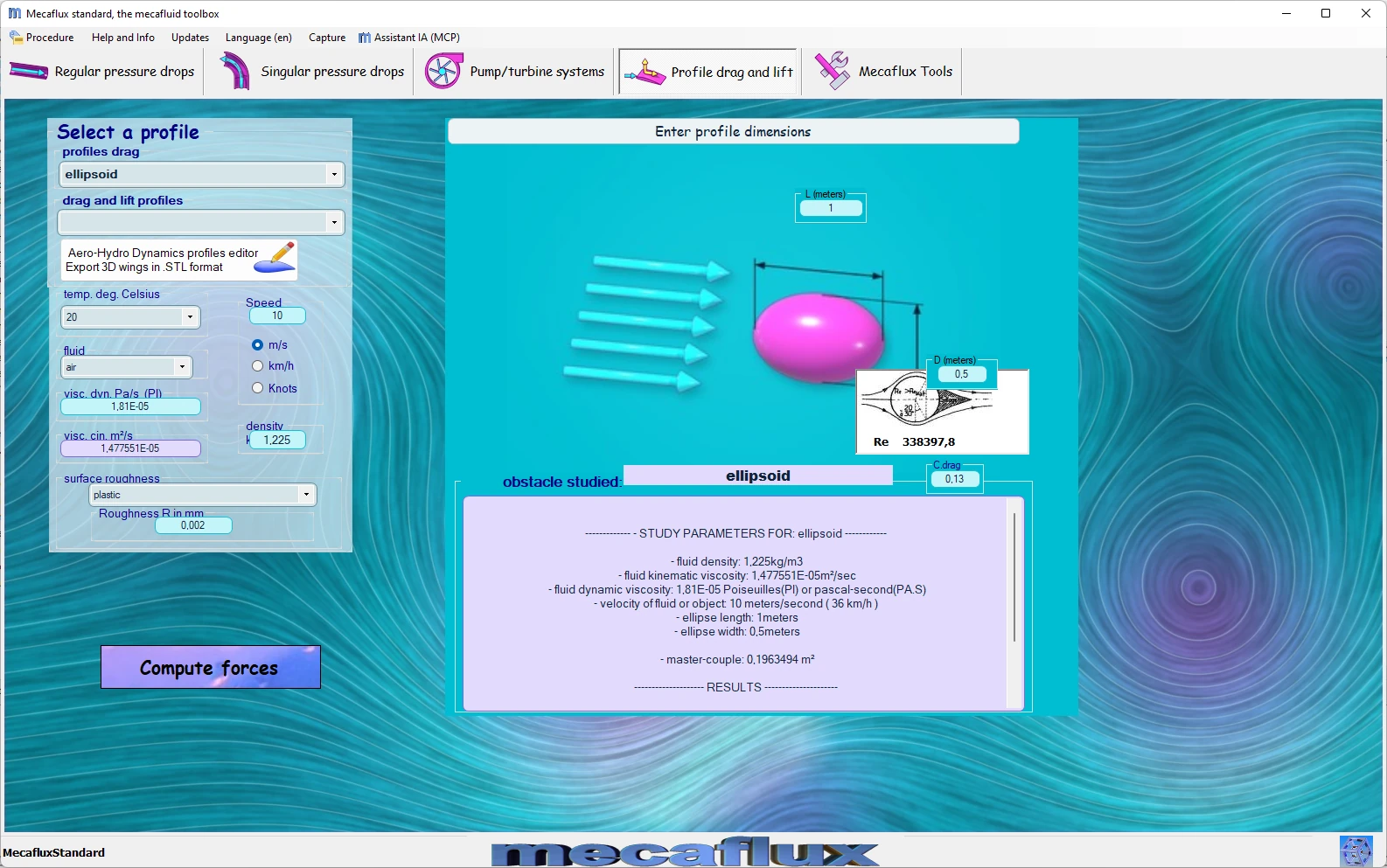
The resistance results are:
4175 Newtons ( 425 Kg.f ) divided by 2 = 2087 Newtons (213 Kg.f) = 213 kilogram-force resistance to the advance or drag for a boat of 10 meters by 2 meters wide, 1 meter deep moving at 10 knots.
We estimate our ship resistance to the advance from the ellipsoid and estimate it about 2100 Newtons (excluding wave resistance).
For a more precise evaluation of the drag resistance of the form of a carene ship, submarine or airship will use the software HELICIEL, which will also provide us the 3D model of the submerged part of the hull shape depending on a variety of hydrodynamic profiles.
back to exemple external flows
Frequently asked questions
Why does this method leave out the wave resistance?
Because the ellipsoid is computed in deep immersion, where it makes no waves. At the surface the hull spends energy lifting water: negligible below Fn = 0.25 (10 m at 5 knots), this resistance becomes dominant above 0.35 and sets the speed limit of a displacement hull, around Fn = 0.4 to 0.45 (12 to 13 knots for a 10 m waterline). It is read on the residuary resistance curves of the naval hydrodynamics page.
How do I estimate the wetted surface of a hull?
From the lines plan if available, otherwise with an approximation such as the Denny-Mumford formula, S ≈ 1.7 L T + ∇/T, with L the waterline length, T the draught and ∇ the displaced volume; for the hull of the example (10 m, 1 m draught, about 8 m³) it gives 25 m², the same as the half-ellipsoid. The wetted surface directly controls the frictional resistance, hence the fuel consumption at cruising speed.
What engine power follows from it?
The effective power RT × V is what it would take to tow the hull. The engine must deliver more, because the propeller converts only 50 to 65 % of its power into useful thrust: divide by the propulsive efficiency, then keep a margin of 15 to 20 % for wind, sea and fouling. For 2,100 N at 10 knots, 11 kW of effective power thus calls for an engine of 20 to 25 kW.
How do I calculate the resistance of my own hull, submarine or craft?
Mecaflux Standard gives a quick order of magnitude with its geometric bodies (ellipsoid, cylinder, sphere) and its flat plate, in the fluid and at the speed of your choice. Heliciel models the hull in 3D from hydrodynamic sections, computes its wetted surface, its frictional and form resistance, exports the model to CAD and sizes the matching propeller. For a boat, a submarine or an airship to design or power, Mecaflux carries out the study of your project, or offers training on the software applied to your own project.