How do I calculate the force of wind or current on an inclined plate (solar panel, blade, paddle)?
A flat plate inclined at an angle α to the flow is subjected to a force practically perpendicular to its surface, proportional to the dynamic pressure ½ ρ V² and to its area S: FN = ½ ρ V² S CN(α). Projected on the flow direction and its perpendicular, this normal force gives the drag FN sin α and the lift FN cos α. The normal force coefficient CN grows with the angle of attack: the Rayleigh-Kirchhoff theory (separated wake) gives CN = 2π sin α / (4 + π sin α), i.e. 0.24 at 10°, 0.56 at 30° and 0.88 at 90°; wind tunnel measurements on a real plate give more at high angles (1.1 to 1.2 for a square plate normal to the wind, up to 2 for a very long plate), hence the correction applied by Mecaflux. Example: a 1.6 m² solar panel tilted at 30° in a 100 km/h wind (473 Pa) receives a normal force of 430 N (Rayleigh-Kirchhoff) to about 700 N (measured values): this is the load its mounting must withstand.
Formulas for the force on an inclined plate
- FN: force normal to the plate, in N; FD: drag, along the flow; FL: lift, perpendicular to the flow
- α: angle of attack between the plate and the flow direction (90° for a plate normal to the wind)
- ρ: density, in kg/m³ (air 1.225, water 1,000); V: fluid velocity, in m/s (100 km/h = 27.8 m/s)
- S: area of the plate, in m² (width × length, not the projected area)
- CN: normal force coefficient, dimensionless; the Rayleigh-Kirchhoff formula underestimates the measured values beyond about 30°, Mecaflux corrects it from test data
Wind force on a 1.6 m² panel against its tilt (Rayleigh-Kirchhoff formula)
| Angle α | CN | Normal force FN | Lift FL | Drag FD |
|---|---|---|---|---|
| 5° | 0.128 | 97 N | 97 N | 8 N |
| 10° | 0.240 | 182 N | 179 N | 32 N |
| 15° | 0.338 | 255 N | 247 N | 66 N |
| 20° | 0.423 | 320 N | 301 N | 110 N |
| 30° | 0.564 | 426 N | 369 N | 213 N |
| 45° | 0.714 | 540 N | 382 N | 382 N |
| 60° | 0.810 | 612 N | 306 N | 530 N |
| 90° | 0.880 | 665 N | 0 N | 665 N |
Measured coefficient of a plate normal to the wind against its aspect ratio
| Aspect ratio b / h | Measured CN | Force on 1.6 m² at 100 km/h |
|---|---|---|
| 1 (square) | 1.17 | 885 N |
| 2 | 1.19 | 900 N |
| 5 | 1.20 | 907 N |
| 10 | 1.30 | 983 N |
| 20 | 1.50 | 1,134 N |
| ∞ (very long plate) | 1.98 | 1,497 N |
Detailed explanations and calculation in Mecaflux
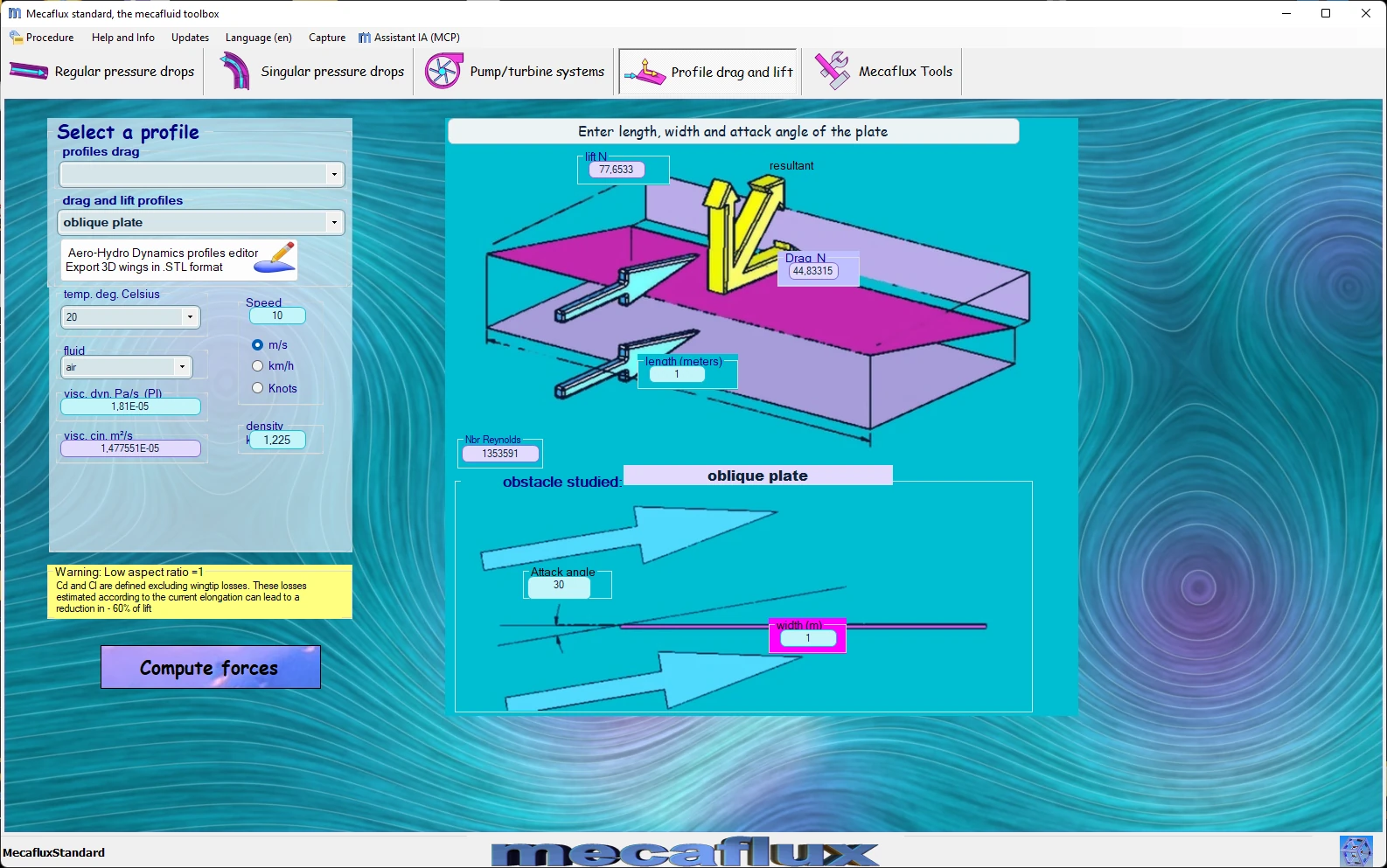
The drag and lift on an inclined plate in a fluid flow (angle of incidence) can be calculated with the study of oblique plates in mecaflux
Resistance oblique plates in a fluid stream can, for example, to quickly evaluate the stresses on a solar panel attached to a frame. Just enter the width and length of the plate representing the solar panel and indicating the incident angle it forms with the wind.
For example one can calculate the forces on a blade or dawn of mill, at an angle and a given water speed at a moment of its rotation.. This applies to the thrust generated by a blade impeller of paddleboat. The sum of the forces may give the torque on the shaft depending on the position and number of blades ...
The lift force and the drag will be given in Newtons as a function of the rate of fluid entry. The fluid used can be changed by selection (air, water, oil....) or by entering the parameters of density and viscosity.
Mecaflux uses the method of rayleigh kirchhoff Corrected described in the report naca dealing plates in a fluid stream .
to calculate the forces of drag and lift forces on inclined plates in a fluid flow, use the "oblique plate in Mecaflux:
Frequently asked questions
Why is the force perpendicular to the plate?
Because it results almost entirely from the pressure difference between the windward face (overpressure) and the leeward face (suction of the separated wake), and a pressure always acts perpendicular to the wall. Friction, parallel to the plate, adds only a few per cent. This is what distinguishes a plate from a wing section, where lift comes from the attached flow around the section and the lift-to-drag ratio is far higher.
What wind load should I take for a solar panel or a sign?
For an order of magnitude, the normal force with a CN of 1.2 and the reference wind speed of the site; the Eurocodes (EN 1991-1-4) then set the pressure coefficients to apply according to tilt, height, exposure and position of the panel (roof edge, ground effect), which can exceed 1.5 at the corners. At 150 km/h the dynamic pressure reaches 1,060 Pa: the mounting of a 1.6 m² panel must then withstand more than 2,000 N.
How do I calculate the torque of a paddle wheel or a mill?
Calculate the force on each blade with its relative velocity (water or wind speed minus the blade speed, which is ω r at its radius r) and its angle of attack at the instant considered, then multiply by the lever arm and add up the immersed or windward blades. The power is the torque multiplied by the rotational speed. On a pedalo paddle wheel, a blade works efficiently over about a third of a turn.
How do I calculate the loads on my own panel, blade or paddle?
In the drag and lift tab of Mecaflux Standard, the oblique plate study asks for the width, the length, the angle of attack, the speed and the fluid (air, water, oil or your own density and viscosity) and gives lift and drag in newtons, with the diagram of the plate. For a blade of varying shape and setting (propeller, wind or tidal turbine), Heliciel computes each blade element with its true section and derives torque and power. For a structure to justify or a machine to design, Mecaflux carries out the study of your project, or offers training on the software applied to your own project.