Page contents
How do I calculate the frictional resistance of a flat plate and the thickness of the boundary layer?
On a flat plate parallel to the flow, the only force is the viscous friction in the boundary layer, the thin region where the velocity rises from zero at the wall to the free-stream velocity. It is laminar near the leading edge and becomes turbulent beyond a critical distance xc where the local Reynolds number V x/ν reaches about 5 × 10⁵; the turbulent layer is thicker and rubs two to three times harder. The friction force is F = ½ ρ V² S Cf, with a coefficient Cf that decreases slowly with the Reynolds number of the plate (ITTC-57 formula for turbulent flow, 1.328/√Re for laminar flow). Example: a 1 m × 1 m plate towed at 2 m/s in water (Re = 2 × 10⁶) rubs with 8.1 N per face; transition occurs 25 cm from the leading edge and the boundary layer reaches 20 mm of thickness at the trailing edge. This calculation gives the viscous resistance of a long hull, the main component of its resistance.
Friction and boundary layer formulas for a flat plate
- F: friction force on one face, in N; S: wetted area of that face, in m²; ρ: density, in kg/m³; V: free-stream velocity, in m/s
- Cf: mean skin friction coefficient of the plate, dimensionless; ReL = V L/ν, Reynolds number based on the length L of the plate along the flow
- ν: kinematic viscosity, in m²/s (water at 20 °C: 1.0 × 10⁻⁶; air: 15 × 10⁻⁶)
- xc: distance from the leading edge where the boundary layer turns turbulent (Rex ≈ 5 × 10⁵, earlier if the surface is rough or the stream disturbed)
- δ: boundary layer thickness at distance x from the leading edge, in m; Rex = V x/ν
Friction of a 1 m × 1 m plate in water against speed
| Speed V | Reynolds ReL | Critical distance xc | Cf | Friction force F (one face) |
|---|---|---|---|---|
| 0.5 m/s | 5.0 × 10⁵ | 1.00 m (fully laminar plate: Cf = 0.0019, F = 0.23 N) | 0.0055 | 0.7 N |
| 1 m/s | 1.0 × 10⁶ | 0.50 m | 0.0047 | 2.3 N |
| 2 m/s | 2.0 × 10⁶ | 0.25 m | 0.0041 | 8.1 N |
| 5 m/s | 5.0 × 10⁶ | 0.10 m | 0.0034 | 42 N |
| 10 m/s | 1.0 × 10⁷ | 0.05 m | 0.0030 | 150 N |
Boundary layer thickness along the plate at 2 m/s in water
| Distance x from the leading edge | Rex | Regime | Thickness δ |
|---|---|---|---|
| 0.1 m | 2.0 × 10⁵ | laminar | 1.1 mm |
| 0.25 m | 5.0 × 10⁵ | transition | 1.8 mm |
| 0.5 m | 1.0 × 10⁶ | turbulent | 12 mm |
| 1 m | 2.0 × 10⁶ | turbulent | 20 mm |
| 2 m | 4.0 × 10⁶ | turbulent | 35 mm |
Detailed explanations and calculation in Mecaflux
The flat surface flow resistance can be calculated with the detailed study of flat plate in mecaflux (tab drag-lift / profiles with drag) .
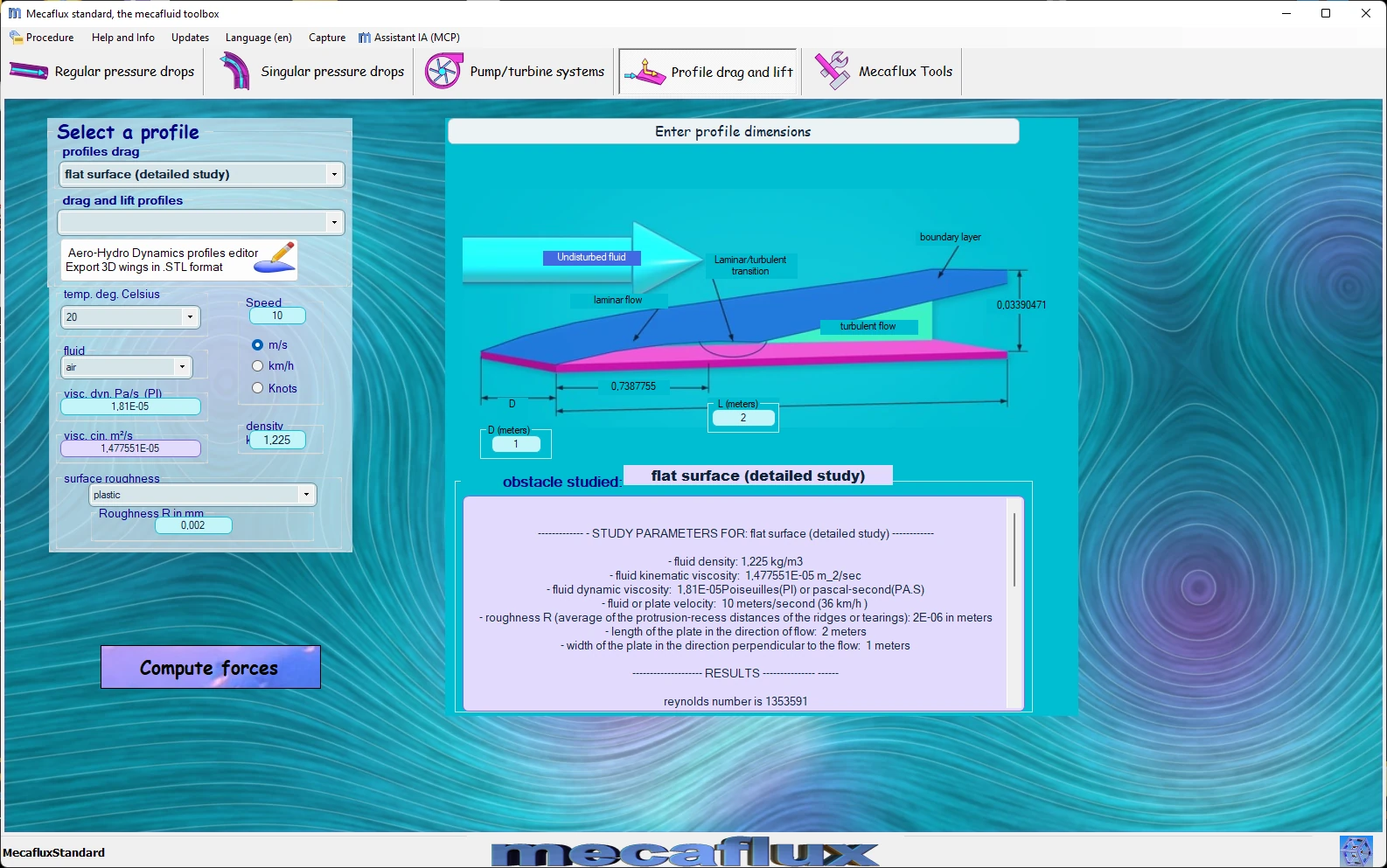
For large hulls or completely planing hulls, resistance is mainly composed of frictional resistance on the surface in contact with the fluid. calculating the frictional resistance of a flat plate can quickly evaluate this component of ship resistance to advancing.
The width of the boundary layer is given and the critical distance where the flow changes from laminar to turbulent. It is thus readily identify whether an appendage comes out of the boundary layer. If this is the case, add the drag of the outgoing part of the boundary layer (using the tab drag lift, geometric object, for example)
Frequently asked questions
Why does a turbulent boundary layer rub harder than a laminar one?
Because its eddies stir the fluid: fast particles from the outside are brought close to the wall, where the velocity gradient, hence the shear stress τ = μ du/dy, is far higher than in laminar flow. At Re = 10⁶ the friction coefficient rises from 0.0013 (laminar) to 0.0047 (turbulent), 3.5 times more. In return, the turbulent layer resists separation better, which reduces the form drag of bluff bodies.
Should I count one face or both?
For a plate, a fin or a rudder standing alone in the stream, both faces rub: double the force calculated for one face. For a hull or a fuselage, take the total wetted surface with a single face. Mecaflux Standard displays the force for the area entered; it is up to you to enter the area actually swept by the fluid.
What is the effect of surface roughness?
As long as the asperities stay buried in the viscous sublayer, the wall behaves as smooth: this is the case if their height stays below about 100 ν/V, i.e. 50 µm for water at 2 m/s and 10 µm at 10 m/s. Beyond that, the friction coefficient rises and no longer depends on the Reynolds number, as for a rough pipe. A dirty or weed-covered hull can thus rub 50 to 100 % more than a clean one, hence the value of polishing and antifouling.
How do I calculate the frictional resistance of my own hull or plate?
In the drag and lift tab of Mecaflux Standard, the flat plate study asks for the length, the width, the speed and the fluid and displays the friction force, the boundary layer thickness and the critical transition distance, which shows whether an appendage protrudes from the boundary layer. Heliciel computes the complete hull in 3D from hydrodynamic sections, with its wetted surface, its frictional and form resistance. For a hull, a submarine or a craft to design, Mecaflux carries out the study of your project, or offers training on the software applied to your own project.