Page contents
The wing editor of Mecaflux Standard calculates the lift, drag and lift to drag ratio of a wing, from a database of airfoils and their polars. The wing can then be exported in 3D, as an STL file.
It opens from the Profile drag and lift tab, with the "Aero-Hydro Dynamics profiles editor" button.
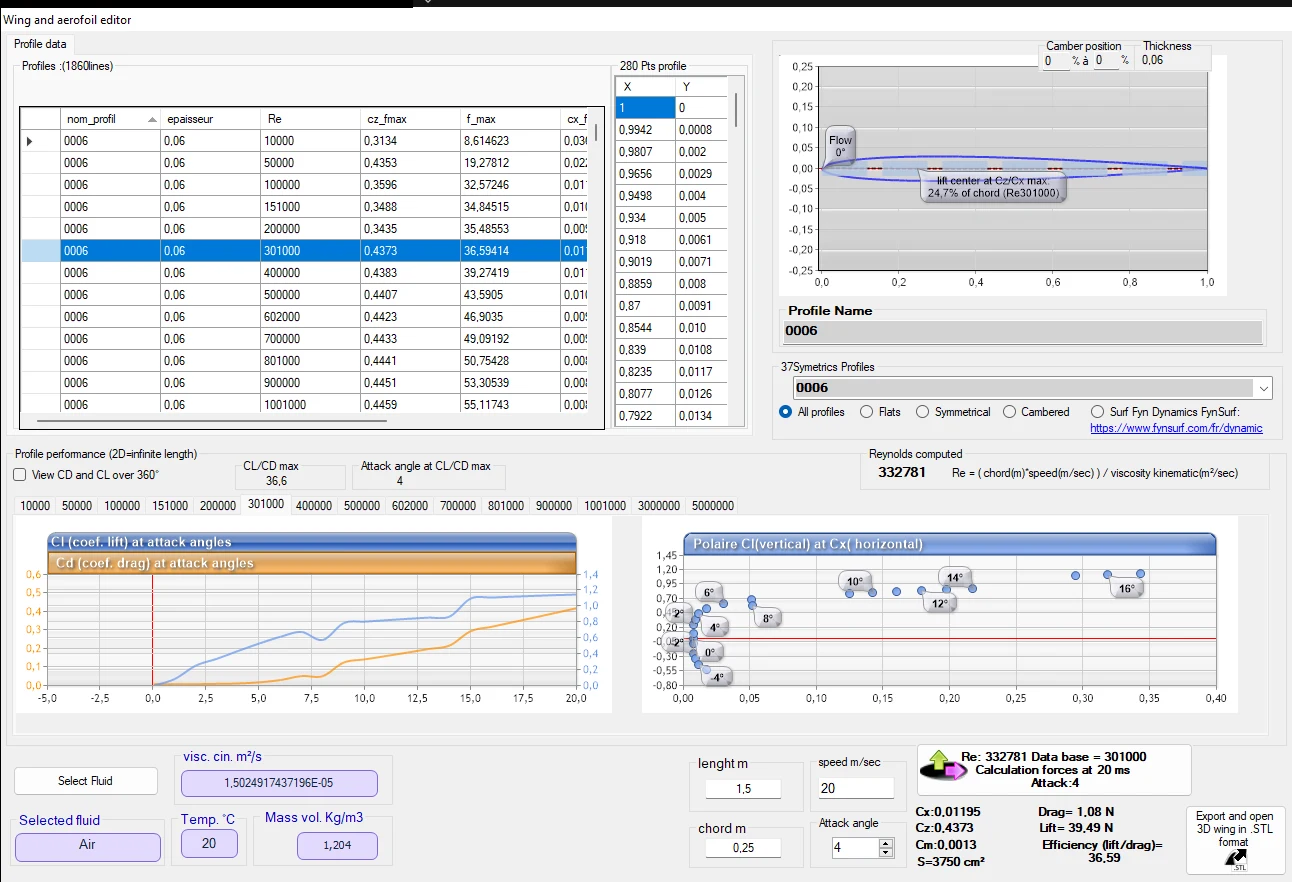
A database of 120 airfoils and their polars
The database holds 120 airfoils, sorted into families:
- 72 cambered profiles, for wings and propellers that must lift;
- 37 symmetrical profiles, for fins, rudders, masts and aerobatic wings;
- 11 flat-bottomed profiles, easy to build;
- the Fyn Dynamics surf fin profiles (see the shaper's guide).
For each airfoil, the database gives the polars at 15 Reynolds numbers, from 10,000 to 5,000,000: lift (CL) and drag (CD) coefficients versus angle of attack, maximum lift to drag ratio and its angle of attack. The table lists each profile, its thickness and its performance; the plot shows its shape and the position of the centre of lift.

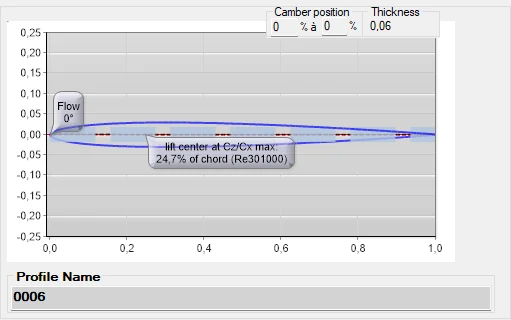
These airfoils and their polars come from Heliciel, the Mecaflux software dedicated to designing airfoils and propellers.
Calculating a wing
- Choose the fluid ("Select Fluid"): the fluid editor gives its density and viscosity at the chosen temperature, for example air at 20 °C.
- Choose the airfoil in the list, or in one of the families.
- Describe the wing: chord and length in metres, speed in m/s, angle of attack.
- Run the force calculation.
Mecaflux calculates the Reynolds number of the wing and takes the polars of the database at the nearest Reynolds number. It gives the CD, CL and CM coefficients, the wing area, the lift, the drag and the lift to drag ratio.
Example, the one of the video tutorial: a wing with the 0006 profile, 25 cm of chord and 1.5 m long, in air at 20 °C, at 20 m/s and 4° of incidence. The Reynolds number is 332,781; Mecaflux uses the polars at 301,000. The wing lifts 39.5 N for 1.08 N of drag, a lift to drag ratio of 36.6.
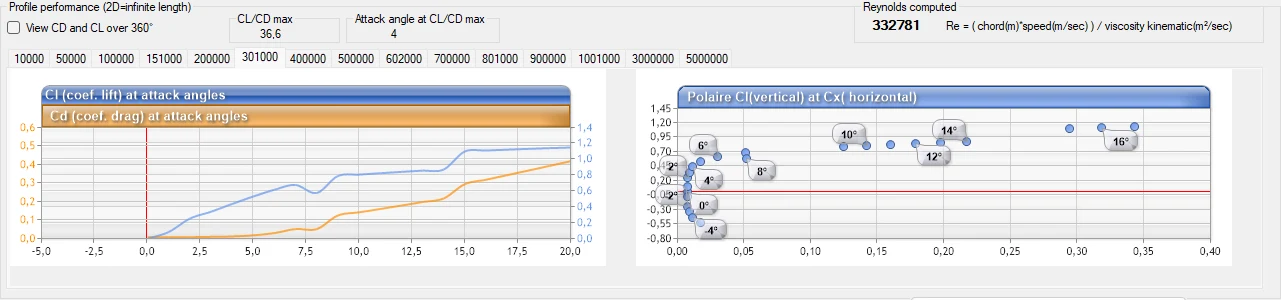
The curves give the 2D performance of the profile (wing of infinite length): CL and CD versus angle of attack, and the polar CL versus CD. One tab per Reynolds number lets you compare how they change; the "View CD and CL over 360°" box extends the curves to all angles of attack.
Exporting the wing in 3D (STL)

One click on "Export and open 3D wing in .STL format" writes the wing to an STL file: the chosen profile, at the chord and length entered, with dimensions in metres. The file opens straight away in your 3D software, and goes directly into CAD or to a 3D printer: model, fin, rudder or foil.
- See also: modelling a wing in 3D
Designing your own airfoils
The Mecaflux Standard editor calculates wings from the database; it does not create new profiles. To draw your own airfoils, calculate their polars and design propellers, blades or twisted wings, use Heliciel. Its airfoil database can also be browsed online: aerodynamic and hydrodynamic airfoil database.
Video tutorial
The tutorial "Wing calculation and 3D export" (2:20) shows the whole process: choosing the fluid and the airfoil, calculating the forces, exporting to STL.
All tutorials: Mecaflux Standard video tutorials.