Try this little hydrodynamics test:
At the end of this test you will know exactly how and why the ADAC system
sticks so well to your instinctive feeling of the wave’s trajectories. Do not
ask us why it doesn’t have be done before, we do not
know, we simply create what the waves whisper in us…
The concept of static and dynamic weight is essential to objectively
approach the quality of a surf fin:
·
The static weight is easy to gauge, with a balance for
example. This weight is an argument widely used but it doesn't really impact
the surf performance: A glass of water drunk before (or during) the session is
heavier than the maximum observable difference between two fins technologies,
carbon or classic!
• Dynamic “weight”(drag) is more difficult to evaluate:
it represents the resistance to progress which hinders the board. So, a fin
which presents an inappropriate angle, or that generates stall, causes drag and
therefore a dynamic weight more embarrassing and sensitive than its static
weight...
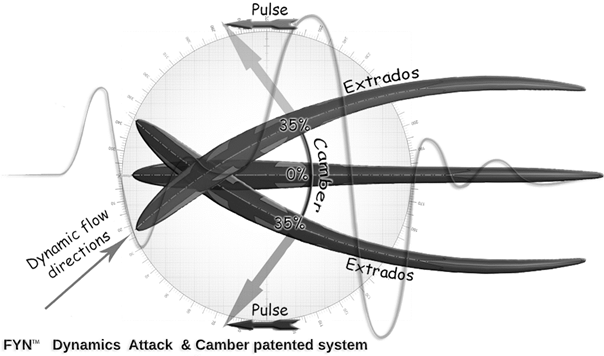
The ADAC system adapts the shape of the camber and the incidence angle of
attack to generate the form of profile, hydro dynamically optimal for the
various wave phases. The dynamic weight is greatly decreased, and grip
increased, the maneuvers are done without resistance or loss of speed.
Exceptional fluidity is thus afforded to the surfer.
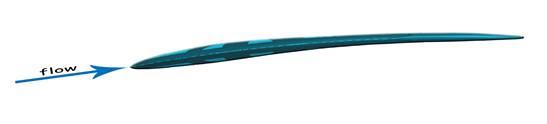
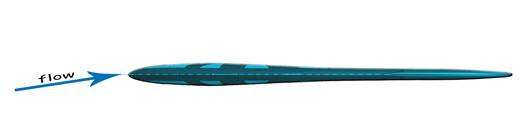
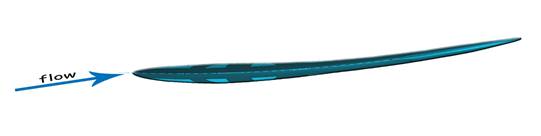
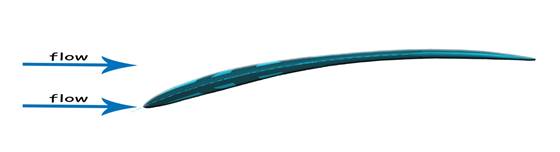
Test 1 : Which fin profile fly best?(maximal
lift/drag):
a)
b)
c)
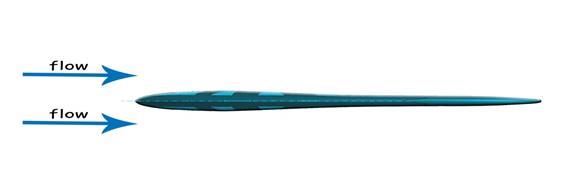
Test 2 : Which fin profile generates the
least hydrodynamics drag in a straight line ?:
a)
b)
c)
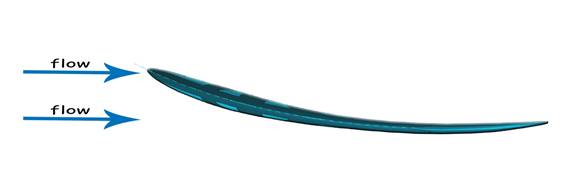
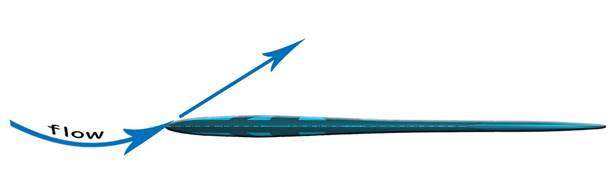
Test 3 : Which fin profile provides a suitable
angle, to avoid stall into the turn?:
a)
b)
c)
Test 4 : Which profile uses the suction force
together with the force of pressure to generate an acceleration component
forwards and lift (grip) Maximum?:
a)
b)
c)
Test 5 : What fin configuration promotes rail
work, generating the least cant force?:
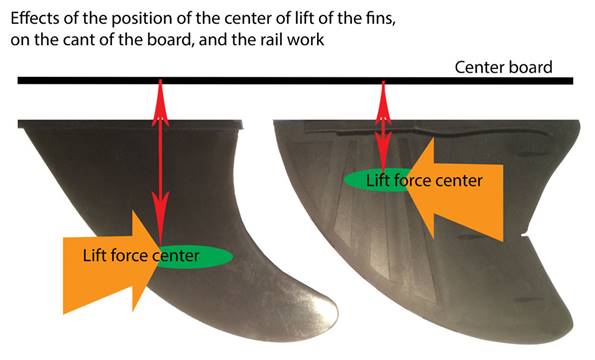
Configuration a Configuration
b
Test 6 : Which turn generates a dynamic
weight (braking) minimum, with a maximum path accuracy?

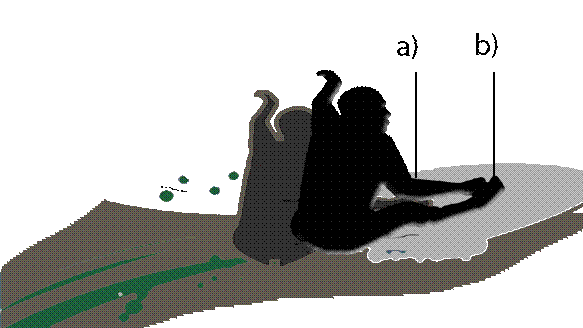
Test 7 :
What position promotes sliding by reducing the immersion of surfing in
maneuvering through a low dynamic weight?
Test 8 :
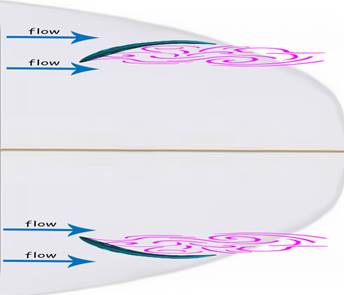
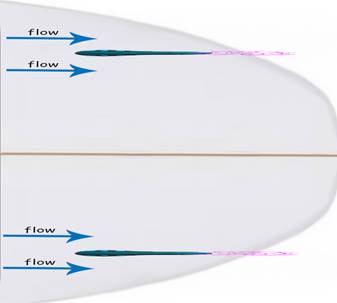
Which alignment configuration of fins generates the least dynamic weight?
a)
b)
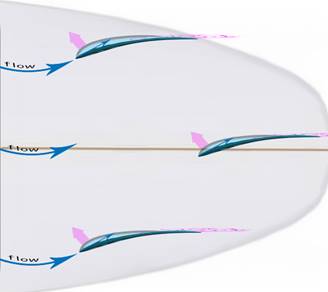
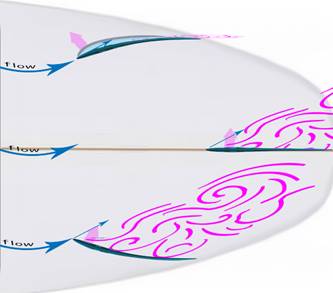
Test 9 : What alignment configuration
generates both: the least dynamic weight (drag), the more grip due to the
suction pocket offering 70% additional lift, and more fluidity to maneuver by
to the orientation the leading edge?
a)
b)
Replies substantiated:
Response Test 1 :
Which fin profile fly best?: a
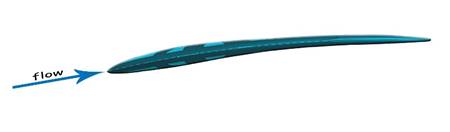
a)
A suction side camber shape on top, generating a lift
depression. The leading edge is oriented in the direction of flow, so as to avoid turbulence and stalls. This directs the lift forward, and helps lead the profile effortlessly. The
trailing edge straightens the flow output, this change direction imposed by the
camber generates depression and acceleration. This is the configuration of the
aircraft wings. The suction force on the upper 70% of the total force of lift, the
remaining 30% are produced by the pressure under the wing (underside):
b)
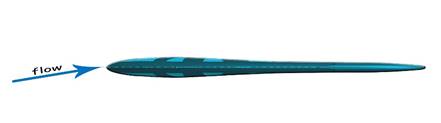
Right Profile, no camber or leading edge
adjustment. The angle of attack can become maladaptive and generate a stall in
the maneuver or phases requiring a strong grip. If the stream is too deviated
at the leading edge, it becomes turbulent and can not
generate suction area, then used as 30% of the available pressure force:
c)
Upper
surface upside down under the effect of twisting. The angle of attack can
become maladaptive and generate a stall in the maneuver or phases requiring a
strong grip. If the stream is too deviated at the leading edge, it becomes
turbulent and can not generate suction zone. The
trailing edge is oriented in the flow, then using the best 30% of pressure to
generate thrust. But the non-recovery of the output stream causes drift, and
the lack of aspiration lift that makes up 70% of the capturable force when the
suction is on the right side (on top):
Response test 2 :
Which fin
profile dynamically generates the least weight (trail braking) in a straight
line ?: Response=b
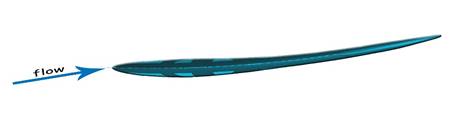
a)
The arched profile presents more surface opposite the fluid
displacement, it generates a large drag force, as if the profile was very thick.
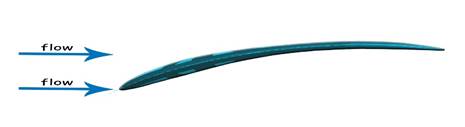
b)
In a straight line if there is no lateral force skid
is the right and symmetrical profile, the most energy-efficient of drag. This
case is, for example during take-off if one tries to go straight look for a
bottom-turn in front of the wave, but attention in fast and vertical phases
across the wave, there will be a slippage force and require significant grip,
and camber will be useful!
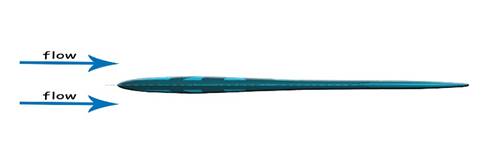
c)
The arched profile presents more surface opposite to the movement of the
fluid, this generates a large drag force, as if the profile was
very thick.
Response test 3 :
Which fin
profile provides a suitable angle, to avoid stall into the turn?: Response=c
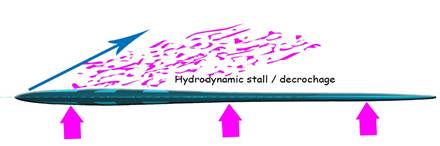
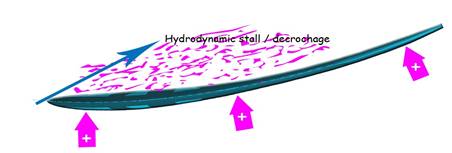
Explanation: in curves, the angle of attack is important if the curve is
tight, and that the supporting force is important. If the angle of attack is
high (above 20 degrees vicinity), fluid "refuses" to follow the
direction of the profile and generates vortices which destroy the vacuum area
generating 70% of lift. This is the spin-out or stall. This phenomenon results
in braking and a major skid.
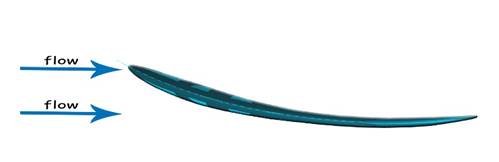
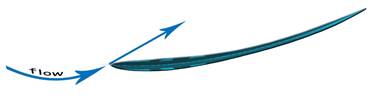
a)
The upper
surface is turned upside down by twisting of the fin. Sometimes called the
"drive", this configuration is introduced in the 70s (see
Greenought). It is produced by the elongated and retracted shape of the tip of
the fin which deforms under the pressure. The leading edge stall,
and generates braking and skidding by loss of upper surface aspiration.
The trailing edge, twisted by the direction of the fluid, generates a slight
push, based on 30% pressure. This is the main advantage of this configuration,
but 70% of the suction aspiration force are unfortunately lost..
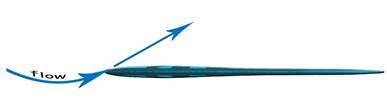
b)
The leading edge stall generating braking and skidding by loss
of upper surface aspiration.
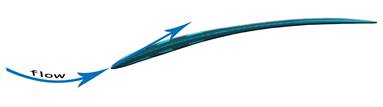
c)
The leading edge adapts to the
flow direction by aligning the pressure forces and depression forward to
exploit 100% of acceleration effects. The upper surface curve on top the fluid
to the trailing edge without separation, to keep all the traction and lift. A
depression is formed on the upper surface. This generates additional lift of
70%, with respect to a not suitable profile.
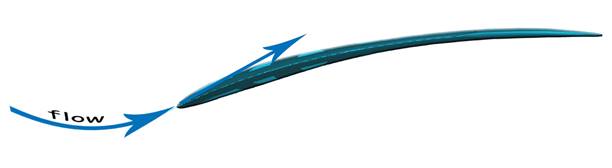
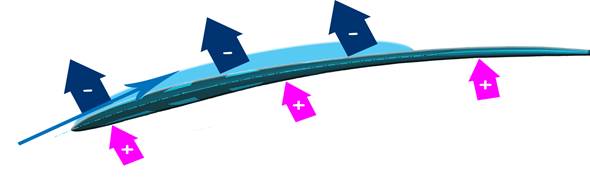
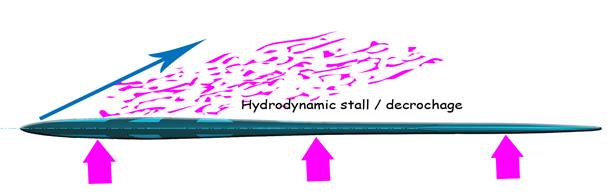
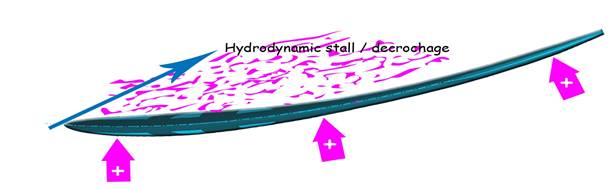
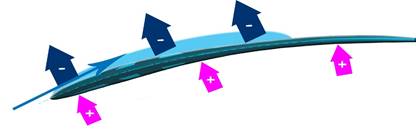
Response Test 4 : Which profile uses the suction force together with the force of pressure to generate an acceleration component forwards and lift (grip) Maximum? Response=a
a)
The leading edge adapts to the
flow direction by aligning the pressure forces and depression forward to
exploit 100% of acceleration effects. The upper surface curve on top the fluid
to the trailing edge without separation, to keep all the traction and lift. A
depression is formed on the upper surface. This generates additional lift of
70%, with respect to a not suitable profile
b)
The leading edge stall
generating braking and skidding by loss of upper surface aspiration.
c)
The upper surface is turned upside down by
twisting of the fin. Sometimes called the "drive", this configuration
is introduced in the 70s (see Greenought). It is produced by the elongated and
retracted shape of the tip of the fin which deforms under the pressure.The leading edge stall,
and generates braking and skidding by loss of upper surface aspiration. The
trailing edge, twisted by the direction of the fluid, generates a slight push,
based on 30% pressure. This is the main advantage of this configuration, but
70% of the suction aspiration force are unfortunately lost..
What fin
configuration promotes rail work, generating the least cant
force: Configuration b
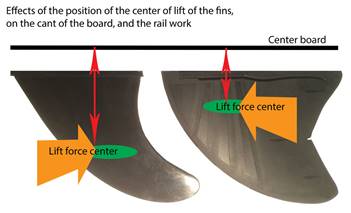
Configuration a Configuration b
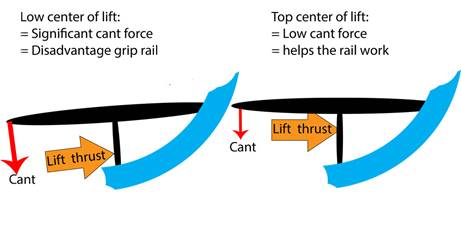
A pressure center near the board limits its cant
and the effort to hook the rail into the wave. Long drifts with
"sweep" type Greenought, allow the introduction of the flexibility
and drive effect, but unfortunately tilt increase the effect tends to reverse
the board when the support is important. The ADAC system provides the drive and
70% additional thrust through its leading edge and its dynamic camber, while
keeping a very close thrust center of the board to
reduce the cant.
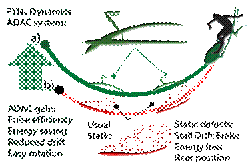
Which turn generates a dynamic weight (braking) minimum, with a maximum path accuracy? Response=a
·
The trajectory) is a "cut curve" without
skidding. No brake feel on the back foot (it surprises even at the beginning
because it is heavily used to feel the weight dynamic, static stall classic
fins on the back foot), the movement swept the back foot refocuses the axis of
rotation surfer on his spine, generating an acceleration
·
The trajectory b) is a "turn-sided." A brake feel on the back foot corresponding to the dynamic weight
(drag) of the fin, is caused by the hydrodynamic stall. The energy of the
surfer is transmitted to the fluid in the form of turbulent losses, the
movement is no longer applied to control trajectory, it is transformed into
dynamic weight (braking).
The angle
of incidence perceived by the fin varies with the path. An angle and camber
constant adaptation can drive back the hydrodynamic stall. This increasing the
lift (grip) and reduces drag (dynamic weight gains of around 3KG strength are
achievable with an ADAC system).
Analogy
types of curves in Ski or Snowboard: We can compare curve with:
static aileron (path b) and equipped with fins ADAC (trajectory), to ski curves:
skidded, or cut:
At a higher technical level, the “skid curve”
has major drawbacks:
o It is not
suitable for high speed cornering. Indeed, the centrifugal force is such that
the rider can not remain in its path.
o It does not
allow a sufficiently accurate control of the board
o It does not
turn into a small space
o It is an
important source of speed loss.
o positions
the body too far back to fast relaunch
The “ cut curve” enables precise driving in high speed curve. As motorcycle in a
curve, the speed of loss is very low. In addition,
support remains centered during cornering control phase and control can be very effective and intuitive. Body position remains centered
the relaunch is immediate. It allows to turn in a small space
· Response Test 7 : What position promotes sliding by reducing the immersion of surfing in maneuvering through a low dynamic weight? Response=b
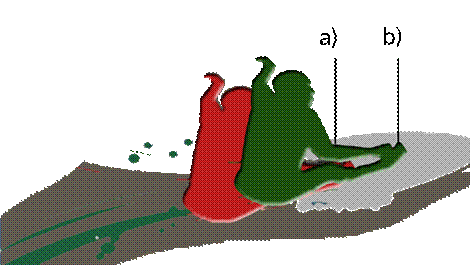
The
position a) corresponds to rear foot-oriented bend, is skidded turns
configuring static fins in phase unhooked, described above. The weight of the
rider is applied to the back of the board, which plunges by lifting the front.
The board is stopped, and the dynamic flow of the path is lost...
The position b) corresponds to a center of rotation aligned with the
spine. This positioning is obtained by adapting the angle and the camber of the
fin profile, cut phase curve, as described in the response to test 6. The ADAC
system moves the center of rotation through the pivot board attack. The back
foot is freed, and the body turns on its natural center of gravity. The back
foot sweeping product of acceleration, by operation of lift of the fin, which
avoids stall through its dynamic adaptation.
Response Test 8 : Which alignment configuration of fins generates the least dynamic weight? Response=b
a)
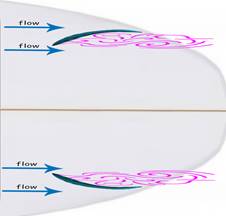
The
dynamic weight (running resistance drag) is proportional to the front surface,
opposite to the fluid. The angles of opposite side wings, non-parallel and opposite
camber generate a braking surface which are opposed to the fluid flow.
b)
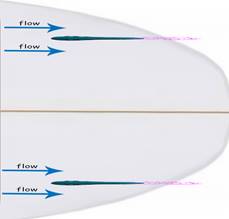
The ADAC system aligns the angles
of the opposite aileron and clears camber when no lateral force requires. The
fins are parallel to the direction of the fluid and offer minimal frontal area
reduces up to 20 times the dynamic weight (drag) by fin!
Response Test 9 : What alignment configuration generates both: the least dynamic weight (drag), the more grip due to the suction pocket offering 70% additional lift, and more fluidity to maneuver by to the orientation the leading edge? Response = a
a)
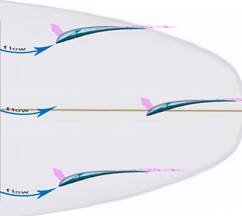
The ADAC system directs the
leading edge of all wings in a synchronized manner, to apply an angle providing
a hydrodynamic fineness (lift / drag) optimal. A depression pocket forms on all
upper surface cambered in agreement with the direction of the fluid. The
propellant projection of the lift thus produced provides surfer a flowability
effect and commitment in the maneuver. The absence of effort, and produced
responsiveness, provide a feeling of "board that sticks to feet."
b)
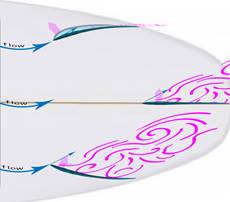
Only one of the three fins have a
profile adapted to the direction of the fluid. The other two have unhooked
regime, their presence may even damage the maneuver. This configuration of
static aileron needs to leave the antagonist fin of the water to limit the
braking and the path error.